This description has been translated and may not be completely accurate. Click here to see the original
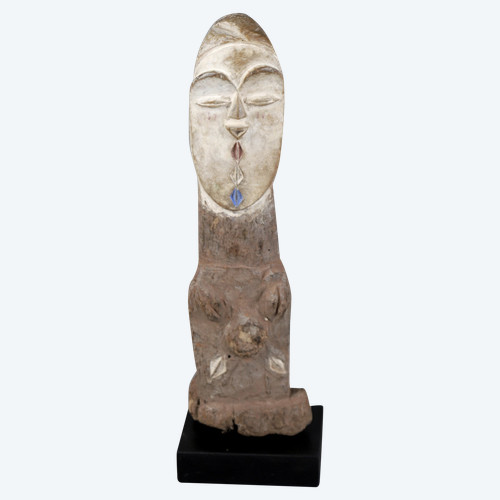
Anthropomorphic divination staff
Central Africa – Fang/Beti area
First half of the 20th century
Carved wooden divination staff with an anthropomorphic figure at the top, extended by a forked shaft. This type of object is associated with divination practices, spiritual mediation, and ritual consultation, used by diviners (nganga) or initiated figures within Fang and Beti societies.
The object has a slender, vertical, and hieratic silhouette, conforming to the aesthetic canons of the Central African forest region:
A small, ovoid head with deliberately stylized features
An elongated neck, creating a symbolic separation between the visible and spiritual worlds
A cylindrical torso, devoid of superfluous anatomical details
A forked lower shaft, forming two asymmetrical branches, one longer, likely intended for anchoring to the ground or stabilizing during ritual ceremonies
The overall design prioritizes symbolic clarity and ritual function over descriptive naturalism.
Dimensions and Weight
Height: 48 cm
Maximum Depth: 15 cm
Maximum Width (at the fork): approx. 14–16 cm
Weight: 380 grams
The relatively light weight, combined with the length of the shaft, confirms that this is an object intended to be held, moved, or manipulated in a ritual context, rather than simply a static element. Material and Patina
Dense, fine-grained wood
An old, dark brown, matte patina with areas polished by handling
Traces of use consistent with repeated ritual function
Condition
An old, authentic condition, with no visible major restoration:
General surface wear
Longitudinal micro-cracks due to the natural aging of the wood
Slight erosion of the edges
Blunt ends of the fork from use
No major structural damage
The condition is consistent with actual ancient ritual use and enhances the ethnographic value of the piece.
This staff was likely used in divination or spiritual mediation sessions, potentially serving:
As a support for ritual speech,
A marker of the diviner's authority,
A symbolic designation tool (for the ground, objects, people),
A mediator embodying the presence of ancestors or invisible forces.
The lower fork can be interpreted as a symbol of choice, duality, or transition—central concepts in Fang/Beti divination systems.
Cultural attribution (cautious)
The stylistic characteristics—extreme verticality, formal simplicity, reduced head, elongated body—point to a Fang/Beti area (Gabon, southern Cameroon, Equatorial Guinea).
Comparisons and Museum References
Comparable objects are held or documented in:
Musée du quai Branly – Jacques Chirac, Paris (Fang and Beti ritual objects)
Musée Dapper (former collections)
Rautenstrauch-Joest Museum, Cologne
British Museum, London
Bibliographical References
Louis Perrois, Arts du Gabon, Éditions 5 Continents
Philippe Laburthe-Tolra, Les Fang, PUF
Christian Kaufmann, L’art Fang, Musée Barbier-Mueller
Frank Willett, African Art, Thames & Hudson
Ezio Bassani & William Fagg, Africa and the Renaissance of African Art Studies
Ref: 1ZN1LOO4N4

 English
 Français
  Italiano
  Deutsch
  Louis XIV Norman writing table
850 € EUR
Louis XIV Norman writing table
850 € EUR