



Would you like more images?


This Parisian chest of drawers from the Transition period, which contemporaries readily referred to as "Greek-style" furniture, is part of the pivotal period between 1760 and 1775, when taste underwent a profound change. The excesses of Louis XV rocaille gave way to a more measured, constructed aesthetic, nourished by a return to Antiquity. Lines were straightened and composition structured, but without totally denying the curves inherited from the previous period. This tension between flexibility and rigor, between tradition and renewal, is the very essence of the Transition style.
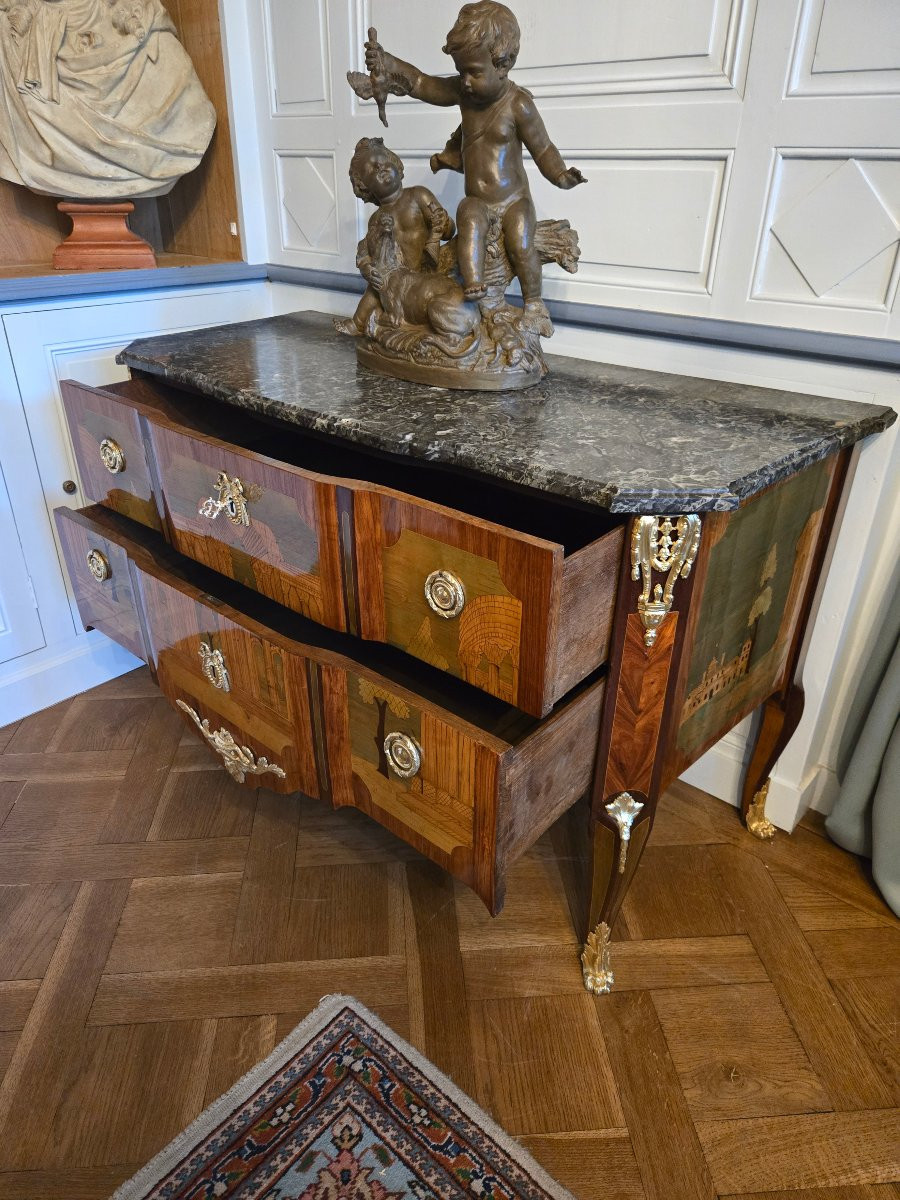
The chest of drawers presented here is a perfect illustration of this evolution. Its three-panel front, with a slight protrusion in the middle, reflects the period's quest for balance and clarity. The two crossbarless drawers, which occupy the entire width of the chest, reinforce this new horizontality, while the sides are also inlaid, confirming a design conceived to be viewed from all angles.
Careful observation of its proportions reveals a further refinement: the body adopts a very slightly trapezoidal plan, wider at the rear than at the front. The dimensions of the body, measured with a marble block that faithfully follows the contours of the body, clearly highlight this particularity: 130.5 cm wide at the rear compared with 125 cm at the front, 58 cm deep and 84.5 cm high. This subtlety, almost imperceptible at first glance, gives the cabinet a more stable visual base and reinforces the presence of the front.
The commode is double-stamped with A.L. Gilbert, for André-Louis Gilbert, received master in 1774, and with the JME hallmark. This double stamp, visible on both the front right and rear left uprights, unambiguously situates its manufacture within the regulated framework of Parisian cabinetmaking. Established in the heart of the Faubourg Saint-Antoine, close to major merchants such as Léonard Boudin, Gilbert belonged to the generation of cabinetmakers active at the very moment of this stylistic transition.
His work is particularly well known today for his landscape and ruin marquetry, one of the most distinctive contributions of this period. Inspired by a taste for Antiquity and the world of Hubert Robert, these decorations translate into wood a picturesque vision of idealized architecture, arcades, colonnades and recomposed landscapes. Research into these productions, particularly in the workshops of Pierre Roussel, shows that these compositions are often the result of models circulating between different cabinetmakers. However, several texts put forward the hypothesis that Gilbert may have played a central role in their dissemination, and may even have been at the origin of certain clichés subsequently taken up by other workshops.
The chest of drawers shown here is of particular interest in this context: while comparable pieces are known to have been stamped by masters such as Léonard Boudin or Nicolas Petit, the sources suggest that the decorations themselves - the characteristic ruin landscapes - were essentially inspired by Gilbert. Here, the presence of the double A.L. Gilbert stamp lends a rare coherence to the piece, its decor and the documentation.
On the front, the marquetry develops three architectural scenes, with ancient ruins, arcades and landscape elements, in a clear, legible composition. The central, more structured panel is framed by more restrained side scenes, in keeping with a principle well identified in these productions. The drawing, deliberately graphic and at times almost naïve in its treatment, corresponds precisely to the observations made about Gilbert's works: great decorative efficiency rather than strict illusionism, in an evocative and balanced spirit.
The construction is based on an oak frame, and the drawers, including their fronts, are made entirely of oak, demonstrating solid, consistent workmanship. The unit opens with two drawers without a crossbar, typical of quality Transition chests of drawers.
The gilded bronze ornamentation is one of the highlights of this piece. It is distinguished by the richness of its patterns and the finesse of its chasing. The falls, which are particularly remarkable, feature a highly elaborate design, combining acanthus leaf bases, laurel garlands and architectural elements evoking a stylized Athenian form. Their deep modelling and quality of execution place them well above the current production of this period.
The feet end in powerful lion's paw-shaped hooves wrapped in acanthus leaves, with very fine chasing. The pull handles, composed of twisted laurel leaf rings on rosettes, the lock escutcheons with ribboned knot decorations, as well as the tilt and turn knob, are of a very high quality.
Ref: E7S5N26MP1
| Condition | Very good |
| Style | Louis XVI (Chests Of Drawers of Louis XVI Style) |
| Period | 18th century (Chests Of Drawers 18th century) |
| Country of origin | France |
| Shipping Time | Ready to ship in 4-7 Business Days |
| Location | 89260, La chapelle sur oreuse, France |
4 commitments to buy with confidence

 English
 Français
  Italiano
  Deutsch