This description has been translated and may not be completely accurate. Click here to see the original
ITEM AVAILABLE — PAYMENT OPTIONS ARE LISTED AT THE END OF THE DESCRIPTION.
Analysis & Expertise
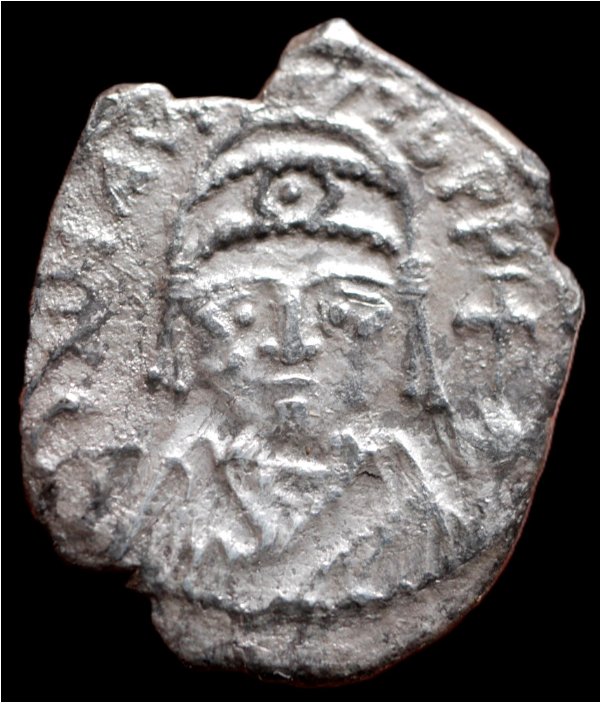
This silver half-siliqua of Maurice Tiberius (582–602), attributed to the Carthage mint and part of the consular issue of 602, belongs to a particularly sought-after group of small western divisions: a solemn frontal portrait in consular robes, and a Christian reverse with strong symbolic significance (cross potent on steps, A–Ω), all framed by a double beaded and crowned motif typical of late African coinages. The typology is well documented under MIB II 61 and Sear (SB) 553, with institutional collection documentation (Dumbarton Oaks) for dating to 602. Careful observation under a 10x loupe and raking light reveals a hammer strike on a small, irregular flan, with a light, satiny silver to gray finish, exhibiting fine, cross-hatched striations in the fields (superficial marks consistent with early handling and/or cleaning), while the reliefs (face, crown, cross, and steps) catch the light clearly. The rim shows marked flan losses/notches (particularly on one lateral sector), common features on these types of coins, but the overall appearance (metal, reliefs, decorative logic) does not suggest, based solely on visual observation, modern manufacture.
Obverse
The obverse features a crowned frontal bust in the late Byzantine style: a full face, wide-open eyes, a straight nose, and a thin mouth, with a headdress/crown structured by a band and a central relief element. Under magnification, the expected "ceremonial" attire is discernible (compatible with consular robes and accessories), even though the periphery is affected by the incomplete flan, making the legend DN MAV RIC PP only visible in fragments—a consistent feature for this type, often determined by the centering and shape of the flan.
Reverse
The reverse is particularly demonstrative: a cross potent on three steps (the three steps are clearly visible as superimposed lines), flanked by A on the left and Ω on the right, with a dotted border and then a peripheral wreath. Under raking light, the beads of the inner rim appear regular, and the outer wreath retains its volume despite wear, reinforcing the typological identification.
Characteristics
Authority: Maurice Tiberius, 582–602
Denomination: Demi-siliqua (AR)
Mint: Carthage
Issue: Consular, dated 602 (series attributed to the last consulship)
Obverse: DN MAV RIC PP, crowned frontal bust in consular attire, holding a mappa and scepter/badge (depending on the variant)
Reverse: Cross potent on three steps, A–Ω in the fields, dotted border, all within a wreath
References: MIB II 61; Sear (SB) 553; DOC (Dumbarton Oaks) similarities documented in the catalog
Weight: 0.92 g (data provided)
Rarity: This type is regularly described as very/extremely rare in specialist notes and specimen files.
Historical Context
The year 602 was a turning point: the end of Maurice's reign was marked by the military and political crisis that led to his overthrow and the accession of Phocas.
In this context, the consular minting and the visual affirmation of imperial Christianity on the reverse (cross on steps, Alpha & Omega, symbol of totality/eternity) constitute a particularly dense discourse of legitimation, all the more striking on a silver fragment from Carthage—an African mint whose later productions are clearly distinguished in the corpus.
Cultural Value
For a collector, this half-siliqua possesses criteria rarely found in such a small coin:
immediately identifiable consular iconography (official frontal portrait),
a strong and highly legible Christian reverse (A–Ω framing the cross),
an attribution and dating documented by references (MIB/Sear) and by parallels in institutional catalogs, making the coin particularly comparable, quotable, and valuable in a Byzantine collection focused on Africa and the late 6th century.
Traceability & Guarantees
In accordance with our practices, each coin is examined, described, and accompanied by a certificate of authenticity conforming to the standards of the art and heritage market. The examination is conducted with meticulous observation under a 10x loupe and raking light, and verification of the technical authentication criteria (typological consistency, striking structure, style, logic of symbols and borders, and surface examination using non-destructive analysis).
The provenance is European, originating from a professional numismatic network; the acquisition is the result of a specialized international transaction, conducted within an established numismatic network and validated by experts, according to the standards expected for heritage objects.
Ref: EEGVKCECR5

 English
 Français
  Italiano
  Deutsch
  Pharmacy Balance Scale, Late 19th Century
350 € EUR
Pharmacy Balance Scale, Late 19th Century
350 € EUR