This description has been translated and may not be completely accurate. Click here to see the original
Analysis & Expertise
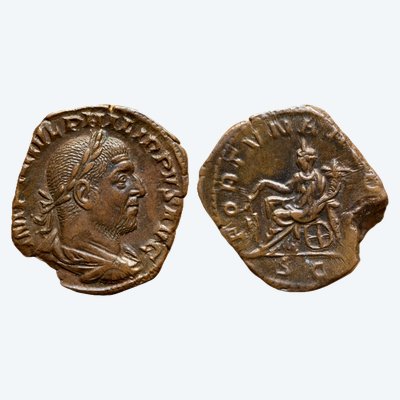
Large sestertius of Philip I the Arab, struck in Rome between AD 244 and 249, presenting a broad 31 mm module for a weight of 19.29 g. The specimen displays the strong presence expected from an imperial bronze, with an ancient patina predominantly brown-olive in tone, locally nuanced with reddish and greenish reflections, typical of old copper-alloy surfaces preserved over a long period.
Obverse: the legend IMP M IVL PHILIPPVS AVG runs around the laureate, draped and cuirassed bust of the emperor facing right. The titulature remains largely legible, with well-separated letters across much of the circumference. The portrait retains excellent expressive strength: high forehead, pronounced nose, short beard, powerful neck, and hair rendered through fine incisions still perceptible. The laurel wreath is clearly distinguishable, especially above the forehead and behind the head, while the drapery and cuirass remain visible in the lower part of the bust. The style is characteristic of the Roman issues of Philip I: realistic, authoritative, less idealized than the productions of the High Empire, yet highly effective as imperial political imagery.
Reverse: the legend ADVENTVS AVGG accompanies the emperor on horseback moving left, raising his right hand in a gesture of greeting and holding a sceptre. The S C appears in the exergue, in accordance with bronze coinage issued under senatorial authority. Despite a relief softer than that of the obverse, the scene remains perfectly identifiable: the horse, the imperial figure, the raised arm, and the attribute held in the hand together form a clear representation of the adventus, meaning the solemn arrival of the emperor. This monetary type belongs to the official language of Roman power: it presents the prince not only as a military leader, but also as a visible presence, welcomed and acknowledged by the city.
Surface condition: well-preserved reliefs on the obverse, more subdued on the reverse but still readable; homogeneous ancient patina, with some areas of mineral deposits and slight surface granularity; irregular edge, consistent with a large ancient bronze; micro-scratches and old marks visible in the fields, without affecting the general readability of the coin. The specimen retains strong numismatic coherence: weight, module, titulature, iconography, and references all correspond to the sestertius of Philip I with the ADVENTVS AVGG reverse, listed as RIC 165.
Characteristics
Authority: Philip I the Arab
Mint: Rome
Date: AD 244–249
Denomination / metal: Sestertius, AE
Module / weight: 31 mm; 19.29 g
Obverse: IMP M IVL PHILIPPVS AVG; laureate, draped and cuirassed bust right
Reverse: ADVENTVS AVGG; emperor on horseback left, raising his hand and holding a sceptre; S C in exergue
References: RIC 165; Cohen 6; Sear 8986
Condition: fine specimen with ancient patina, expressive portrait, clearly legible titulature, identifiable reverse, regular wear, and surfaces consistent with a large ancient Roman bronze
Historical Context
Philip I, known as Philip the Arab, ruled from AD 244 to 249, during a period in which the Roman Empire was experiencing increasing political instability, while imperial government still retained a strong capacity for public representation. His reign is notably associated with the celebration of Rome’s millennium in AD 248, a major event that gave rise to important political, religious, and monetary manifestations. Philip was overthrown at the end of his reign during the conflict opposing him to Decius, who subsequently established himself as emperor. (Wikipedia)
The ADVENTVS AVGG reverse is particularly interesting in this context. The adventus refers to the official and solemn arrival of the emperor, a moment of public recognition in which imperial power appears, becomes visible, and affirms its legitimacy. The image of the emperor on horseback, raising his hand in greeting, follows a highly codified imperial iconography: the prince appears as leader, protector, and figure of continuity. On a large bronze intended for broad circulation, the message was immediately understandable: the emperor is present, recognized, and welcomed.
Cultural Value
This sestertius possesses genuine collector appeal. It combines an expressive imperial portrait, a legible legend, a historically meaningful reverse, and a large module pleasant to display. The bronzes of Philip I are of particular interest to collectors of the third century, a pivotal period during which imperial portraits became more direct, more military, and more intense, reflecting a form of power exposed to pressure from the armies, the frontiers, and internal rivalries.
The obverse offers a remarkable presence: Philip I appears with a restrained, almost severe gravity, conveying the political spirit of the mid-third century. The reverse adds a narrative dimension: the emperor on horseback, shown in a scene of official arrival, gives the coin an immediately historical reading. This is not merely an imperial portrait; it is an image of power in motion, a coin of public representation and legitimization.
The specimen will appeal to a collector seeking a large Roman bronze that is readable, documented, and rich in meaning. Its ancient patina, well-preserved portrait, and identifiable reverse give it strong display presence in a cabinet or collection tray. It is a coin that is both accessible in its visual reading and rich in historical context, ideal for illustrating the transition between the classical Roman Empire and the deep tensions of the third century.
Traceability & Guarantees
Provenance: from established European collections.
Certificate of authenticity: supplied with the specimen.
Sale: specialized international transaction conducted within a recognized numismatic network, carried out in strict compliance with applicable regulations and according to the professional standards of the numismatic market; each specimen is examined, described, and accompanied by a certificate of authenticity in accordance with the standards of the art and heritage market.
Ref: B6NDJF5WWN

 English
 Français
  Italiano
  Deutsch
  Macassar Ebony 1930 Art Deco Coffee Table
2.050 € EUR
Macassar Ebony 1930 Art Deco Coffee Table
2.050 € EUR