This description has been translated and may not be completely accurate. Click here to see the original
Analysis & Expertise
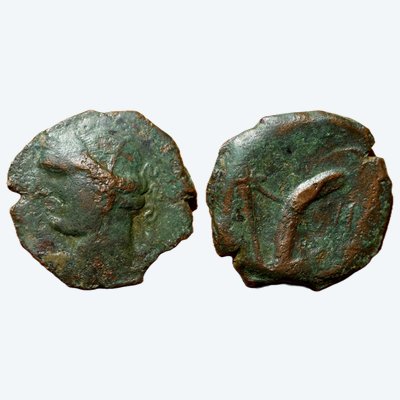
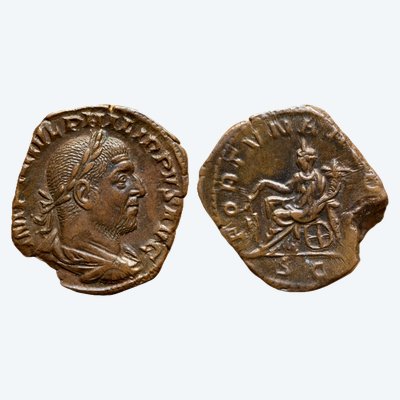
Large sestertius of Philip I the Arab, struck in Rome between AD 244 and 249, with a module of 30 mm and a weight of 17.61 g. The specimen displays very fine overall readability, with a particularly expressive obverse and an iconographically complete reverse dedicated to Fortuna Redux, the deity associated with favorable return and the protection of imperial travel.
Obverse: the legend IMP M IVL PHILIPPVS AVG runs around the laureate, draped and cuirassed bust of the emperor facing right. The titulature is clearly readable across a large part of the circumference, especially in the upper and right-hand areas of the field, where the letters retain strong relief. The portrait is one of the specimen’s major strengths: the profile of Philip I appears with great vigor, marked by a straight forehead, powerful nose, well-defined eye, finely rendered short beard, and hair treated through small, closely spaced incisions. The laurel wreath is well preserved, with leaves still distinct, while the drapery and cuirass remain visible in the lower part of the bust.
Under raking light, the obverse reliefs show fine surface definition, particularly on the wreath, hair, ear, beard, and outline of the neck. The surface presents an ancient patina predominantly brown-grey to brown-olive, with slight mineral nuances in the recesses. The flan is irregular, with a small opening or marginal break in the upper part, without serious impact on the portrait or on the understanding of the type.
Reverse: the legend FORTVNA REDVX accompanies Fortuna seated left, holding a rudder and a cornucopia; a wheel appears beneath the seat, and S C is visible in the exergue. The scene retains very satisfactory readability: the deity is clearly identifiable, seated in profile, with the arm extended toward the rudder, a symbol of direction and controlled return, while the cornucopia evokes prosperity and divine favor. The wheel placed beneath the seat is an important and clearly visible iconographic detail, reinforcing the traditional association of Fortuna with fate, movement, and mobility.
The reverse shows more pronounced wear than the obverse, but the composition remains complete in its overall interpretation. The right-hand periphery shows a more marked flan irregularity, with a slightly open or lacunar edge, affecting mainly the margin and part of the field, without preventing identification of the type. The central reliefs, the seat, the posture of Fortuna, the wheel, and the S C remain sufficiently legible to give the coin genuine documentary and visual value.
Surface condition: stable ancient patina, strong obverse reliefs, readable reverse despite more even wear, minor circulation marks, small marginal irregularities, and a surface texture consistent with a large ancient bronze. All the elements provided — authority, module, weight, titulature, iconography, and reference — correspond to the sestertius of Philip I with the FORTVNA REDVX reverse, referenced as RIC 174a.
Characteristics
Authority: Philip I the Arab
Mint: Rome
Date: AD 244–249
Denomination / metal: Sestertius, AE
Module / weight: 30 mm; 17.61 g
Obverse: IMP M IVL PHILIPPVS AVG; laureate, draped and cuirassed bust right
Reverse: FORTVNA REDVX; Fortuna seated left, holding a rudder and a cornucopia; wheel beneath the seat; S C in exergue
Reference: RIC 174a
Condition: very fine portrait, largely readable obverse legend, reverse complete in its interpretation, ancient brown-grey to brown-olive patina, regular wear, visible marginal flan irregularities compatible with a large ancient Roman bronze
Historical Context
Philip I, known as Philip the Arab, ruled from AD 244 to 249, after the death of Gordian III, at a time when the Roman Empire was seeking to maintain its balance between military pressure, senatorial legitimacy, and growing political instability. His reign is notably associated with the return to Rome after the eastern events and with the great celebration of Rome’s millennium in AD 248, a moment of strong ideological staging of imperial power. (Wikipedia)
The FORTVNA REDVX reverse is particularly meaningful in this context. Fortuna Redux is the aspect of Fortuna connected with favorable return, especially that of the emperor after a journey, campaign, or perilous situation. Her usual attributes, the rudder and the cornucopia, express both mastery over destiny, the successful conduct of imperial affairs, and the promise of prosperity. (Wikipedia)
On this sestertius, the message is therefore highly political: Philip I presents himself as a returned prince, recognized and protected by Fortune, capable of bringing stability and abundance back to the Empire. The choice of a large bronze, a coin intended for wide circulation, gives this image strong public reach. The people did not merely receive a coin; they received an official message of continuity, favorable return, and imperial legitimacy.
Cultural Value
This sestertius possesses several important qualities for a collector: a powerful portrait, a clear titulature, a reverse iconography rich in meaning, and a large module pleasant to display. The obverse is particularly attractive, as the face of Philip I retains real intensity: the details of the hair, wreath, beard, and gaze give the portrait a presence far superior to that of many worn bronzes of the third century.
The reverse adds a strong symbolic dimension. Fortuna Redux is not a decorative figure: she embodies favorable return, the safety of the prince, restored prosperity, and the idea that imperial destiny remains guided despite crises. The presence of the rudder, cornucopia, and wheel beneath the seat gives the scene an iconographic density of particular interest for a thematic collection focused on imperial virtues, Roman deities, or large bronzes of the third century.
The specimen will therefore appeal to a collector seeking a Roman coin that is readable, historically situated, and visually expressive. The marginal irregularities of the flan, far from diminishing its interest, recall the material nature of large ancient bronze coins: an object struck, handled, transmitted, and whose surface still preserves the memory of its circulation.
Traceability & Guarantees
Provenance: from established European collections.
Certificate of authenticity: supplied with the specimen.
Sale: specialized international transaction conducted within a recognized numismatic network, carried out in strict compliance with applicable regulations and according to the professional standards of the numismatic market; each specimen is examined, described, and accompanied by a certificate of authenticity in accordance with the standards of the art and heritage market.
Ref: 34CV2G1BLE

 English
 Français
  Italiano
  Deutsch
  Blackened wooden cabinet, 17th century.
2.700 € EUR
Blackened wooden cabinet, 17th century.
2.700 € EUR