




Would you like more images?


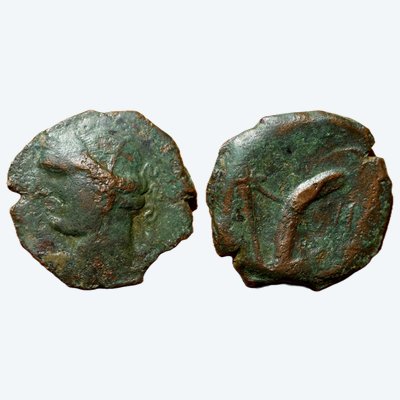
This sestertius of Philip I, struck in Rome and attributable to the FORTVNA REDVX / S C type, corresponds with very strong coherence to RIC IV.3, 174a, also published under MIR 36, 66h, with the obverse IMP M IVL PHILIPPVS AVG and a reverse showing Fortuna seated left, holding a rudder and a cornucopia, with a wheel beneath the seat; the series is documented in public corpora and in specialized comparanda as a large bronze of the reign, generally placed within the interval AD 244–249, with examples measuring around 28 to 30 mm for weights often between 16 and 19 g, which makes the specimen considered here, at 29 mm and 18.12 g, fully consistent with the group. The sought-after character of this issue may be accurately emphasized, several surveys placing it at a high level of rarity in current inventories.
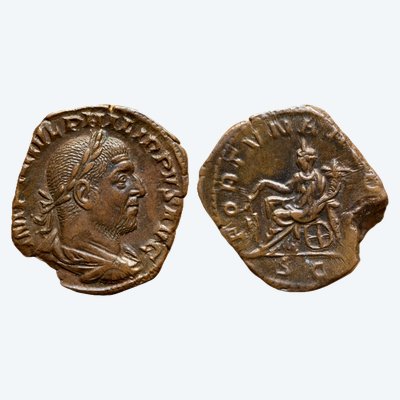
Careful observation under ×10 magnification and raking light. The obverse presents a laureate portrait of Philip I turned to the right, whose structure remains well defined, with a clearly legible laurel wreath, a broad forehead, an open and well-set eye, a clean nasal line, a tight mouth, and a short, regular, firmly modeled beard; the bust retains a clear reading in its drapery and cuirass, and the obverse titulature, although softened in places, remains sufficiently broad to confirm the published type without difficulty. The flan, broad and slightly irregular, is fully consistent with an ancient striking of a Roman sestertius, while the periphery preserves a satisfactory presence of border and letters.
The reverse offers a particularly secure typological reading, since one clearly recognizes Fortuna Redux seated left, holding in the right hand a rudder and in the left a cornucopia, with a wheel placed beneath the seat and S C in exergue, according to a composition exactly conforming to the published descriptions for RIC 174a; the silhouette of the goddess remains intelligible, the rudder remains well individualized, the cornucopia retains its presence, and the wheel beneath the seat, an essential detail of the type, can be recognized with sufficient clarity to support a very firm numismatic attribution. The reverse thus preserves all the doctrinal and iconographic legibility that makes this issue so interesting.
The surface shows an old brown-green patina, with coherent mineral nuances across the entire flan, and reliefs still readable on the strategic points of both portrait and reverse; the fields show regular wear compatible with the ancient circulation of the denomination, without harming the intelligibility of the type, while the overall volume of the coin remains very satisfactory for a large bronze of Philip I. This material coherence, together with the full typological conformity of the specimen, gives it a cabinet presence that is solid, readable, and immediately convincing for an informed collector.
This is a sestertius of Philip I, struck in Rome, in copper alloy / large bronze, with on the obverse IMP M IVL PHILIPPVS AVG, laureate, draped, and cuirassed bust right, and on the reverse FORTVNA REDVX, Fortuna seated left, holding a rudder and a cornucopia, with a wheel beneath the seat and S C in exergue. The principal bibliographic attribution is RIC IV.3, 174a, with concordance MIR 36, 66h; specialized comparanda published under this reference give modules of 28 to 30 mm for weights around 14.48 g, 16.13 g, 17.61 g, or 18.8 g, which places the present example of 29 mm and 18.12 g in a fully convincing metrological range for the type.
The FORTVNA REDVX type belongs to a monetary language of great political legibility, in which the figure of Fortuna of the happy return expresses stability, preservation, and continuity of imperial power; under Philip I, whose reign extends from 244 to 249, this iconography takes on particular resonance in a context of strong political and military tension, the coinage participating in the affirmation of a protective and ordering authority. Specialized references record this type among the Roman sestertii of the reign, and catalogue tradition firmly maintains it within the 244–249 group, some published specimens being more narrowly dated to 249 within the final sequence of Philip’s Roman bronzes.
The cultural interest of this piece is high, because it combines a large imperial bronze, a highly recognizable portrait of Philip I, and a Fortuna Redux reverse whose iconographic legibility remains exemplary; this is not an anonymous circulation bronze, but an object in which typology, titulature, and the symbolism of power remain perfectly articulated. For an informed collector, the presence of the wheel beneath the seat, a distinctive detail of the type, further increases the interest of the reverse by giving the issue an immediately recognizable visual personality within the bronzes of the mid-3rd century. The fact that the type is regularly noted as uncommon or rare in specialized surveys further strengthens its numismatic desirability, without departing from a strictly well-founded framework of assessment.
Coming from a European provenance, from an established numismatic dealer, this specimen was acquired as part of a specialized international transaction, conducted within a recognized numismatic network and validated by leading experts, according to the highest standards of the art and heritage market; the examination of the present object retains exclusively the stylistic, technical, epigraphic, and metrological characteristics actually observable, placed back within the framework of the Roman type Philip I / FORTVNA REDVX / RIC 174a, with particular attention paid to the coherence of the portrait, the reading of the titulature, the structure of the reverse, and the general conformity of the flan. The concordance between the obverse IMP M IVL PHILIPPVS AVG, the reverse FORTVNA REDVX with Fortuna seated holding rudder, cornucopia, and wheel beneath the seat, the mint of Rome, the observed metrology, and the references RIC 174a / MIR 66h establishes a particularly solid numismatic attribution, formulated within a framework of strict descriptive accuracy and fully suited to an audience of informed collectors.
Ref: 6PFC7QVQRT
| Condition | Good |
| Style | Rome and ancient Greece (Numismatics of Rome and ancient Greece Style) |
| Period | 16th century and older (Numismatics 16th century and older) |
| Country of origin | Italy |
| Internal reference | SKU: 003000 |
| Shipping Time | Ready to ship in 2-3 Business Days |
| Location | 75008, Paris, France |
| Shipping Information | All our shipments are handled with the utmost care. Secure packaging: Each item is protected by appropriate and reinforced packaging to guarantee its integrity during transport. Tracked shipping: All packages are sent via registered mail or international tracked service with a tracking number provided to the buyer. Processing time: Shipments are generally processed within 2 to 5 business days after payment confirmation. Insurance: Additional insurance can be added to the shipment upon request. Delivery areas: Shipping is available to the European Union. For other destinations, please contact us before purchasing. |
4 commitments to buy with confidence

 English
 Français
  Italiano
  Deutsch