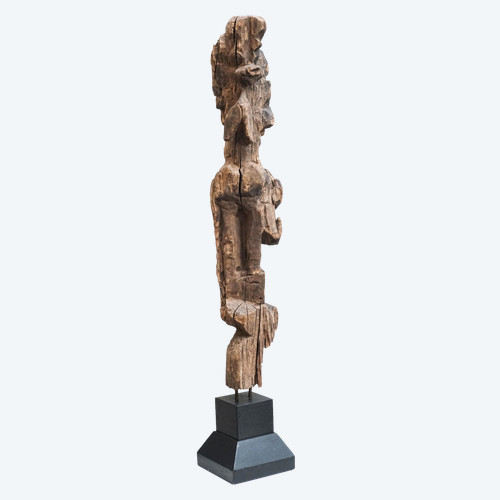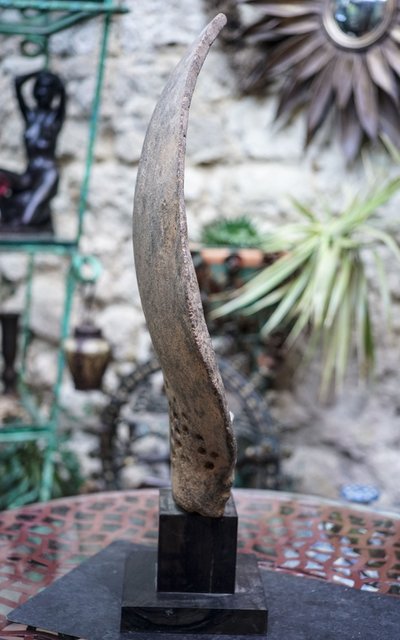





Would you like more images?

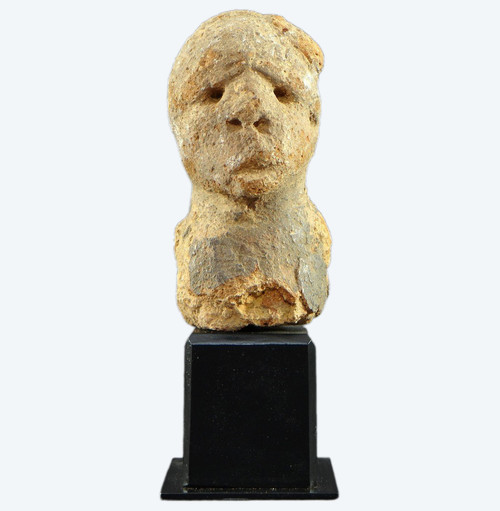
Terracotta. Height: 73 cm. Excluding the base: 58 cm × 40 cm.
From the 15th to the 18th century, the southern Akan peoples, primarily in Ghana and Ivory Coast, used terracotta heads in the funeral rituals of their chiefs or the royal family. During these ceremonies, which could take place up to two years after the chief’s death, a head or statue representing the deceased was carved and carried through the village. It was then left on the deceased’s grave or placed on an altar where libations were offered to it.
The production of terracotta portraits of members of royal families and their entourages was entrusted to women—potters and ceramicists—whose workshops were once controlled by the queen mothers. A variety of regional styles developed among various Akan groups from 1600 to 1965.
We present this major work from a private collection in France, purchased in 1996 from a French gallerist based in Togo, who also crafted the ebony base. We do not have the documentation to verify this, but we are in contact with the collector.
A remarkable work with a perfect circular shape, its rounded form corresponding to one of the most significant styles of the Kwahu people—an ethnic subgroup of the larger Akan community in Ghana that lives primarily in the eastern region of the country, on the steep heights of the Kwahu Plateau—often dubbed the “natural fortress”—overlooking Lake Volta to the west.
The sublime face of this funerary terracotta, with its delicately summarized and suggested features, tends toward abstraction and Cubism. One might think, for example, of Paul Klee’s painting *Senecio* (1922). Our terracotta piece masterfully bridges the interests of Cubists like Picasso and Braque—who were primarily interested in the geometry, structure, and planes of African objects—and those of Surrealists like Breton, who sought mystery, myth, and ritual function.
Ref: MH7RSFK909
| Condition | Very good |
| Style | Tribal Art (African Statues, Puppets, Dolls, Maternity of Tribal Art Style) |
| Period | 20th century (African Statues, Puppets, Dolls, Maternity 20th century) |
| Country of origin | Tonga |
| Internal reference | P641 |
| Shipping Time | Ready to ship in 8-15 Business Days |
| Location | 33000, Bordeaux, France |
4 commitments to buy with confidence

 English
 Français
  Italiano
  Deutsch