





Would you like more images?

Kuba Libation Horn
DRC – Kuba Kingdom (Bushoong), early/mid-20th century
Material: Finely carved animal horn
Dimensions: 31 cm (L) – Ø approx. 7 cm – Weight: 160 g
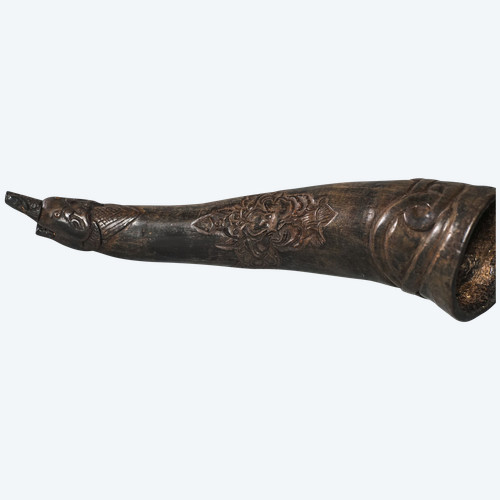
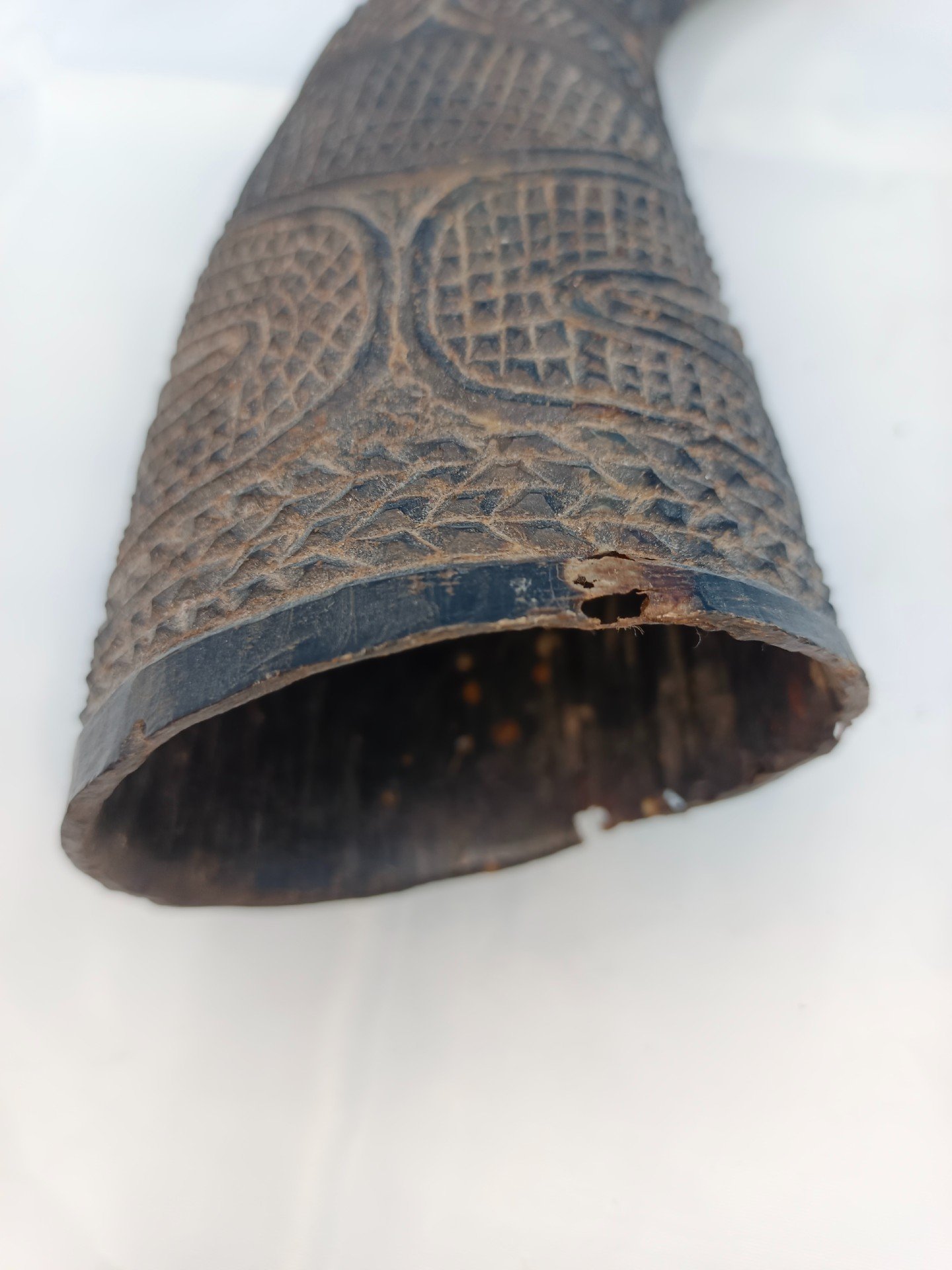
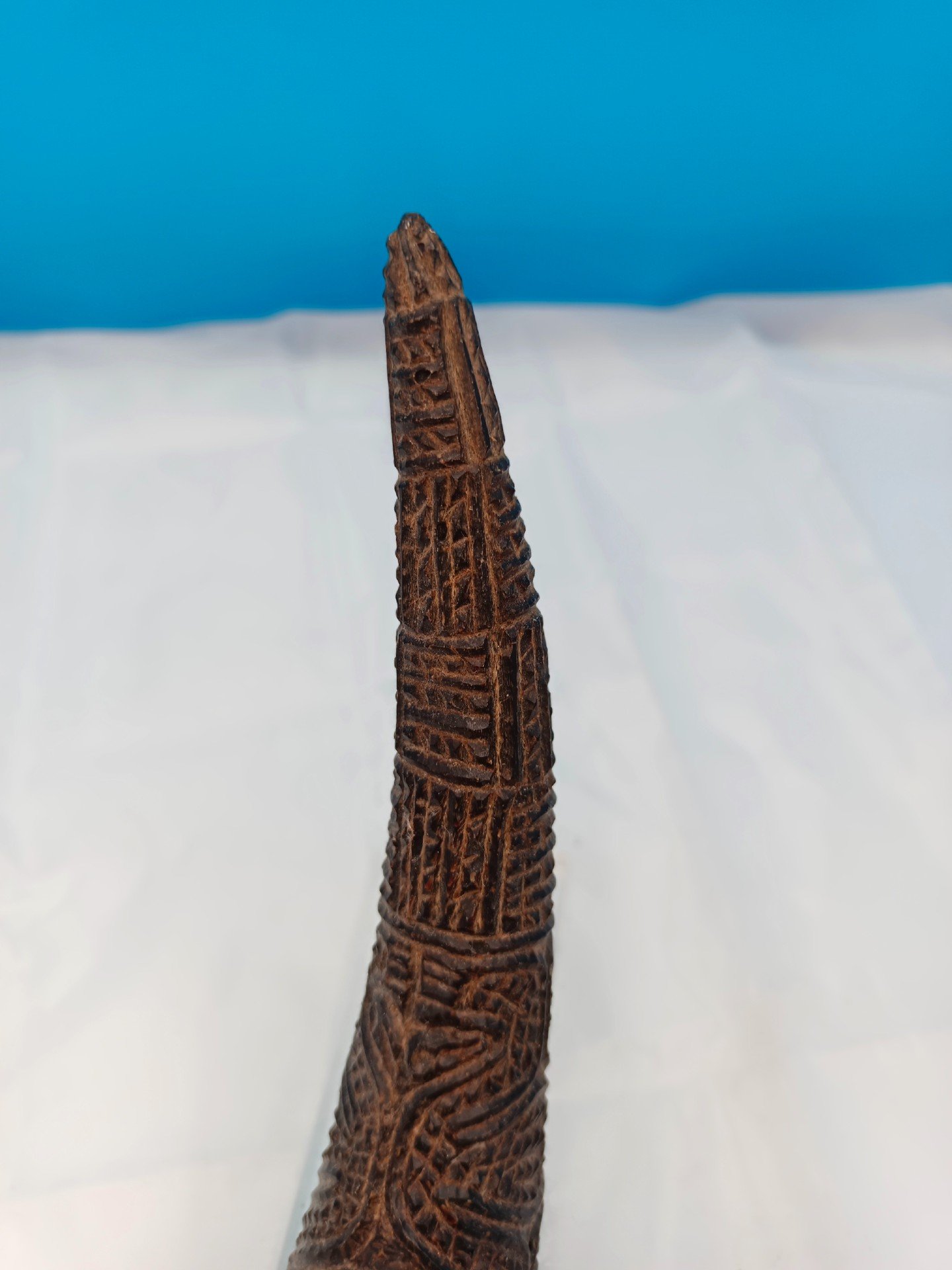
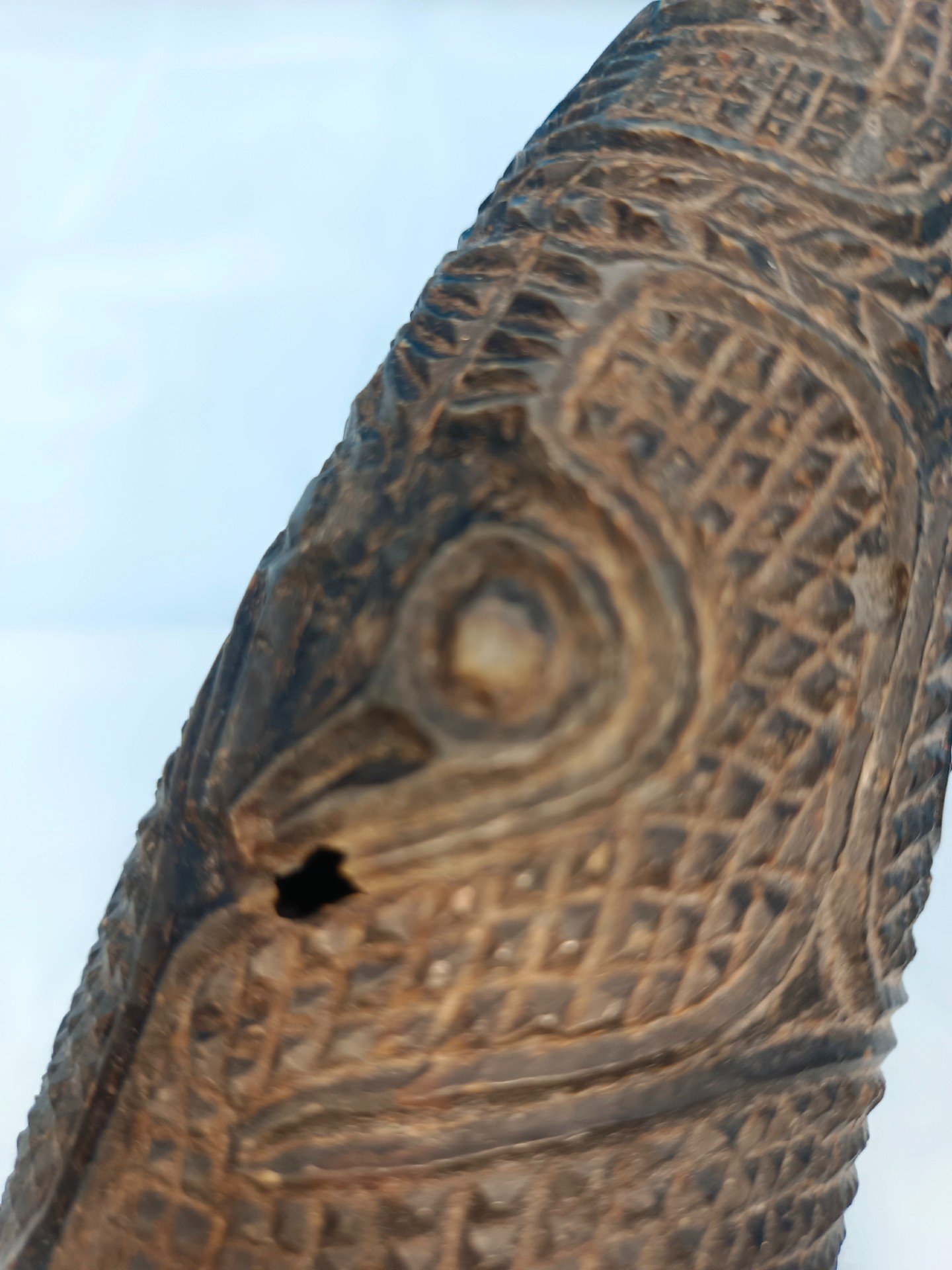
This libation horn features a full-surface carving in low to medium relief. The motifs depict:
Stylized animal figures—likely crocodiles, snakes, or chameleons, recurring animals in the Kuba repertoire symbolizing vigilance, the spirit world, and sovereignty.
A network of geometric patterns in diamonds, grids, checkerboards, and intersecting lines, typical of Kuba decorative vocabulary (echoing textile motifs from cut-pile raffia, kasai velvet).
An open terminal loop (wide end) without a mouthpiece, indicating pouring rather than blowing.
The horn was likely used for:
Ritual libations (palm wine, lustral water, beer),
Royal blessings,
Commemorative offerings during funeral or lineage ceremonies.
Stylistic Analysis
Several elements confirm a Kuba origin, rather than Pende, Luba, or Chokwe:
1. Structured Geometric Motifs
The tightly packed lozenges, grids, and dense modeling directly reference Kuba aesthetics, in particular:
Shinga, kasa, and imboong motifs,
The Kuba principle of “fully activated surface.”
2. Intertwined Animal Figures
The continuously carved serpentine representation is well documented in:
Bushoong horns,
Some Kuba scepters and pipe handles.
3. Absence of Human Faces
Unlike Pende or Luba horns, which are often anthropomorphic, Kuba horns favor:
Dynamic patterns,
Animal symbolism,
Textile aesthetics transferred to sculpture.
Estimated Dating
The evidence places the piece between 1930 and 1950.
Old, natural patina from use.
Consistent wear on the edges and most prominent reliefs.
Internal dryness and micro-chips consistent with pieces over 60 years old.
A visible hole from an old wood-boring insect on the side (consistent with village storage).
State of Preservation
Good overall condition, intact structure.
Visible signs of ritual wear: rubbing, polished edges.
Small, old insect holes (now deactivated), including one in the central area.
Wide, slightly irregular rim: old but stabilized chips.
Brown surface covered with a matte patina from repeated use and handling.
Ritual Function
These horns were used by:
Village chiefs,
Bushogun dignitaries,
Diviners (ngesh),
Ancestor-related ceremonies.
They symbolize: Transmission, abundance, lineage authority.
Cultural Provenance
Kuba Kingdom (DRC) – probably Bushoong, the central and aristocratic group, renowned for its carved wood, finely engraved ivory and horns, and highly developed sense of geometry.
Bibliographical References
To situate and document this type of piece precisely:
General Works on the Kuba
J. Mack, The Kingdom of Kuba, London, 1989.
D. Binkley & P. Darish, Kuba Art and Royal Ideology, Cleveland Museum of Art, 1985.
V. F. Cordwell, Some Kuba Decorative Arts, Africa, vol. 30, 1960.
Arthur P. Bourgeois, Arts of the Kuba, Milan, 2014.
On Carved Horns and Ivories
E. Cornet, Art Royal Kuba, Tervuren, 1982 (contains several carved horns and scepters).
F. Neyt, L’Art Kuba, Paris, 1977.
P. Darish, Patterns of Prestige: African Arms & Armor, 1998 (sections on carved horn objects).
Museum References
Comparable Kuba libation horns are held in:
Royal Museum for Central Africa, Tervuren – Kuba Collections, similar inv. in the section "Prestige Objects / Horns".
The Metropolitan Museum of Art, New York – Department of African Art (Kuba horn, inv. 1978.412.468).
Brooklyn Museum, New York – Bushoong prestige objects in carved horn.
Musée du Quai Branly – Jacques Chirac, Paris – Kuba collection including horns, ivories, and decorated scepters.
Ref: 39SZM6QMDY
| Condition | Good |
| Ethnic group | Kuba |
| Style | Tribal Art (African Usuels and Rituals items of Tribal Art Style) |
| Period | 20th century (African Usuels and Rituals items 20th century) |
| Country of origin | Congo |
| Length (cm) | 31 |
| Width (cm) | 6 |
| Weight (Kg) | 0.160 |
| Materials | Horn |
| Internal reference | BRAN002B002-70 |
| Shipping Time | Ready to ship in 2-3 Business Days |
| Location | 06460, Saint-Vallier-de-Thiey (06460), France |
| Shipping Information | Shipping within France and Europe via Colissimo within 1 to 2 working days. |
4 commitments to buy with confidence

 English
 Français
  Italiano
  Deutsch