This description has been translated and may not be completely accurate. Click here to see the original
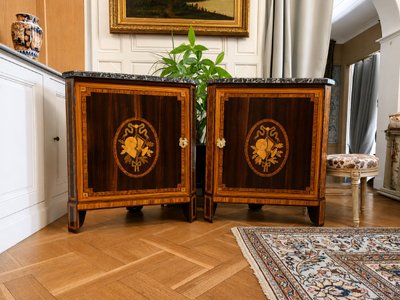
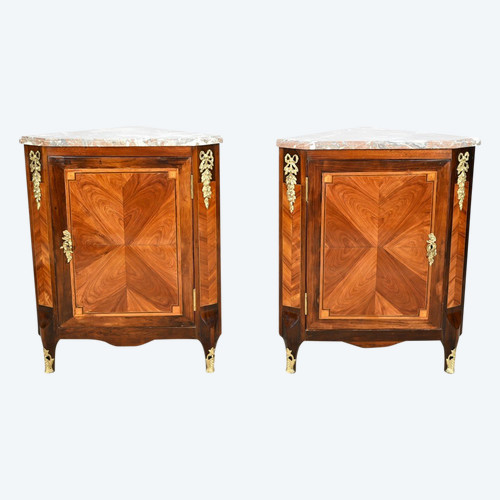
An interesting pair of Louis XVI corner cabinets, each opening with a door, one on the left and the other on the right. The harmony of their proportions, the quality of their marquetry, and the originality of their decoration make them a remarkable example of late 18th-century Neoclassical taste.
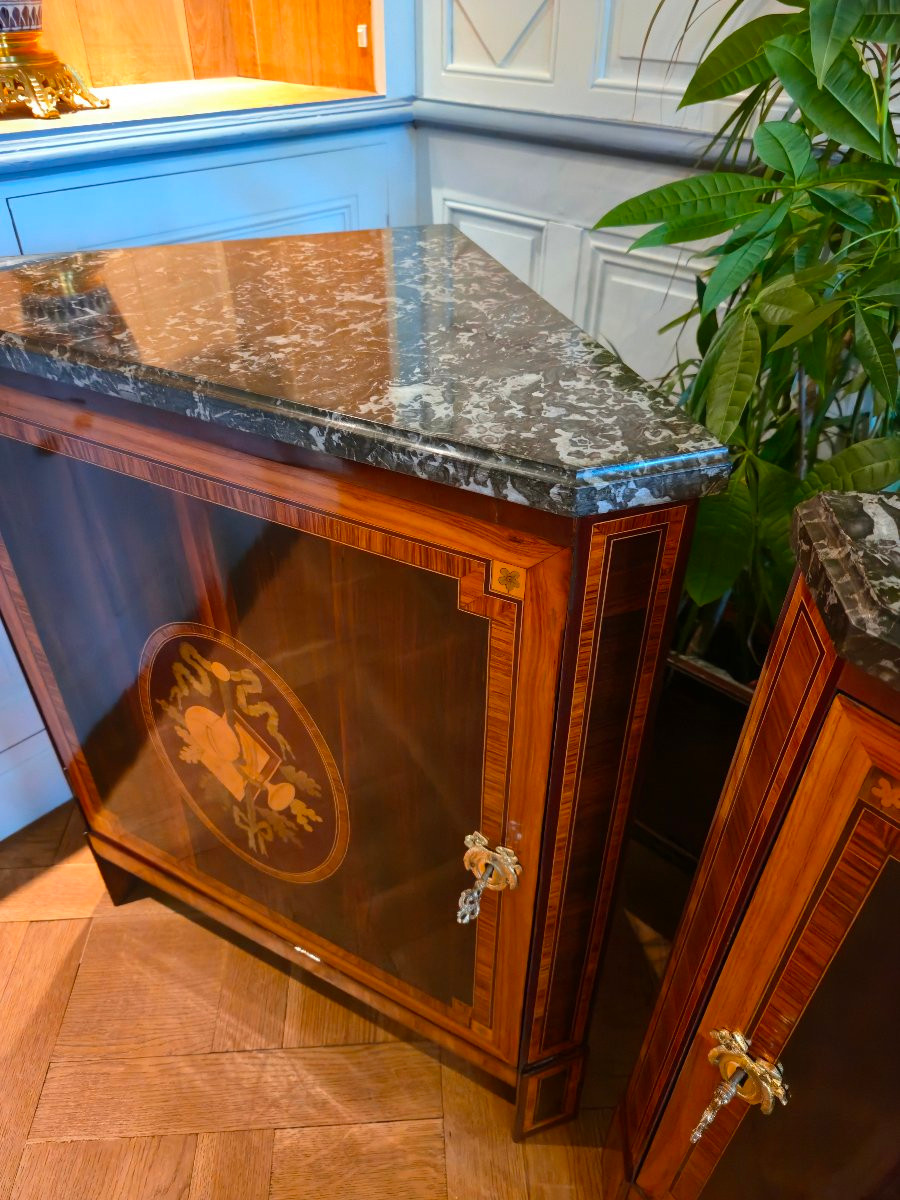
The flat fronts are veneered in rosewood and framed with rosewood reserves highlighted by fine fillets. The chamfered corners are also decorated with structured veneer in long rectangular reserves, contributing to the overall architectural balance. This rigorous composition, based on symmetry and geometry, is characteristic of the Louis XVI style.
Each door is centered with an oval marquetry medallion on an amaranth ground depicting a remarkable trophy of science and geography. This medallion features a globe, a closed book, and a quill pen suspended from tied ribbons. The piece is accompanied by oak leaves, a symbol of strength, wisdom, stability, and the enduring nature of knowledge.
The medallion is framed by rosewood and light fillets. It sits at the center of a large rosewood panel, itself framed by geometric reserves, the four corners of which are embellished with delicate marquetry spandrels depicting small stylized leaves.
This iconography is particularly interesting. While trophies of music, love, or the arts frequently adorn furniture from the second half of the 18th century, representations associated with geography, study, and the dissemination of knowledge are rarer. They reflect the profound influence of the Enlightenment on the decorative arts.
The 18th century was the era of the Encyclopedia, learned academies, great scientific expeditions, and the development of modern cartography. The world map thus became a symbol of knowledge and openness to the world. Associated with the book and the quill, it evokes study, writing, the transmission of knowledge, and the intellectual ideal championed by Enlightenment philosophers. The oak leaves reinforce this interpretation by imbuing this knowledge with a sense of solidity, permanence, and moral authority. This decoration thus transcends mere ornamentation to become a true tribute to science, education, and culture.
The quality of execution of this marquetry also deserves to be highlighted. The cabinetmaker used numerous natural wood species combined with stained woods to enrich the decorative palette. The ribbons and certain foliage still display subtle color variations intended to accentuate the contrasts. The piece was originally complemented by extensive engraving to refine the details of the globe, the folds of the ribbons, the veins of the oak leaves, and the various attributes of the trophy. While past restorations and natural wear have gradually softened, or even obscured, some of the engravings, the remaining traces allow us to appreciate the richness of the original work and the quality of the marquetry.
Its refinement evokes certain exquisite pieces from the late 18th century, where the combined use of stained woods, shading, and engraving achieved highly sought-after effects of relief and naturalism.
The frames are made of fir planks joined with dovetail joints. The interior retains its two original softwood shelves resting on cleats. The door panels are veneered with cherry and walnut, a construction detail that reveals the care taken in their execution.
These manufacturing characteristics, combined with the quality of the marquetry decoration, suggest that this pair dates from eastern France in the late 18th century. It demonstrates a perfect assimilation of Parisian decorative vocabulary while retaining certain regional characteristics in its construction.
The doors have retained their original hinges. The locks were replaced some time ago, and the opening directions were changed at that time. They are adorned with elegant gilt-bronze keyhole escutcheons decorated with a knot motif in the Louis XVI style and come with their two keys.
The bronze ornamentation is deliberately minimal to allow the richness of the veneers and the refinement of the marquetry decoration to take center stage, in keeping with the purest Neoclassical aesthetic.
The corners are topped with molded breccia gray marbles featuring a chamfer and a quarter-round molding. One of the marbles is original, while the second was made later from a marble with very similar tones and veining to preserve the visual harmony of the pair.
An earlier restoration involved replacing two stiles on one of the corners. The entire piece has been refinished and is presented
Ref: 04SIONDG9D

 English
 Français
  Italiano
  Deutsch
  Oak sideboard, 1950
1.100 € EUR
Oak sideboard, 1950
1.100 € EUR