

Would you like more images?


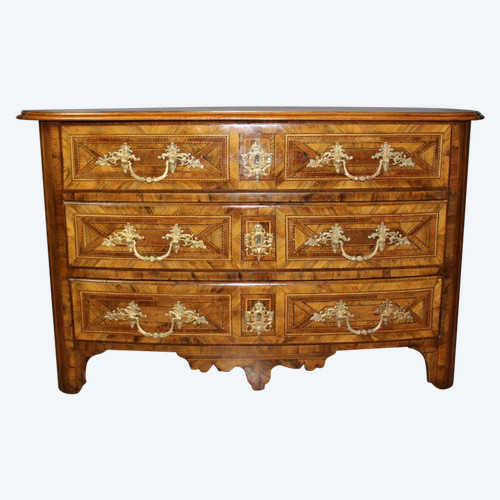
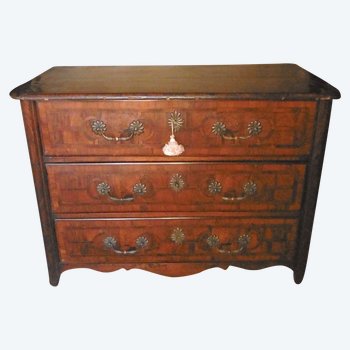
A rare and interesting Louis XIV commode made in Besançon around 1740.
This remarkable commode exemplifies a rare and precious Besançon production, dating from the first third of the 18th century, a time when cabinetmaking in the Franche-Comté region was just emerging in the French decorative landscape. It constitutes an exceptional example of regional furniture art, still influenced by Louis XIV, predating the more widely represented curved forms of the Regency period.
Architecture and Construction:
The frame is made entirely of softwood, a characteristic common to provincial production, but also found in Paris during the Regency.
The piece has a straight plan, with rounded front uprights and a very slightly curved front, in the purest Louis XIV tradition.
The commode opens with three independent drawers separated by visible rails, in a robust and functional arrangement, typical of the still classical style of this period.
Veneer & Decor:
The richness of the decor lies in the carefully laid plum veneer, arranged in a herringbone pattern, following the tradition of the period. This creates an effect of structured geometric panels alternating between diamond-shaped joints, chevrons, and large lozenges and rectangles. This warm, finely grained fruitwood is framed by wide walnut burl fillets, visible on the sides, uprights, apron, and base.
Walnut burl elegantly highlights the tabletop's apron and the front rails, lending the whole a subtle yet refined contrast. This choice of fine, locally sourced veneers underscores the piece's regional identity while evoking a refinement worthy of Parisian workshops.
Marble:
The top is crowned with an exceptional 45 mm thick Turquin marble from Caunes, molded with a corbel-shaped profile and a lower groove that refines the design and prevents any heaviness. This marble, with its blue-gray tones veined with red, harmoniously complements the warm hue of the plum wood and the depth of the walnut burl, creating a beautifully balanced chromatic dialogue.
Bronzes and Ornamentation:
The commode is adorned with a set of gilt bronze mounts in the Parisian style, of exquisite craftsmanship:
Drop handles with gadrooned rosettes,
Keyhole escutcheons featuring the mask of Ceres, a motif prized in the grand Parisian cabinetmaking of the Regency period, but also used notably by Thomas Hache in Grenoble.
The use of such decoration, as meticulous as it is expressive, testifies to the cabinetmaker's high level of culture and technical skill.
Locks & Besançon Attribution:
Two of the three locks are original and bear the official hallmark of the master locksmiths of the city of Besançon. This hot-stamped emblem (an eagle surmounted by a key) is attested to by the regulations of 1716, which required Besançon locksmiths to mark their work intended for joinery and cabinetmaking (Ordinances, Regulations and Statutes of the Locksmiths of Besançon, Article XII). The use of stamped locks was a mandatory condition of authenticity in the Franche-Comté city, and their presence allows for a certain attribution of the commode to Besançon.
This hallmark is documented and reproduced in the work by Bernard Deloche & Jean-Yves Mornand, Provincial Cabinetmaking in the 18th Century (Faton Publishing), where several pieces of furniture are compared. In particular, the authors emphasize that few antique Besançon pieces of furniture have retained this hallmark, and that the presence of such a mark allows for the precise dating and identification of a piece. Comparing the commode presented here with other models reproduced in the book, it becomes clear that this one is older, still very much in the Louis XIV style in its structure, whereas the published examples already display the full curves of the Regency period and the rounded lines of Louis XV.
An exceptional document on Besançon cabinetmaking:
This commode is not merely decorative. It constitutes an extremely rare historical document on the emergence of cabinetmaking in Besançon. It is distinguished as much by its integrity and the quality of its materials as by its documentary value. It embodies regional craftsmanship at its finest, at the precise moment when Parisian influence began to spread to provincial workshops.
Conclusion:
With its still classical form, the richness of its decoration, the elegance of its bronze mounts, and the authenticity of its hallmarked locks, this commode stands out as a rare collector's item, rigorously attributed to Besançon, and worthy of the finest collections of French provincial cabinetmaking.
Ref: H3LRVPNR8U
| Condition | Very good |
| Style | Regency style (Chests Of Drawers of Regency style Style) |
| Period | 18th century (Chests Of Drawers 18th century) |
| Country of origin | France |
| Shipping Time | Ready to ship in 4-7 Business Days |
| Location | 89260, La chapelle sur oreuse, France |
4 commitments to buy with confidence

 English
 Français
  Italiano
  Deutsch