

Would you like more images?

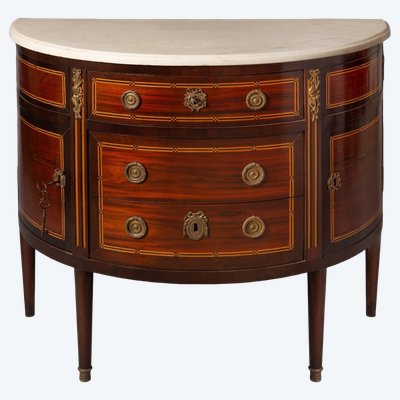
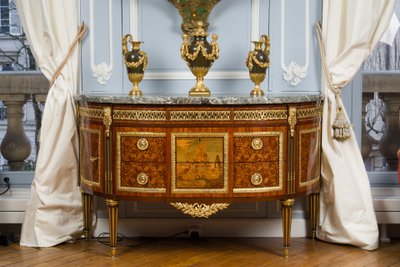
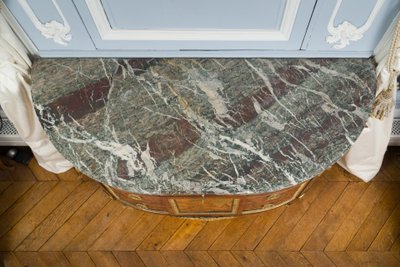
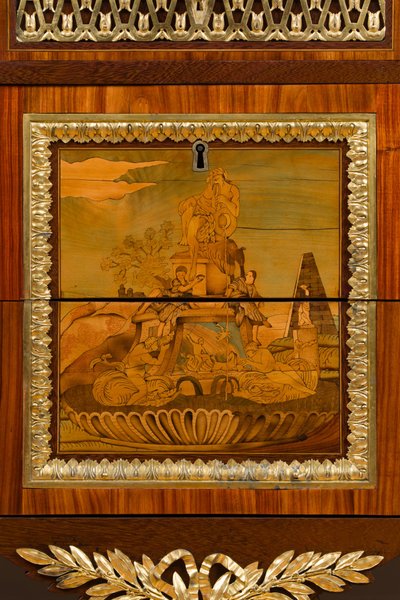
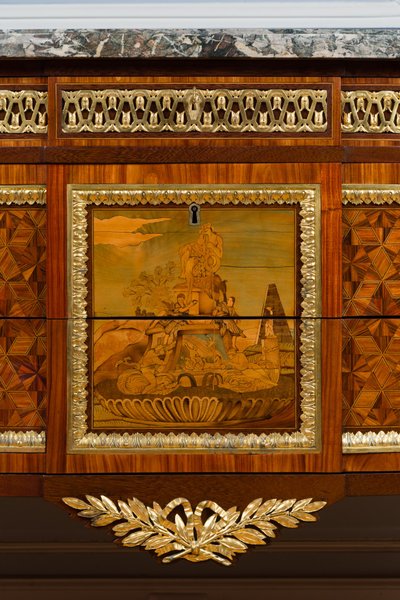
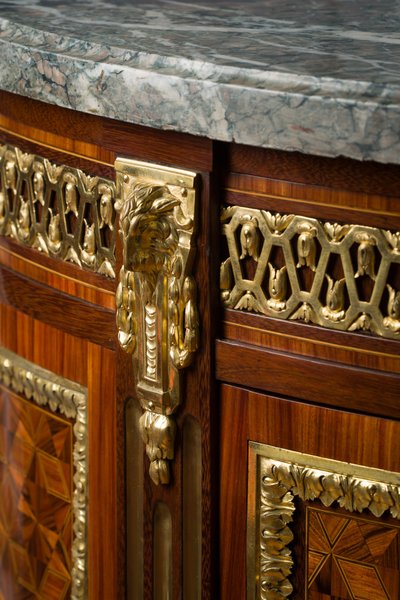
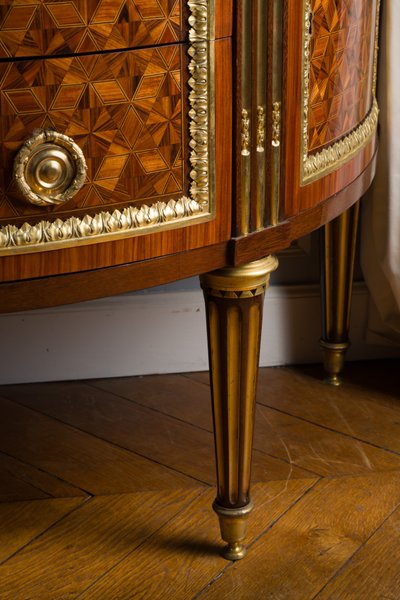
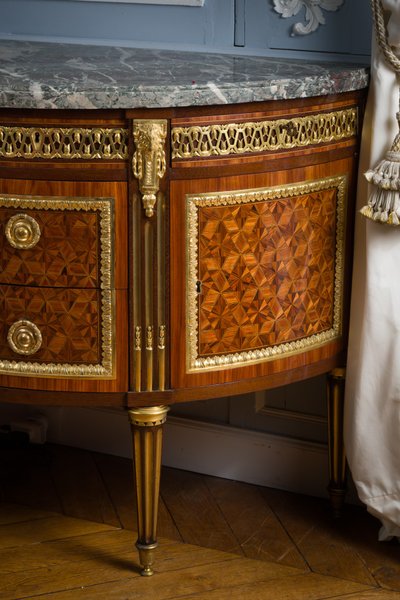
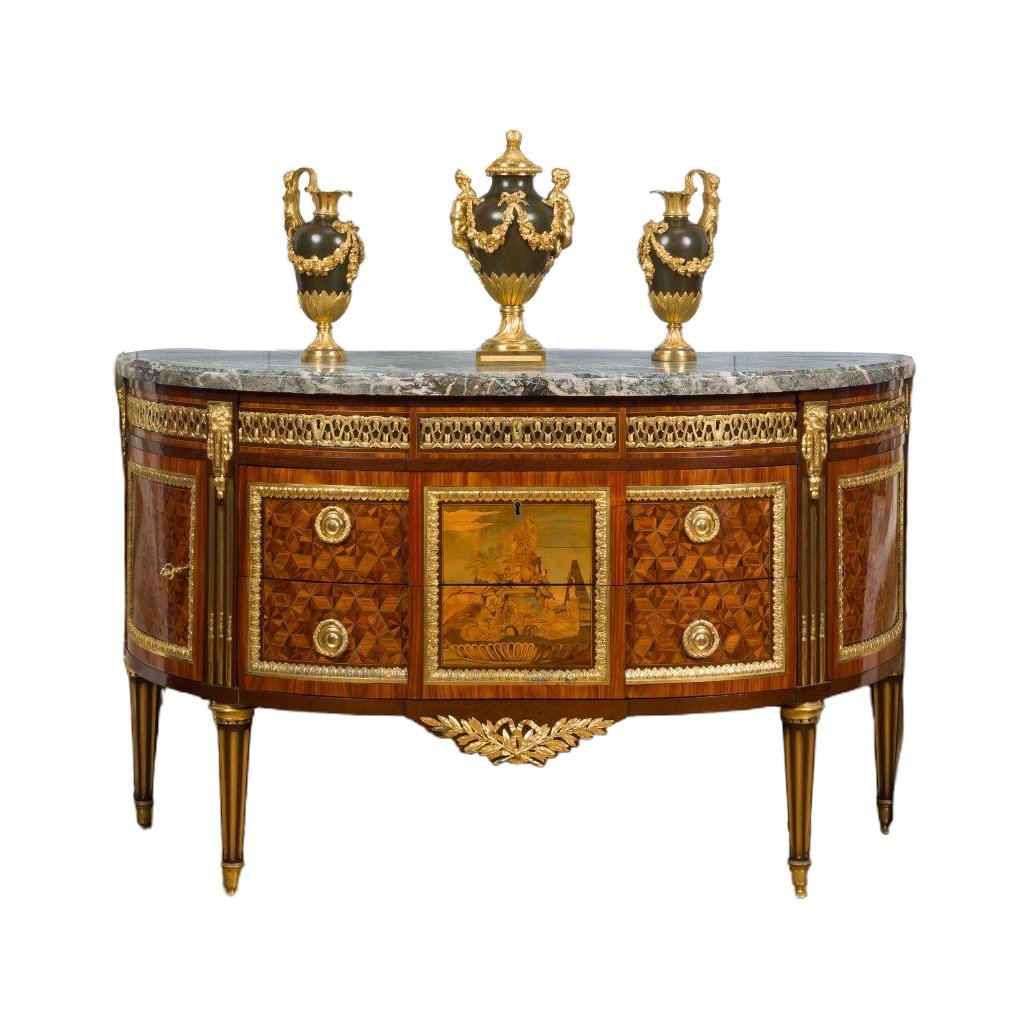
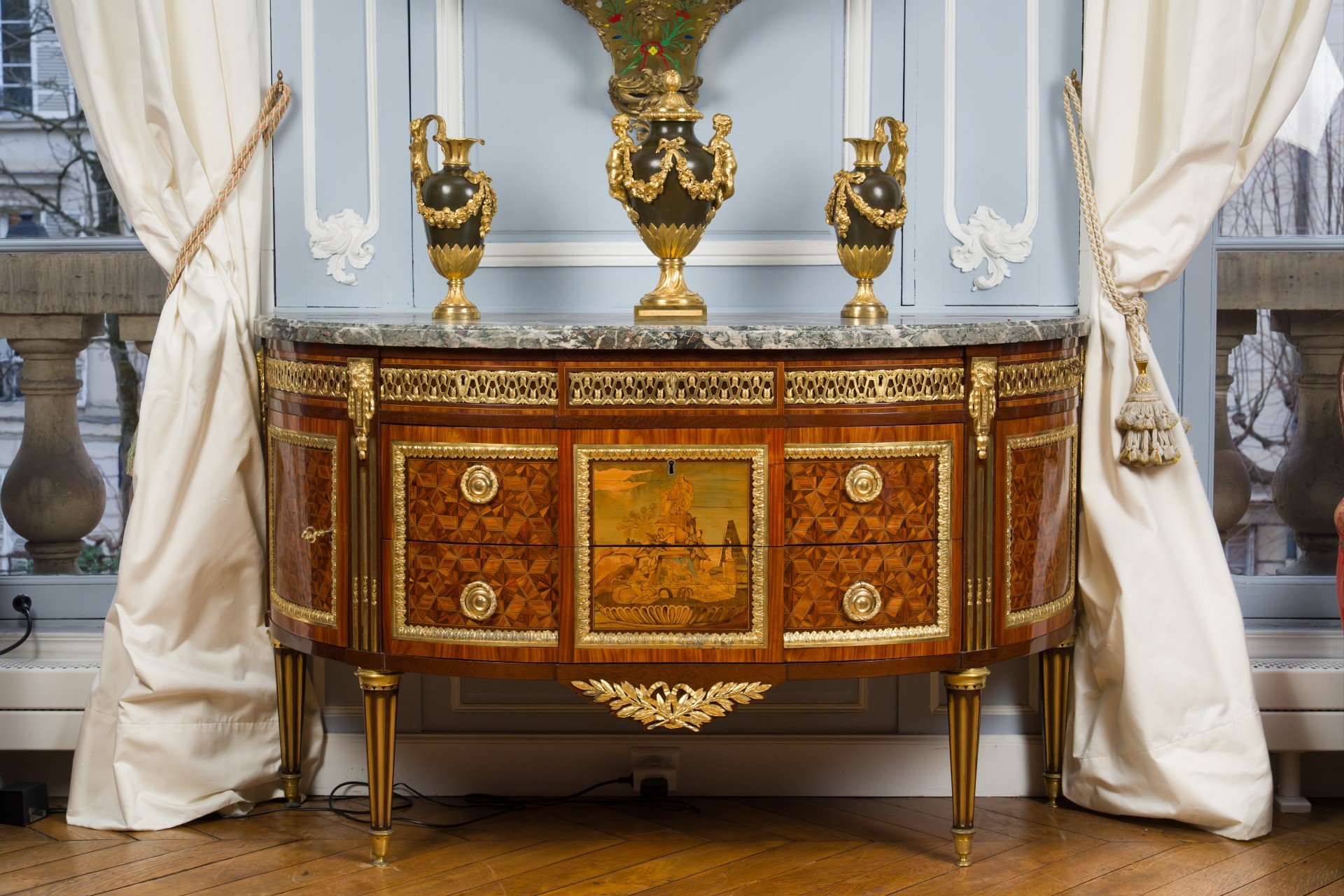
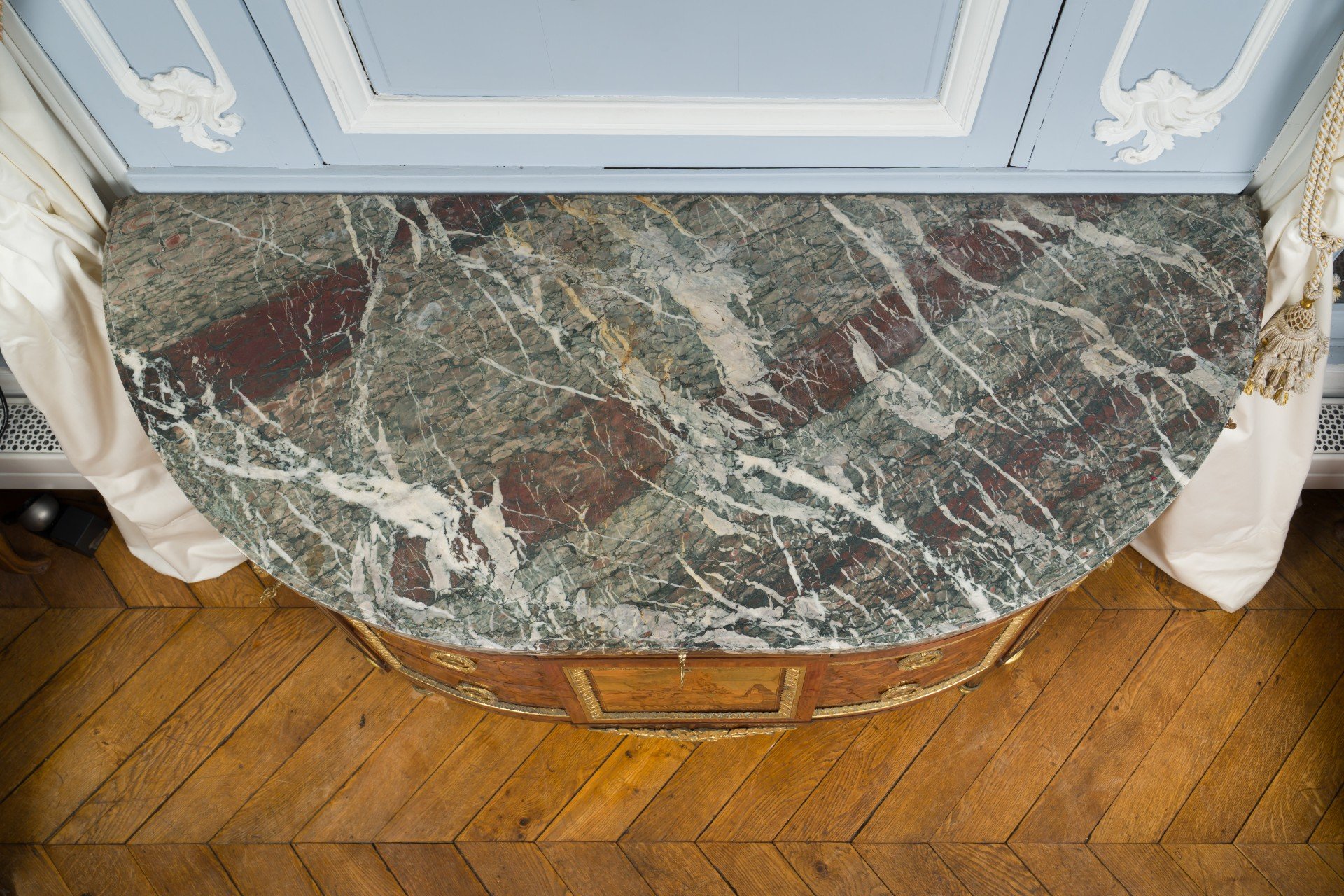
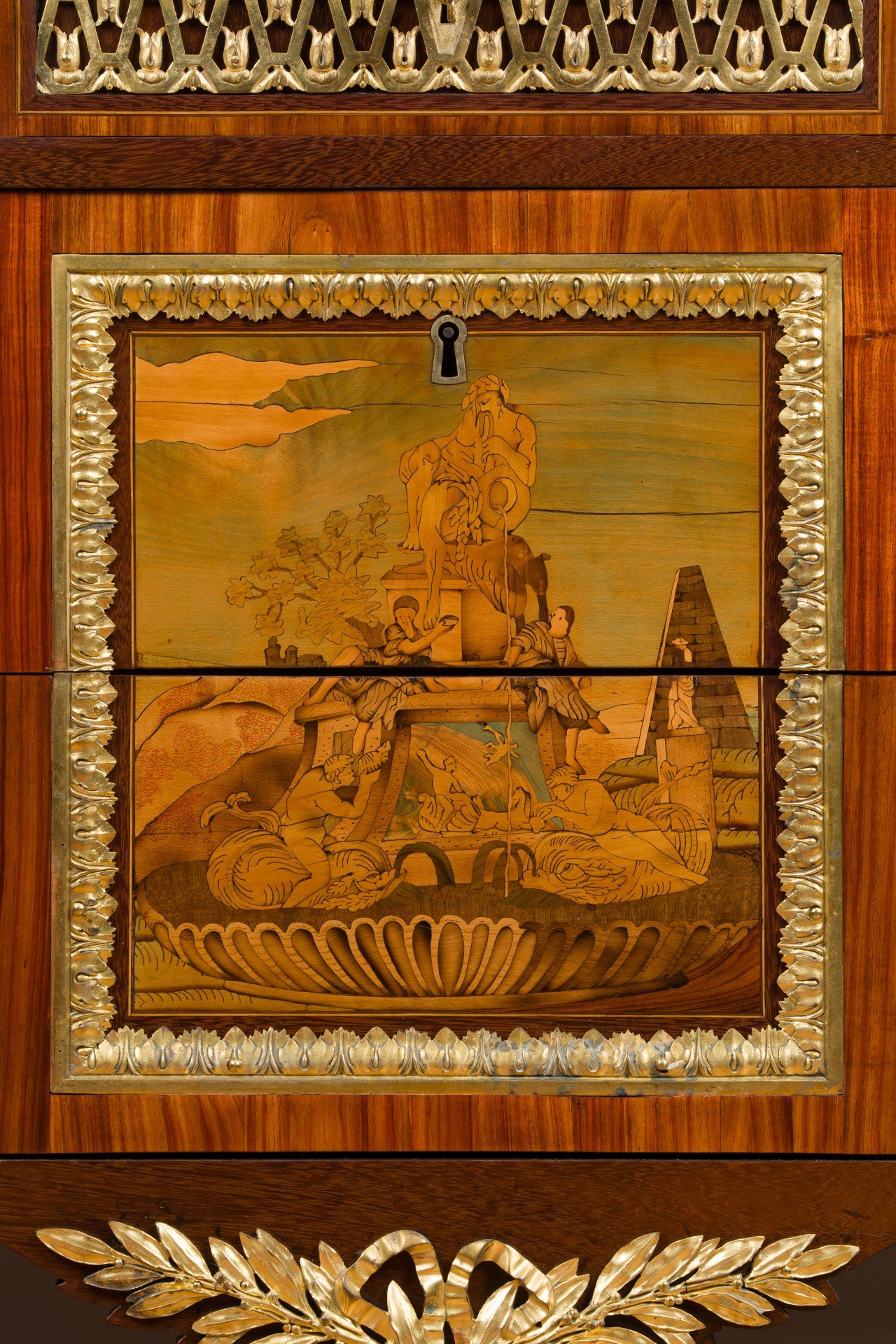
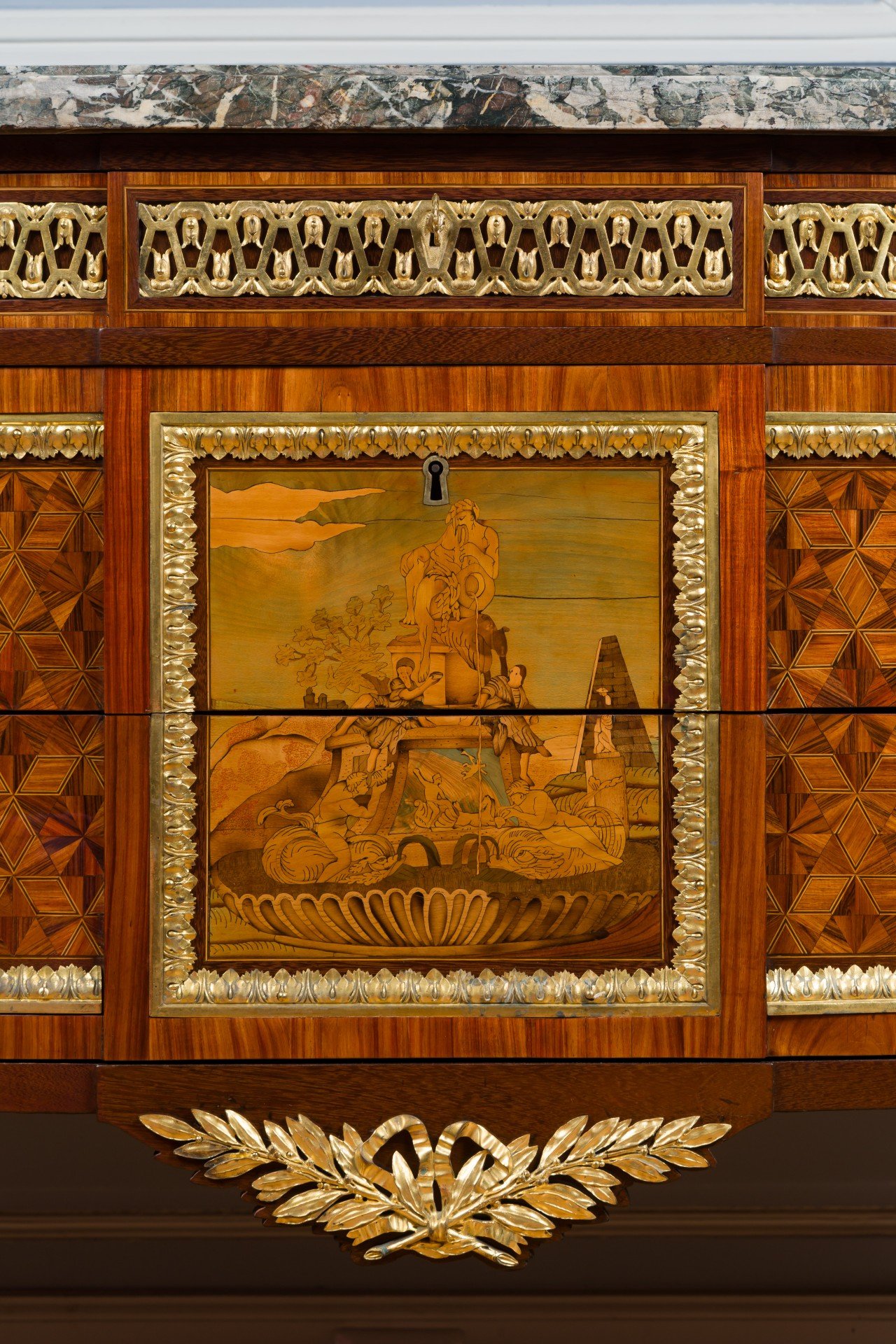
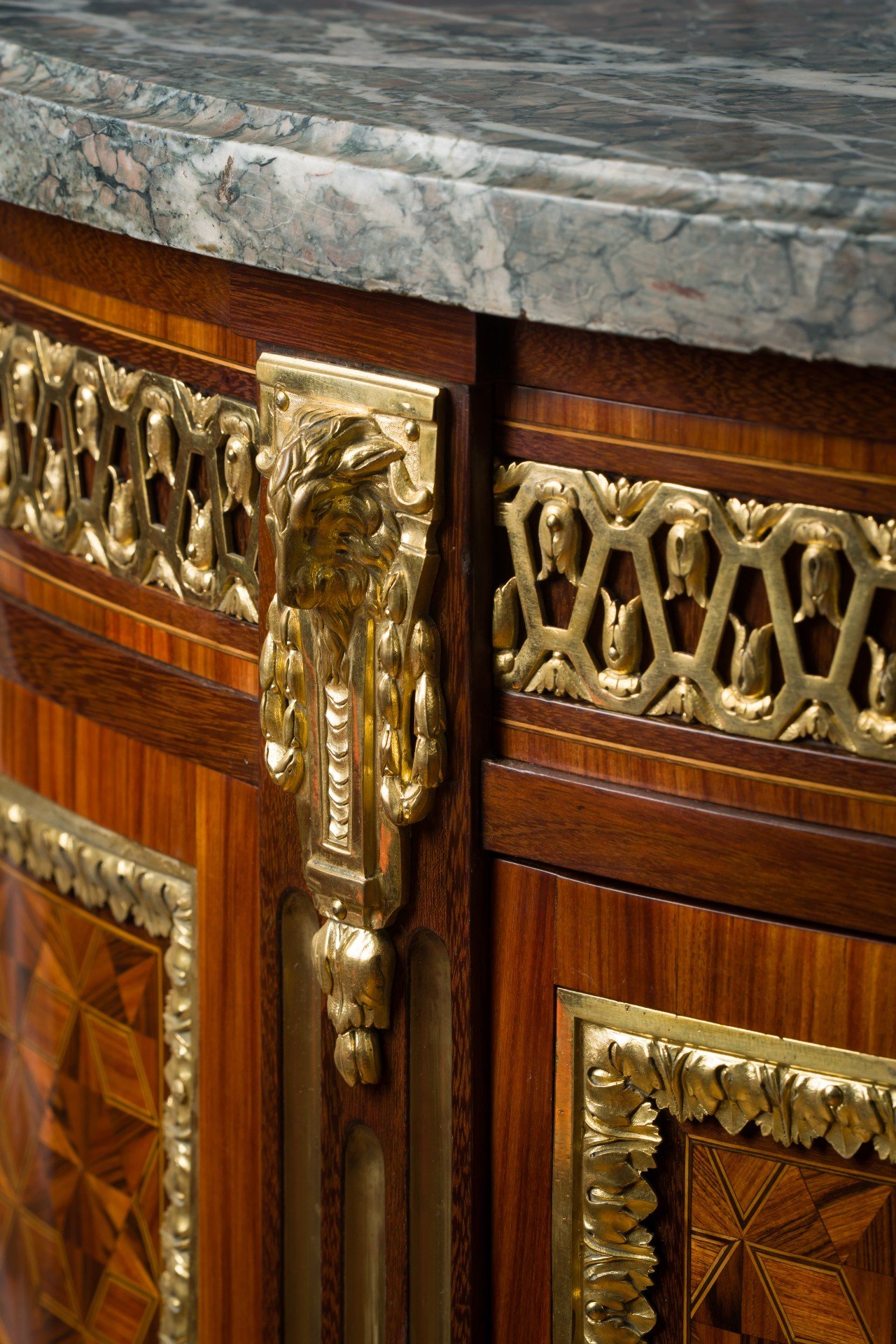
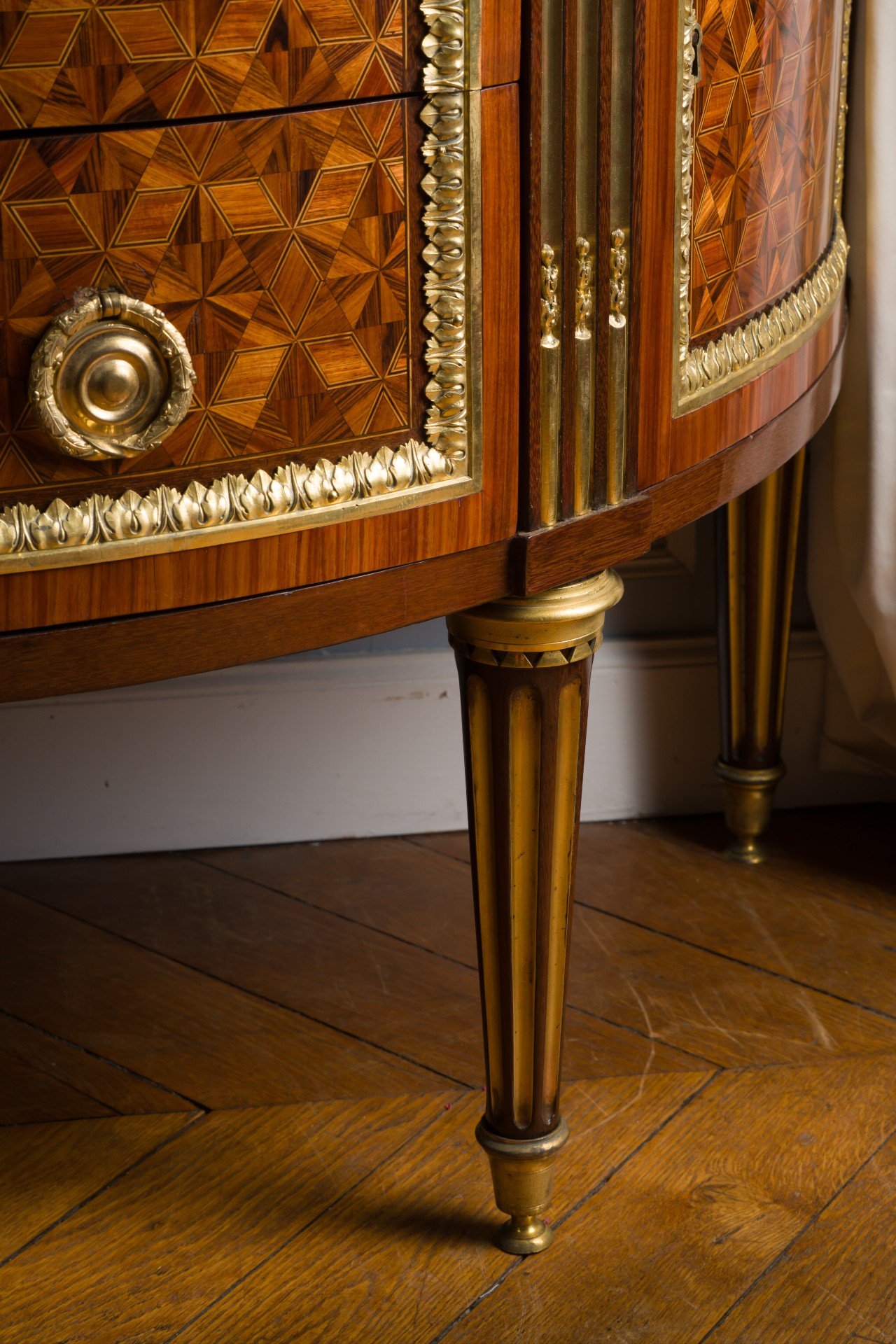
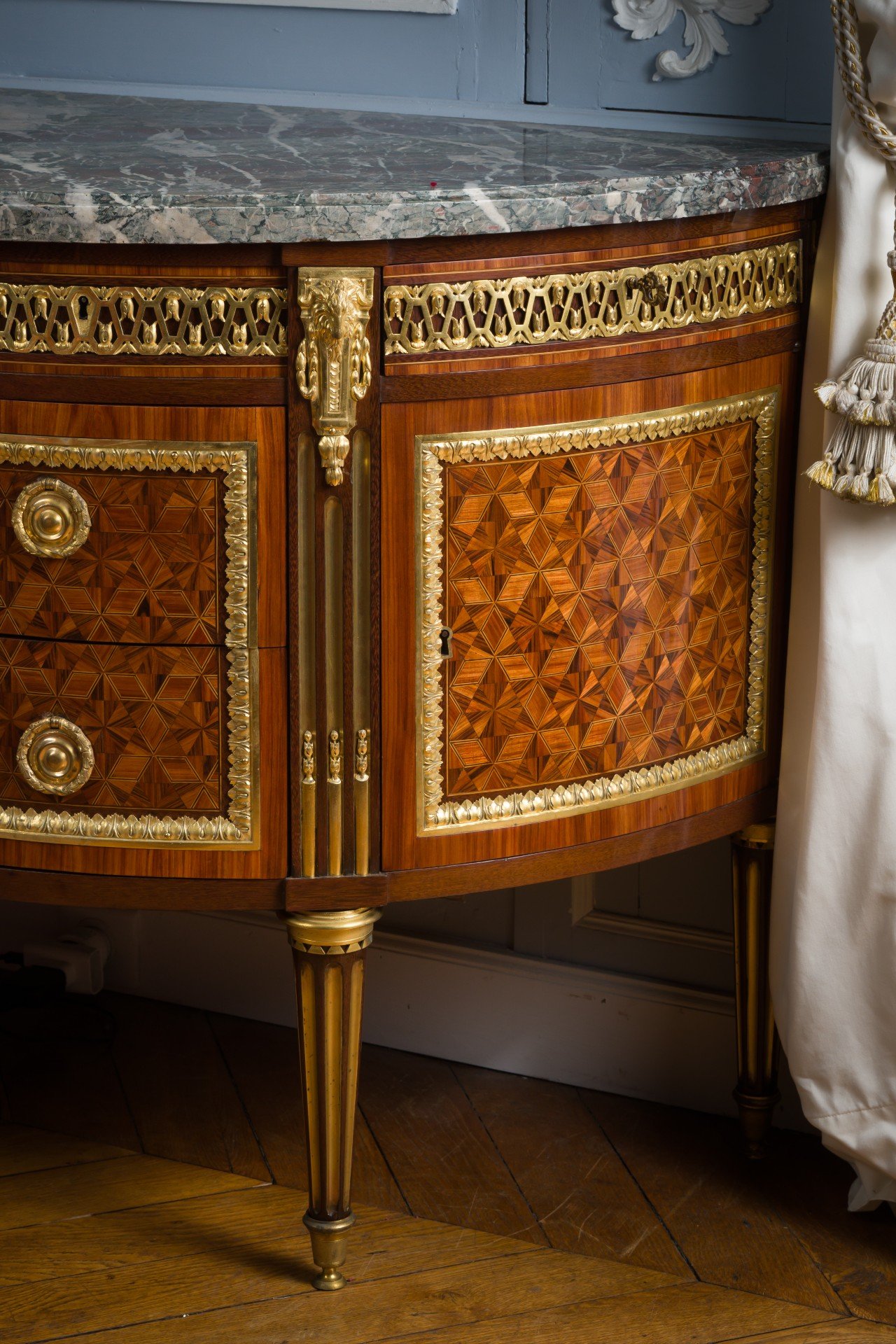
A half-moon commode in rosewood, violet wood, and amaranth marquetry. With a slight central projection, it opens to reveal two drawers without a central rail, three narrow drawers in the frieze, and sides with pivoting drawers and doors. It rests on four tapered, fluted legs. The decoration features geometric motifs with fillets, the central section depicting a mythological scene. The front is decorated with an antique scene representing Neptune on a fountain with conch shells, with the pyramid of Callius Cestius at Ostia (the port of Rome) in the background. Rich ornamentation of chased and gilded bronze mounts includes foliate friezes, water leaf moldings, branches, ram's head drops, fluting, and asparagus tips. The top is of banded Campan marble.
Louis XVI period
Usual restoration
Height 88 cm - Width 144 cm - Depth 58 cm
Our commode closely resembles another commode stamped RVLC and marked with a crowned C, sharing the same dimensions and similar decoration, both in marquetry and bronze mounts. It was sold at Drouot in December 2012 by Europ Auction. Ref.: Formerly in the SICHEL collection.
The crowned "C" likely points to a French royal commission and an inventory of a royal residence in Germany.
This uncatalogued mark resembles known French royal marks. We know of two commodes with similar marks: a mahogany commode bearing the mark of the Garde-Meuble Royal (Royal Furniture Repository) during the Restoration period, and a commode by J. F. Oeben also bearing an inventory number from the Garde-Meuble de la Couronne (Crown Furniture Repository). To date, only two commodes bear this branded letter and can be identified with the Garde-Meuble de la Couronne by their inventory numbers. The commode we are presenting here could be the third one belonging to the Crown Furniture Repository, if the number had not been erased.
Our commode is distinguished by its richer frieze and apron, as well as its Campan marble top, which is more elaborate. Similarly, the gilt-bronze mounts are more ornate on our commode.
Roger Vandercruse is among the most celebrated Parisian cabinetmakers of the 18th century.
He was the brother-in-law of Jean François Oeben and a contemporary of J. F. Leleu and Riesener.
He supplied the same clients at Court and among the Parisian aristocracy. Between 1769 and 1774, he delivered numerous pieces of furniture to the Crown Furniture Repository. RVLC's masterpieces are well represented in museums: the Louvre Museum, the Musée des Arts Décoratifs, and the Carnavalet Museum in Paris; the Victoria and Albert Museum in London; the Frick Collection in New York; and the Paul Getty Museum in Malibu. Furniture decorated with marquetry depicting scenes in the antique style is very rare.
Of particular note is the cylinder desk made for Pierre Augustin Caron de Beaumarchais, executed by Riesener or Leleu.
The influence of engravings by Jean-Laurent Legeay (circa 1710-1786) and the Fountain of the Four Rivers in Rome's Piazza Navona may have inspired RVLC or prompted the commission from the merchant-mercer for the commode we are presenting.
Of Flemish origin, this son of a free-spirited cabinetmaker, born in Paris in the Faubourg Saint-Antoine, integrated himself into the community from the outset and forged numerous alliances, notably with the cabinetmakers Jean-François Oeben and Jean-Henri Riesener, who were successively married to his elder sister, Françoise-Marguerite. He was also a close friend of the merchant Pierre Migeon, to whom he supplied numerous pieces of light furniture, and of the cabinetmaker Martin Carlin. He supplied merchants such as Poirier and Daguerre. In 1755, after his father's death, Lacroix decided to take over the latter's workshop on the rue du Faubourg Saint-Antoine. The high quality of his work and a particularly prolific output quickly brought him great renown. By 1769, through his colleague, the merchant Gilles Joubert, he was in charge of all court commissions. He thus supplied several pieces of furniture to royal residences, notably to the Countess of Provence and Madame Victoire. Within his guild, Lacroix held a respected position: a juror from 1768 to 1770, he was subsequently a syndic and a deputy in 1784. A leading specialist in decorative furniture, Lacroix distinguished himself with highly consistent Louis XV pieces of exceptional quality and a remarkable talent for marquetry. His style is recognizable by his marquetry of crosshatching and quatrefoils, known as "à la reine." He most often adorns his pieces with nuanced mosaics and small wooden panels, in the composition of which he brings taste and whimsy. His early work, during the Louis XV period, evolved with the attributes of the Transition era. At the end of Louis XV's reign, he was one of the first to create furniture in lemonwood inlaid with ebony. He also conceived decorations in monochrome, with floral designs or Chinese motifs. His commodes, almost all of a Transition style, most often consist of a rectangular body.
Ref: CLXR37D510
| Condition | As is |
| Style | Louis XVI (Chests Of Drawers of Louis XVI Style) |
| Period | 18th century (Chests Of Drawers 18th century) |
| Country of origin | France |
| Shipping Time | Ready to ship in 4-7 Business Days |
| Location | 78 000, Versailles, France |
4 commitments to buy with confidence

 English
 Français
 Italiano
 Deutsch