

Would you like more images?

André Masson (1896-1987)
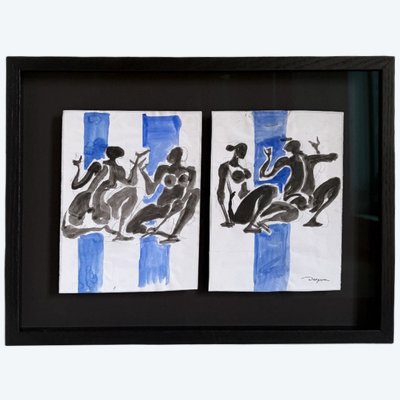
Portrait of Balzac, circa 1945
Ink on paper
14 x 16 cm
Provenance: artist's family
Certificate from the André Masson Committee
André Masson (1896-1987)
André Masson trained in painting from a very young age, studying at the Royal Academy of Brussels from 1907 to 1912, where he received a first prize in decoration. In 1912, he left Belgium and enrolled at the École des Beaux-Arts in Paris until April 1914. After a trip to Tuscany, he enlisted in the infantry. Severely wounded in the chest and for a time left for dead in a bomb crater, he stayed in various hospitals until the Armistice. Since the war, he retained a lifelong aversion to warmongering, which he expressed in several of his works, including *The Massacres*, in 1934.
After the conflict, Masson traveled to Collioure, following in the footsteps of Henri Matisse and André Derain, and finally to Céret, where he was influenced by both Paul Cézanne and Vincent van Gogh. He married Odette Cabalé and settled in Montmartre after the birth of their daughter.
His career truly began in 1922. While his works reflected his interest in Cubism, his contact with Miró, with whom he shared a studio, led him toward a quest for the irrational. He became close to Kahnweiler, exhibiting at his studio in February 1924 and selling all his works. The poet and writer André Breton was a pivotal figure in his career, demonstrating a keen interest in the theories of the unconscious developed by psychoanalysis. He joined the Surrealist group. In 1927, inspired by Breton's concept of automatic writing, Masson created his first "automatic drawings."
1929 was a year of ruptures: with his wife, with his first art dealer, Kahnweiler, whom he left for Paul Rosenberg, and with Breton, whom he considered dogmatic. He then forged a strong friendship with Georges Bataille, for whom he illustrated *Le Dossier de l'œil pinéal. L'anus solaire* in 1931. Reconnecting with Breton, he participated in the Surrealist exhibitions in London (1936) and Paris (1938), but until 1939, he continued his collaboration with Bataille on the journal *Acéphale*, for which he was the sole illustrator.
Masson arrived in the United States in May 1941. He initially settled in New York, where he reconnected with other European intellectuals and artists. His work inspired painters of abstract expressionism and gestural abstraction, such as Jackson Pollock.
Returning to France in October 1945, Masson designed the sets for Hamlet for the Renaud-Barrault Company and for Jean-Paul Sartre's The Respectful Prostitute. In 1950, he published The Pleasure of Painting. His style softened considerably, to the point that he showed an interest in Impressionism.
In 1954, Masson received the Grand Prix National des Arts, and in 1965, André Malraux commissioned him to decorate the ceiling of the Théâtre de l'Odéon. Several retrospectives were dedicated to him: in 1964 in Berlin, in 1965 in Amsterdam and Paris, in 1976 at the Museum of Modern Art in New York, and another the following year at the Grand Palais in Paris.
More than 90 of the artist's works are held at the Centre Pompidou, as well as at the Museum of Modern Art in New York, the Tate Gallery, and the Musée d'Art Moderne in Paris, among others.
Ref: IGVIRZP2SE
| Condition | Very good |
| Style | Modern Art (Drawings of Modern Art Style) |
| Period | 20th century (Drawings 20th century) |
| Country of origin | France |
| Artist | André Masson (1896-1987) |
| Internal reference | 1740216 |
| Shipping Time | Ready to ship in 4-7 Business Days |
| Location | 75008, Paris, France |
4 commitments to buy with confidence

 English
 Français
  Italiano
  Deutsch