This description has been translated and may not be completely accurate. Click here to see the original
René Gruau (1909-2004)
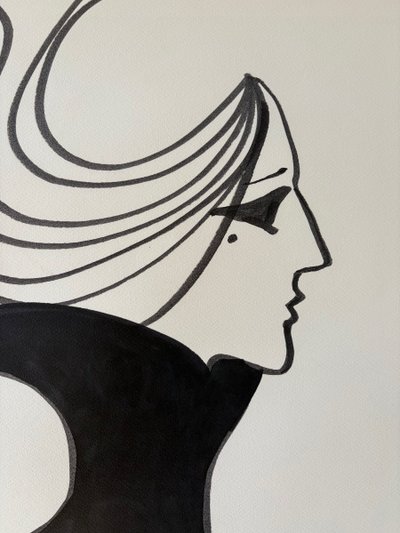
Woman in Profile, Homage to Aubrey Beardsley
Felt-tip pen on paper
Signed lower right
50 x 64 cm
Provenance: René Gruau Estate
René Gruau was born in 1909 in Rimini to an Italian father and a French mother, who gave him his artist name. When his parents separated, he was forced to work to earn a living. He gave up his dream of becoming an architect and began his career as a fashion illustrator in 1924. Self-taught, he took up fashion design at the age of 15, to which he devoted himself for several years: "As far back as I can remember, I always had a pencil in my hand; drawing was a real obsession, it was also the only thing I knew how to do." So I tried my hand at illustrating stories and book covers, mustered my courage, and went to show them to the editors of the magazines and journals I knew.
Gruau settled in Paris in 1928 and began working for magazines like Le Figaro and the hat magazine Marianne. Around this time, he met the young Christian Dior, with whom he became friends. His collaborations with women's magazines multiplied: Gruau illustrated, among others, Vogue, Fémina, Marie-Claire, Silhouettes, and L’Officiel de la Couture. For these publications, he designed, among others, the creations of Balenciaga, Fath, Piguet, Givenchy, Molyneux, and Rochas. For several years, René Gruau devoted himself to fashion illustration, inspired in particular by the creations of his two friends, Christian Dior and Jacques Fath. In 1947, he turned to advertising and created one of his first advertising illustrations for the Miss Dior perfume. Ten more perfume creations followed, including Diorama, Diorissimo, and Eau Sauvage.
Christian Dior gave Gruau free rein, granting him complete artistic freedom in his advertising creations: the artist flourished. He devoted himself increasingly to advertising as fashion magazines began to feature photography more prominently. He created numerous campaigns in the fields of perfumery, fashion, and cosmetics, constantly reinventing French elegance. To achieve this, Gruau explained: “I sometimes make 30 sketches before arriving at the final drawing; first, fantasy sketches, then framing sketches, then I take a model and start sketching from the model… In short, it’s a very complex process.”
On this subject, Fabienne Falluel explains: “His work begins with ‘primary sketches,’ research intended to establish the core idea.” René Gruau describes this stage as "preliminary." He makes about ten sketches, either with a 6B pencil, the softest lead which allows for great flexibility and therefore increased speed, or with charcoal, which he can then erase with his finger or rework. At this stage, both techniques, pencil and charcoal, are used equally. Next comes the "sketch from life": the presence of a model allows him to solidify the movement and form, and to visualize the basic idea. This moment, according to René Gruau, is "intensely tense" and requires great physical effort, leading to rest. These are most often black and white sketches. After the factual drawing, René Gruau reveals: "I let my imagination run wild." On drawing paper, sometimes Canson paper, most often white, he begins the execution with India ink, gouache, or watercolor. The final stage comes only after this long quest and takes shape on heavy Canson paper or cardboard, becoming "the drawing," which is then reproduced in print.
In 1949, René Gruau created his first poster for Rouge Baiser, a lipstick developed by Paul Baudecroux in 1927. He subsequently explored the theme further, creating several advertisements. His drawings consistently evoke a refined woman, both elegant and sensual: "The sense of elegance, as we know, is meant to be lost," says Patrick Mauriès, "and Gruau's images always bear witness, in one of their facets, to a lost world—a world that suits them so perfectly that they bear, as one might have said in the Middle Ages, its 'signature.'"
The advertising drawings for Rouge Baiser have become iconic and unforgettable. Gruau also designed numerous advertising posters for perfumes and cosmetics such as Balmain, Jacques Griffe, Lucien Lelong, Jacques Fath, Elizabeth Arden, Payot, Peggy Sage, and Givenchy. For several seasons, the artist was responsible for the advertising campaigns of the legendary Parisian cabarets, the Lido and the Moulin Rouge. In 1961, he also designed the costumes and sets for an operetta, La Belle de Paris, staged at the Opéra-Comique.
Gruau's drawing style is perfectly in keeping with his era, which made...
Ref: HQ742G63NN

 English
 Français
  Italiano
  Deutsch
  Light stand, 17th century.
1.200 € EUR
Light stand, 17th century.
1.200 € EUR