




Would you like more images?

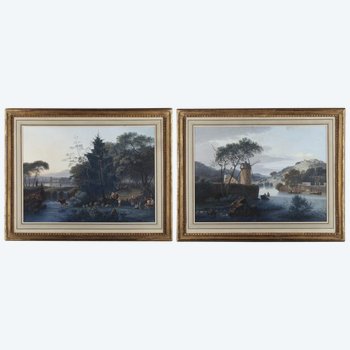
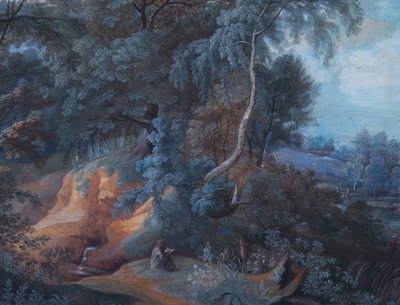
Gouache on paper – Lively pastoral landscape
French School, late 18th century
Circle of Jean-Baptiste Pillement
This delicate gouache on paper belongs to the tradition of 18th-century pastoral landscapes and can be associated with the circle of Jean-Baptiste Pillement (1728–1808), a major figure in European ornamental landscape painting.
The composition presents a bucolic scene typical of the late Rococo style: a path winding through abundant vegetation, slender trees with delicate foliage, and a solitary figure in the foreground, inviting contemplation. In the background, a river and a gently rolling horizon open up the perspective, creating a soft and luminous atmosphere. The whole evokes a sense of harmony and idealized nature, characteristic of 18th-century landscape painting.
The treatment of the foliage, the fluidity of the lines, and the subtle palette of greens, blues, and ochres directly recall the aesthetic developed by Pillement and his followers. The gouache technique, prized for its finesse and decorative qualities, was widely used for this type of scene intended for an aristocratic or bourgeois clientele. A traveling painter, Jean-Baptiste Pillement left his mark on his era by disseminating an immediately recognizable style, blending French, Italian, and sometimes Chinese influences (in his famous chinoiserie). Trained in the Rococo tradition, he worked in Paris, then stayed in London, Lisbon, Vienna, and Warsaw, contributing to the spread of ornamental landscape painting throughout Europe. His work is characterized by free compositions, imaginary follies, and a stylized and poetic nature, often populated by small figures.
The work presented here testifies to this influence and can be attributed to an artist from his circle or a close follower, active at the end of the 18th century or in the early years of the 19th century. It perfectly illustrates the taste for decorative landscapes, both elegant and evocative, which enjoyed great success on the eve of Neoclassicism.
Dimensions:
Image size: 33 × 27 cm
Framed size: 44 × 38 cm
Ref: NP605ARMYR
| Condition | Very good |
| Style | Louis XVI (Gouaches of Louis XVI Style) |
| Period | 18th century (Gouaches 18th century) |
| Country of origin | France |
| Artist | entourage Pillement |
| Length (cm) | 33 |
| Width (cm) | 27 |
| Shipping Time | Ready to ship in 4-7 Business Days |
| Location | 60270, GOUVIEUX, France |
4 commitments to buy with confidence

 English
 Français
  Italiano
  Deutsch