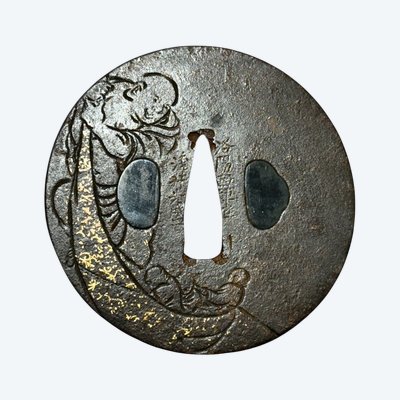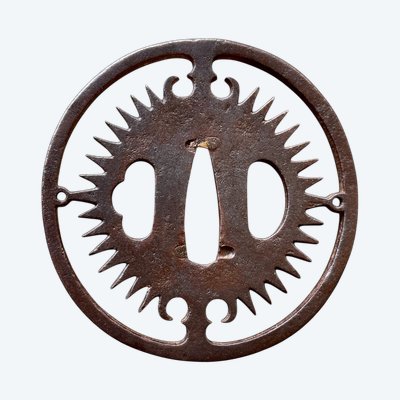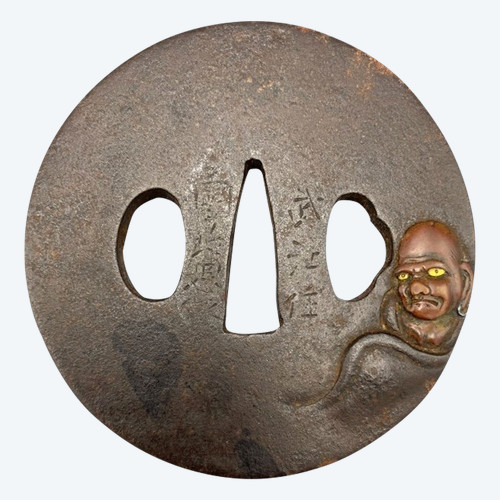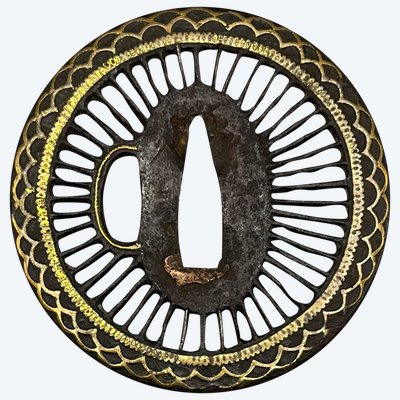
Shape: Maru-gata (round)
Dimensions: 64mm (H) × 60mm (W) × approx. 4 mm (thickness)
Weight: 91 g
Material: Wrought iron (tetsu)
Decoration: Nanako-ji background (regular punched granulation) on both sides
Openings: Nakago-ana (central hole), kogai-ana and kozuka-ana on the sides
Patina: Brown, homogeneous, with traces of old wear
Inscriptions (mei 銘 and kao 花押)
Engraving on the ura (inner face): 鉄元堂 (Tetsugendō)
Small square gilt seal (花押 / kao): stylized workshop signature
School: Tetsugendō (鉄元堂派)
Master: Workshop of Tetsugendō Shōraku II (鉄元堂松楽) (Introduced)
Place of production: Edo (present-day Tokyo), Japan
Period: Late Edo period – circa 1850
The Tetsugendō school, founded by Tetsugendō Shōraku (active circa 1780–1820), is distinguished by the simplicity and technical perfection of its ironwork.
Tsuba from this school are characterized by:
an extremely regular nanako surface,
a near-total absence of figurative decoration,
and a Zen aesthetic, centered on the mastery of the material.
These pieces were prized by the scholar-samurai of the late Edo period and, during the Meiji era, by Western collectors.
Manufacturing process: hand-forging of iron, cutting, filing, and fine chiseling with a punch (nanako-ji).
Finish: black ferruginous patina, inlaid gold seal (kin-in 金印).
Assembly: no alloys added; decoration achieved solely through hammering and engraving.
Ref: E7WT9F2KDD
| Style | Asian Arts (Swords, Bladed weapons of Asian Arts Style) |
| Period | 19th century (Swords, Bladed weapons 19th century) |
| Country of origin | Japan |
| Diameter (cm) | 6.4 |
| Shipping Time | Ready to ship in 2-3 Business Days |
| Location | 93400, saint ouen , France |
4 commitments to buy with confidence

 English
 Français
  Italiano
  Deutsch