This description has been translated and may not be completely accurate. Click here to see the original
Oil on canvas, mounted on a wooden panel
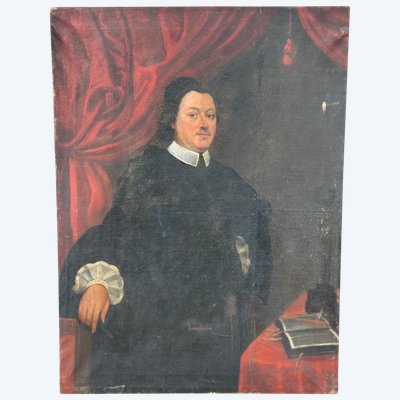
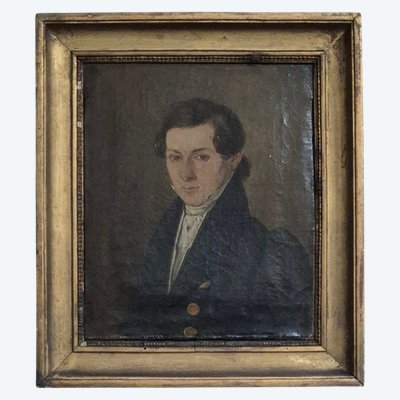
This portrait depicts a member of the secular clergy, likely active in the Southern Netherlands or northern France during the first third of the 19th century.
The sitter wears the traditional black buttoned cassock and white collar, vestments still common in ecclesiastical circles during the 1820s and 1830s, despite the changes in dress that occurred after the French Revolution.
This adherence to earlier customs is particularly evident among teaching priests, canons, and choirmasters.
The cleric is seated in an armchair upholstered in red velvet, holding a small bound book in his left hand. To his right, an open musical score and a stringed instrument—a cello or a late bass viol—clearly establish the sitter's connection to musical practice.
During this period, many clergymen still taught singing, directed choirs, and copied musical scores for worship.
The combined presence of the book, the score, and the instrument thus reflects the musical and literary culture of the Restoration clergy.
The setting includes a mahogany cabinet whose console-shaped uprights, combined with simple molding, correspond to French and Belgian production of the 1820s and 1830s.
This piece of furniture provides a reliable stylistic marker for dating the painting to the first third of the 19th century. The green drapery, the sketched bookcase, and the ordered composition extend the iconographic patterns of the portrait of a cultured cleric, perpetuated in provincial Neoclassical painting after 1820.
The face, rendered with calm modeling and even lighting, illustrates the continued academic style inherited from the 18th century, still practiced in religious circles at the time. This combination of traditional elements and more recent stylistic features supports a dating to around 1830.
The canvas, exhibiting regular craquelure, was relined onto a wooden panel several decades ago. This restoration technique, quite common in the 20th century, ensures the overall stability of the work.
Good overall condition. Later blackened and gilded wood frame, 20th century.
Sight dimensions: 145 × 107 cm
Frame dimensions: 158 × 120 cm
Ref: SQAM8TBDVO

 English
 Français
  Italiano
  Deutsch
  XXth century system tables
1.600 € EUR
XXth century system tables
1.600 € EUR