








Would you like more images?

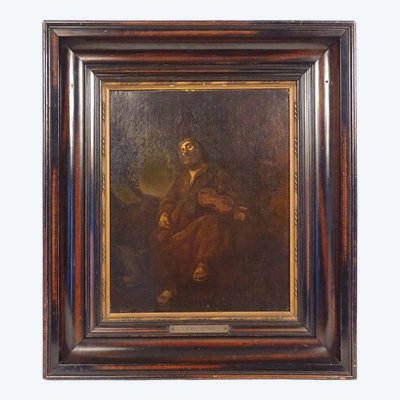
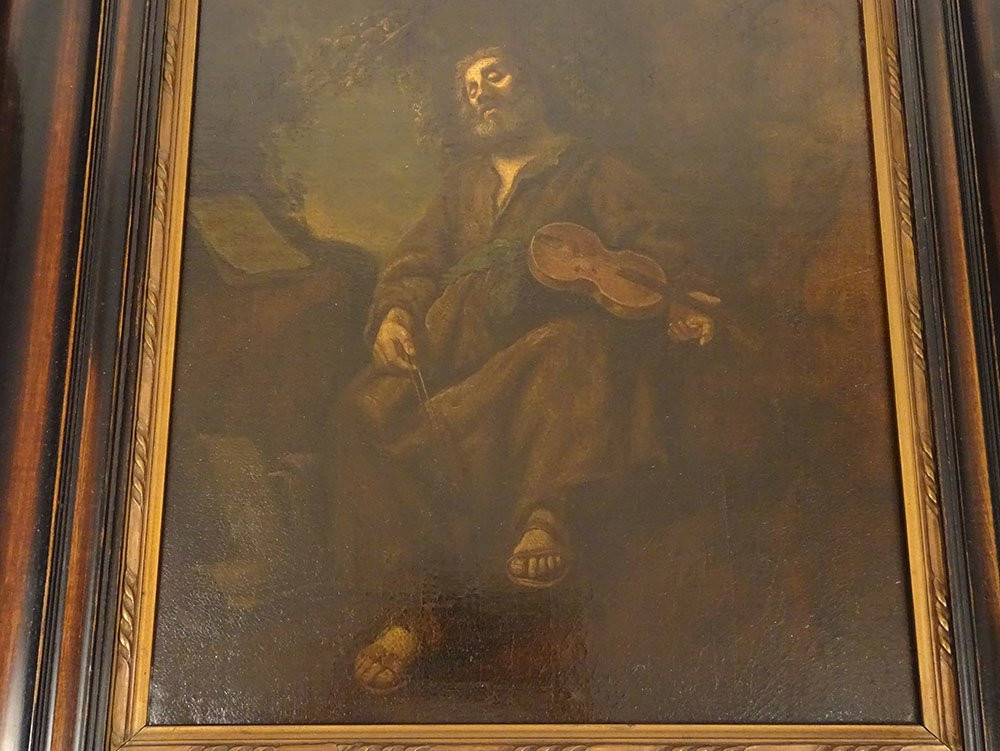
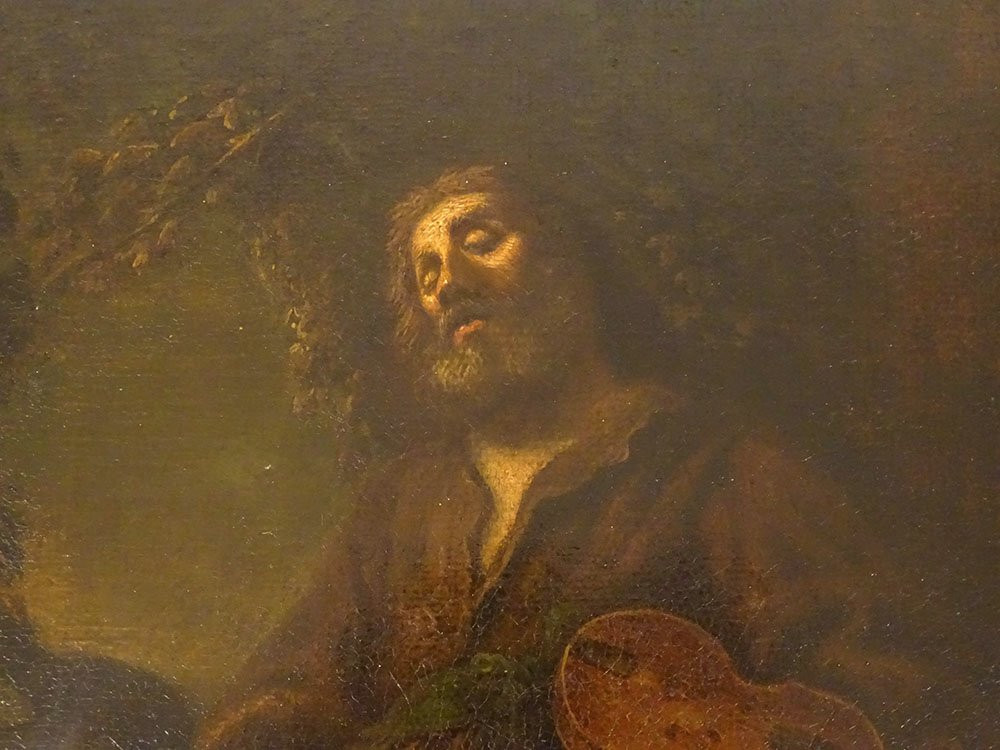
A rare oil-on-canvas painting by Jan de Bray* (1627–1697) depicting a hermit monk (whose features resemble those of Christ) dozing, still holding his bow and violin in his hands, his sheet music and documents beside him or at his feet, set in a chiaroscuro landscape of a forest clearing; dealer’s label on the back; from the Dutch Golden Age, 17th century.
This painting is in good condition. There may be a trace of a signature in the lower left corner (very difficult to see—see last photo). The frame was added later and features a plaque identifying the painter. This canvas was re-stretched in the past. The stretcher is marked “Jan de Bray.” Original label from the American art dealer Curtis M. Moyer** on the back. This painting was therefore exhibited by this dealer in his gallery in the United States in the late 19th–early 20th centuries.
Please note: minor imperfections on the frame, signs of age; see photos.
This painting fits perfectly within the style of the 17th-century Dutch school, particularly certain works by Rembrandt himself, in its depiction of an old man presented in a chiaroscuro or even tenebrist scene (for example, “Old Hermit Reading” (after 1630, Louvre Museum) or “Saint Paul Seated at His Writing Desk” (c. 1629–1630, Nuremberg, Germanisches Nationalmuseum).
It is worth noting that a painting with the same composition, inspired by this one, was painted by Vien in 1750, as the religious theme of the hermit remained popular in the 18th century.
* Jan de Bray or Jan de Braij (c. 1627, Haarlem – 1697, Amsterdam)
was a Dutch portrait painter of the Golden Age. Jan de Bray was introduced to painting by his father, Salomon de Bray, a poet and architect. His mother, Anna Westerbaen, was the sister of the painter Jan Westerbaen and the poet Jacob Westerbaen. His brother Dirck de Bray, also a painter who specialized in still lifes, became a monk at the Gaesdonck monastery near Goch. His other brother, Joseph, was also a painter, and his sister, Cornelia, married the painter Jan Lievens. He was influenced by his father, Salomon, and by the painters Bartholomeus van der Helst and Frans Hals. He spent most of his career as a painter in Haarlem, where he served as dean of the Guild of Saint Luke. He narrowly escaped death on several occasions during his lifetime. Part of his family perished in the plague. His three wives died shortly after marrying Jan; his second wife bore him a son, Johan Lucas de Bray. In 1689, he declared bankruptcy as a citizen of Haarlem and was forced to move to Amsterdam, where he remained until his death around April 1, 1697. He was buried on April 4, 1697, in Haarlem. He painted historical paintings influenced by his father’s art and, above all, portraits—both individual and group portraits—in a noble and delicate style (Regents and Regentesses of the Orphanage and Leprosarium of Haarlem, 1663–1667).
Many of this painter’s works are currently housed in national museums, for example:
Portrait of his mother, 1657, at the National Gallery in London
Judith and Holofernes, 1659, at the Rijksmuseum in Amsterdam
Portrait of a Young Woman, c. 1665, at the Museum of Fine Arts in Ghent
Allegorical Family Portrait, 1670, at the Hermitage Museum in Saint Petersburg
Highly rated artist on ArtPrice
** Curtis M. Moyer,
American art dealer (died in 1939). In the mid-1890s, he opened his art gallery at 105 Pratt Street in Hartford, Connecticut. There, he exhibited works by living artists of his time but also organized exhibitions of Old Masters. Member of St. John’s Lodge, AF&AM. (See obituary in the Hartford Courant dated October 11, 1939).
PLEASE NOTE: FOR A SHIPPING QUOTE, PLEASE CONTACT US WITH THE DESTINATION CITY AND COUNTRY.
BE CAREFUL: PLEASE CONTACT US FOR THE SHIPPING COST.
Dimensions
Frame 51 cm x 59 cm
Oil on canvas 33 cm x 40 cm
Reference: 900 788
All photos are available at:
www.antiques-delaval.com
Ref: ZPEO482SR8
| Condition | Good |
| Style | Other style (Religious paintings of Other style Style) |
| Period | 17th century (Religious paintings 17th century) |
| Country of origin | France |
| Artist | Jan de Bray |
| Internal reference | 900 788 |
| Shipping Time | Ready to ship in 8-15 Business Days |
| Location | 22220, Tréguier, France |
4 commitments to buy with confidence

 English
 Français
  Italiano
  Deutsch