This description has been translated and may not be completely accurate. Click here to see the original
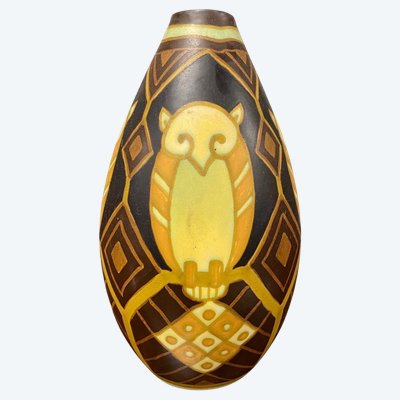
Elegant Art Deco ovoid stoneware vase with a matte glaze and stylized floral and plant motifs in rectangular reserves, circa 1920 (rare decoration).
Charles CATTEAU (1880-1966), BOCH KERAMIS La LOUVIERE (Belgium)
The outlines of the decoration are slightly incised into the stone, subtly giving the piece a delicate relief. The color palette, as is often the case in this type of production, is also restrained and refined, in neutral tones ranging from light brown to white and pale green to khaki.
The vase bears the underglaze mark "BOCH FRES LA LOUVIERE, MADE IN BELGIUM, FABRICATION BELGE" and the mark D.668, corresponding to its type of decoration: "polychrome decoration of stylized dahlias and leaves." This same decoration was thus duplicated on a custom basis in various forms.
Biography
Charles Crépin Nicolas Catteau was born on January 26, 1880, in Douai, to a Belgian father and a French mother. After training as a ceramic engineer at the Sèvres National Porcelain Manufactory—which would later become the École Nationale Supérieure de Céramique Industrielle—where he worked for two years, he left in 1904 for Germany, to the Nymphenburg porcelain factory near Munich. There, he was recruited by Boch Frères, who were looking to revitalize production at their Boch-Kéramis factory in La Louvière, Belgium. In 1907, he took over the management of the decoration workshop, a position he held until his retirement in 1946. He worked with all materials and experimented with all styles (Japanese, African, figurative, Cubist, etc.). In 1908, he founded the artistic circle Les Amis de l'Art in La Louvière. Charles Catteau achieved success, gaining international recognition at the 1925 International Exhibition of Modern Decorative and Industrial Arts in Paris, where he won a Grand Prix. In 1929, he exhibited the paintings Porte de Bourgogne and Aux bords du Loing at the Salon des Artistes Français. He left behind numerous vases, including renowned stoneware pieces with stylized motifs drawn from flora and fauna. After the Second World War, Charles Catteau retired to Nice on the French Riviera.
Catteau is sometimes considered more of a ceramic designer than an artist. Trained during the Art Nouveau period, he was sensitive to the idea that art should be accessible to all and enhance everyday life, something made possible by the industrialization of the 1920s and 1930s. He is one of the great designers of Art Deco, or at least one of the greatest ceramicists of this style.
Ref: 3IXWM69UM1