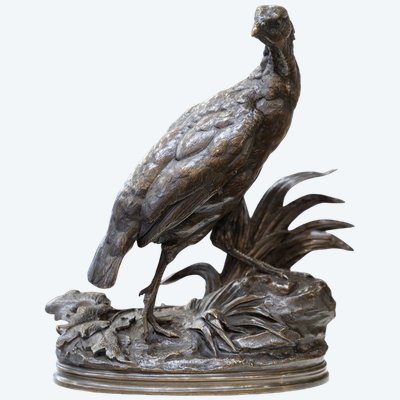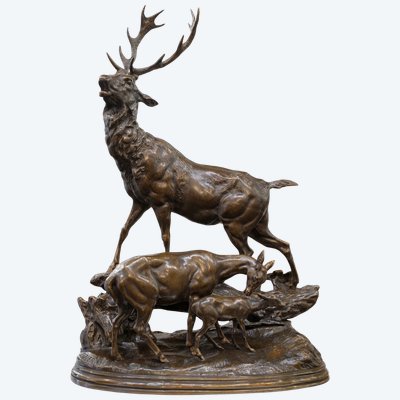
SCULPTURE - RECLINING DOE , ANTOINE-LOUIS BARYE (1795–1875) - BRONZE
slider-bg
more images

Would you like more images?

SCULPTURE - RECLINING DOE , ANTOINE-LOUIS BARYE (1795–1875) - BRONZE

19th century
Second Empire style, Napoleon III style
DELIVERY
From: 93400, Saint-Ouen-sur-Seine, France

Change your address to get an accurate estimate of shipping costs.

    Item offered for sale by

    See the gallery
    This description has been translated and may not be completely accurate. Click here to see the original
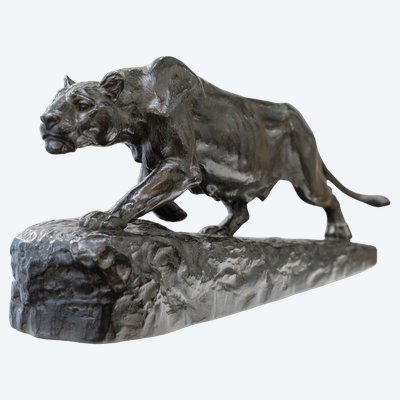
    A bronze cast with a brown patina , depicting a resting doe titled "Reclining Doe", by the animal sculptor Antoine-Louis Barye (1795–1875) .
    The doe is depicted in a moment of calm and serenity .
    The precision of the details reflects the sculptor’s careful observation of his subject .
    The delicately sculpted muscles and the texture of the coat attest to exceptional craftsmanship and a deep understanding of animal anatomy .
    Antoine-Louis Barye elegantly illustrates the workings of nature and the beauty of animal forms .
    The "Reclining Doe" embodies the sculptor’s passion for wildlife and his desire to bring art closer to the wild , thereby contributing to the emergence of animalism in 19th-century art .
    A rare sculpture from an early edition , dating from the second half of the 19th century .
    The sculptor’s signature "BARYE" is incised , on the richly chiseled naturalistic pedestal .
    In perfect condition with excellent patina .

    Dimensions : 6.5 cm x 10.1 cm x 5.2 cm

    Antoine - Louis Barye (1795–1875)

    Famous for his animal sculptures , Antoine-Louis Barye is a silversmith's son , who is trained in metalwork with a military equipment manufacturer and Jacques - Henri Fauconnier.

    In 1818 , he entered the Paris School of Fine Arts and apprenticed in the studio of sculptor François Joseph Bosio and painter Jean-Antoine Gros .
    After several failures at theThe Grand Prix of Rome , Antoine-Louis Barye slammed the door of the Fine Arts in 1825 .
    He then turned to animal sculpture which he would bring back up to date .
    With his friend Delacroix , he goes regularly to the menagerie of the Natural History Museum to study and observe animals .

    It was in 1831 that Barye made himself known to the general public by exhibiting "The Tiger Devouring a Gavial" at the Salon , a work staging a violent fight "of impressive virtuosity".
    Two years later , he triumphed with "The Lion and the Snake" (plaster) , which was also successfully exhibited in its bronze version at the Salon of 1836 .
    Preferring bronze to marble considered too cold , the artist multiplied statuettes and small groups animals,that he melts and chisels himself .

    Antoine - Louis Barye died at the age of 80 , leaving behind an important production of drawings , watercolors and paintings as well as sculptures , pieces of goldsmith's work .
    His works can be seen at the Louvre Museum and Orsay Museum .

    Ref: D0MA4M7079

    Condition As new
    Style Second Empire style, Napoleon III style (Animal sculptures bronzes of Second Empire style, Napoleon III style Style)
    Period 19th century (Animal sculptures bronzes 19th century)
    Country of origin France
    Artist ANTOINE - LOUIS BARYE (1795-1875)
    Width (cm) 10.1
    Height (cm) 6.5
    Depth (cm) 5.2
    Materials Bronze, Patinated Bronze
    Shipping Time Ready to ship in 2-3 Business Days
    Location 93400, Saint-Ouen-sur-Seine, France
    Antikeo Buyer Guarantee

    4 commitments to buy with confidence