This description has been translated and may not be completely accurate. Click here to see the original
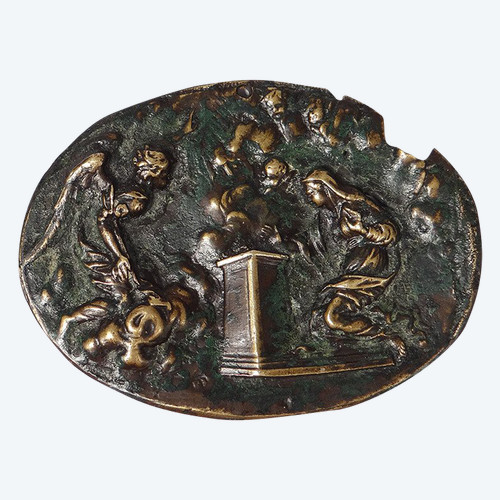
A rare ivory plaque, remarkably carved in very low relief, depicting a mythological scene from ancient Greece: the death of Hippolytus. Beautiful patina on the ivory.
France, 18th century.
Dimensions: 5.8×8.5 cm.
Weight: 25.5 g. (Surface wear).
Provenance: Collection of M.R., former antique dealer.
Hippolytus, son of Theseus and an Amazon queen, is a fervent worshipper of the virgin goddess Diana and despises the cult of Venus, goddess of love. To take revenge for this disdain, Venus strikes his stepmother, Phaedra, with passion. Consumed by guilty love, Phaedra attempts to seduce Hippolytus, who, faithful to his vows of chastity, violently rejects her. Humiliated, she commits suicide, leaving a letter in which she falsely accuses Hippolytus of raping her.
Theseus, discovering the letter and his wife's body, is mad with rage and uses one of his three divine blessings, granted by his father Neptune, to curse his son. As Hippolytus drives his chariot along the shore, Neptune sends a monstrous bull out of the waves. The frightened horses bolt and the chariot breaks apart. Hippolyta becomes entangled in the reins and is dragged over rocks and through brambles until her body is completely torn apart.
Ovid adds an ending specific to his version of the myth: grief-stricken, the goddess Diana goes to the god of medicine, Aesculapius, and persuades him to bring Hippolyta back to life. To protect him from the wrath of the other gods, particularly Jupiter, Diana hides him in the woods of Aricia in Italy, under a new identity: Virbius, the “twice man.”
The details of the mythological scene depicted here are remarkable: Hippolyta is shown lying on the ground, while in the distance a dog can be seen continuing the hunt by chasing a wild boar. Descending from the heavens, the goddess Diana intervenes. On the right, a small winged Cupid or Eros observes the scene with a sad and devastated expression. This plaque will delight lovers of 18th-century French art as well as fans of ancient myths. This type of piece is also rare on the market.
Legal ivory sold with its CITES certificate in accordance with current legislation!
Ref: FWGESJACZF



 English
 Français
 Italiano
 Deutsch