This description has been translated and may not be completely accurate. Click here to see the original
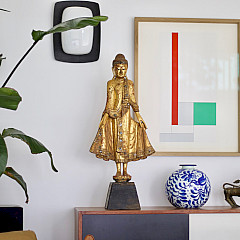
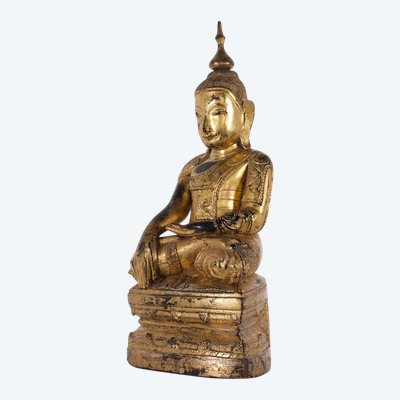
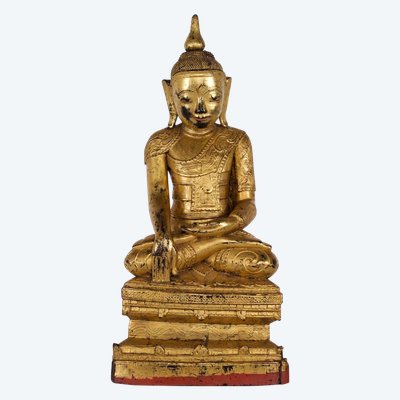
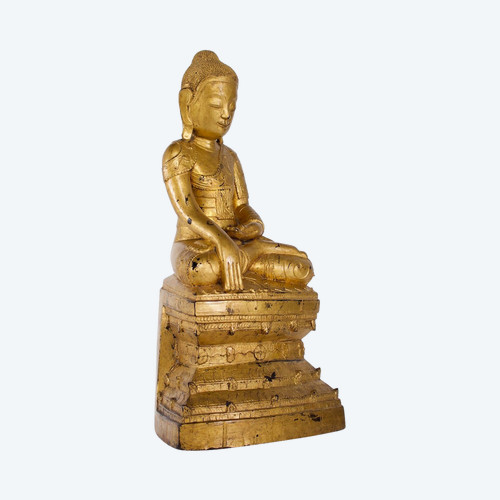
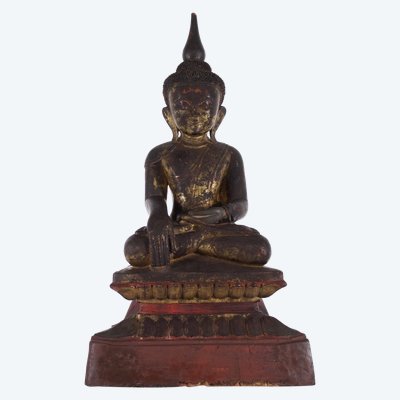
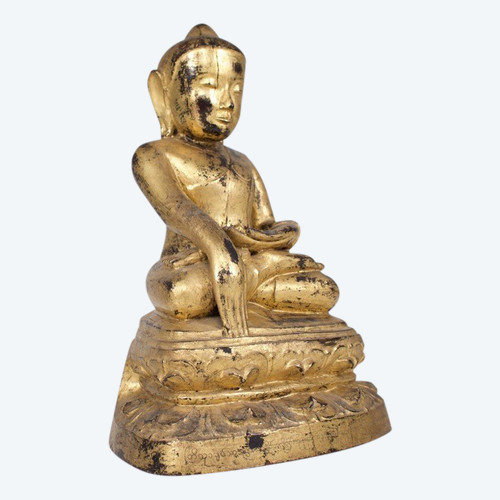
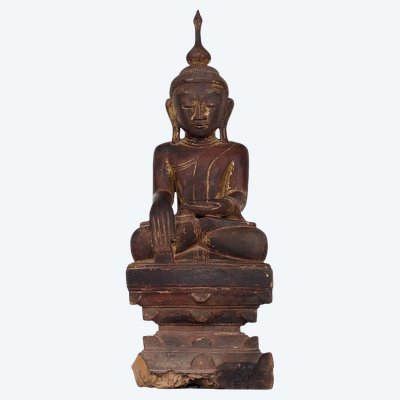
Imposing Maravijaya Buddha in carved wood, covered with wine-red lacquer and gilding.
Burma (Myanmar), Shan princely states, Konbaung period (1752-1885).
He is depicted in vajrāsana, seated on a stylized double lotiform base. His right hand is touching the earth to call upon his goddess to bear witness to his victory over Māra, lord of illusions and obstacles, and to attain enlightenment.
The sculpture, perfectly preserved in its entirety, features particularly refined ornamentation. The back of the throne, adorned with a double register of lotus petals, reveals the open reliquary cavity.
The ushnisha flame is adjacent to this piece.
H 89 cm x W 38 cm x D 27 cm
Weight: 16.58 kg
Provenance: Estate of Claude de Marteau
Sold with certificate of provenance
In Theravāda iconography, the bhumusparsha mudra position is omnipresent, particularly in Burmese and Thai statues. Buddha is depicted in a meditative posture, legs crossed in the lotus position, his left hand resting on his knees in a gesture of concentration, while his right hand touches the ground with its fingertips. This gesture evokes the moment when Siddhārtha Gautama, faced with the onslaught of the demon Māra, invokes the earth as witness to his merits accumulated over the course of his past lives. According to tradition, the earth itself responds by unleashing a flood that sweeps away Māra's forces, thus sealing the Buddha's victory over delusion and his access to enlightenment.
In Thailand, this posture is particularly associated with the iconography of Sukhothai and Rattanakosin-style Buddhas, where it is often depicted with slender forms and a serene expression, accentuating the idea of transcendence and spiritual purity. In Burma, notably in the Mandalay and Konbaung styles, the same posture is ubiquitous, but statues often feature a more rounded, benevolent face, with meticulous details on the folds of the garment and the ornamentation of the base.
This iconography expresses a fundamental aspect of Theravāda Buddhism: the importance of the pāramī (perfections) accumulated by the Buddha through his previous lives and the primacy of karma in the path to enlightenment. Unlike the Mahāyāna and Vajrayāna traditions, where Buddha is often depicted in transcendent forms or adorned with esoteric symbols, Theravāda favors a pared-down, didactic approach, centered on the historical example of Gautama Buddha. In this way, the posture of taking the earth as witness becomes a constant reminder to devotees of the power of merit and the determination required to attain liberation.
See this Maravijaya Burmese Buddha Konbaung Epoque in full screen mode on Vintage Addict
Ref: 9XTQF3UMJT

 English
 Français
  Italiano
  Deutsch
  Oak sideboard, 1950
1.100 € EUR
Oak sideboard, 1950
1.100 € EUR