This description has been translated and may not be completely accurate. Click here to see the original
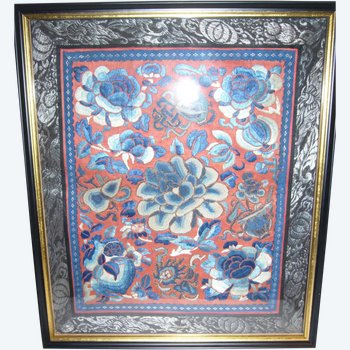
IMPORTANT CHINESE GOLD AND SILVER THREAD EMBROIDERY ON FABRIC, circa 1880
This precious embroidered fabric is composed of two parts and was usually hung from the back of a throne. Originally, these were large brocaded silk embroideries, decorated with gold and silver threads, intended to adorn doors, thrones or altars.
The Chinese Empire was the first to cultivate the silkworm, giving its name to the Silk Road, which linked China to the West. It owed its name to silk, an important commodity traded along its route. These rich Chinese embroideries were also adopted by the Peranakan, the first Chinese immigrants to the British colonies in the Straits of Malacca, Penang and Singapore.
The term Peranakan dates back to the 15th century and refers to people born of marriages between Chinese merchants and Malay, Burmese or Indonesian women, who had partially adopted Malay customs to integrate into local communities. Under British rule, they gained considerable influence in the Straits colonies and were even dubbed the "King's Chinese".
The Peranakan Museum houses a number of altar decorations, usually made in batik. The tablecloths hanging from the front of an altar table are called tok wi. Tok wi batiks were probably a cheaper alternative to embroidered silk fabrics imported from China. Tok wi is the Malay Baba term for a cloth attached to the front of altars for important occasions such as weddings, funerals and festivals.
The Chinese term for tok wi is zhuoqun, or altar skirt.
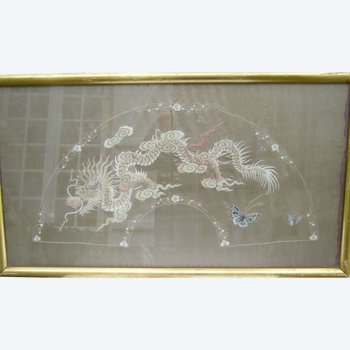
This magnificent example of decoration features two characteristic sections: in the upper part, on a brown background, two magnificent phoenixes in flight, separated by a lotus flower.
The refined white border is adorned with tiny blue clouds, framing the border of flying bats and peonies.
In the lower part, in red, three five-clawed dragons fly among the clouds, accompanied by several bats bearing precious symbols.
In the two lower sections, the sea and waves are also meticulously detailed.
The original plain indigo lining is still present.
Dimensions: 106 x 102 cm
Condition: Some signs of ageing, but overall good condition.
Ref: 9XAYOO5UPQ

 English
 Français
  Italiano
  Deutsch
  Dance drum - Plains Indians, USA
1.600 € EUR
Dance drum - Plains Indians, USA
1.600 € EUR