






Would you like more images?


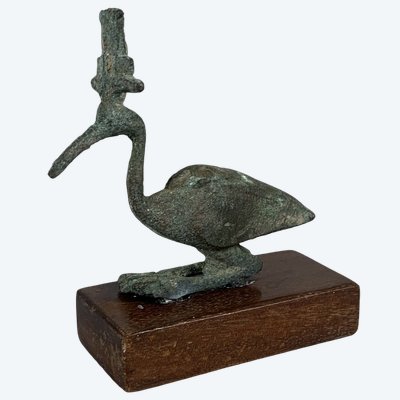
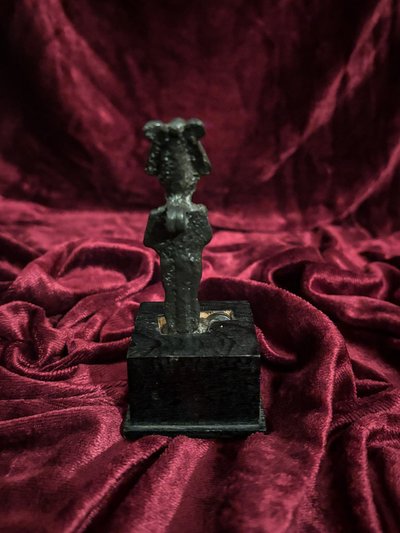
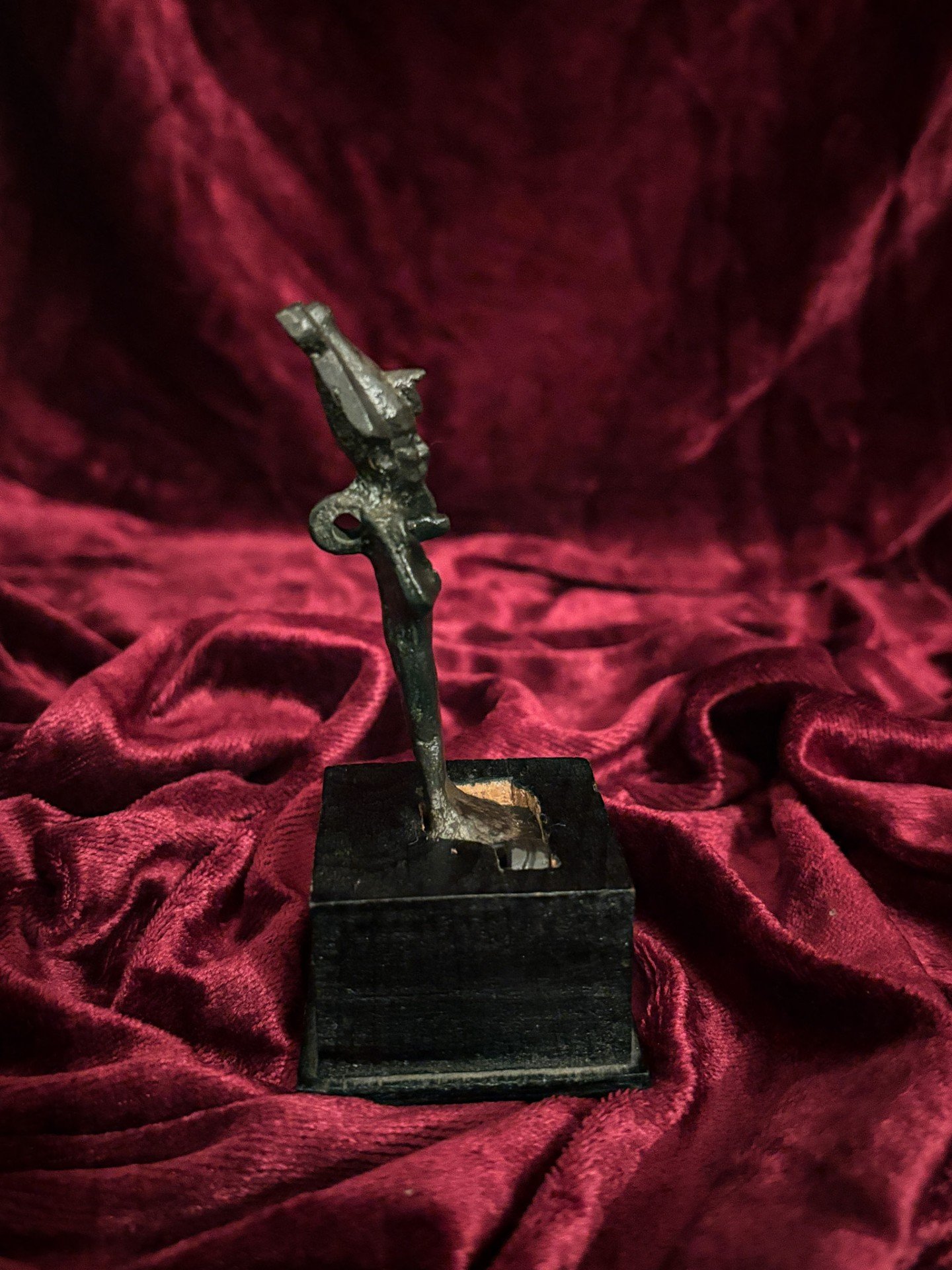
Charming little antique statuette of the god Osiris (god of fertility and judge of the dead) in bronze with a brown patina.
The deity is depicted standing, mummified, wearing the Atef crown flanked by the two feathers of the goddess Maat and adorned with the Uraeus on his forehead. His hands hold the traditional insignia of royal power, the Heqa and the Nekhekh. The lower part and the dorsal pillar are decorated with a period suspension (or attachment) ring.
Presented on a modern black-stained wooden base.
Ancient Egypt, Late Period (circa 664-332 BC).
Height: 8 cm. Height with base: 10 cm.
(Wear and traces of oxidation).
In the Late Period, these statuettes were not only decorative objects but were most often used as votive offerings.
They were placed in temples (such as Abydos or Memphis) by pilgrims to attract the protection of the god or ensure eternal life for the deceased.
They could also have a purely funerary function and be placed in tombs to accompany the mummy, helping it to identify with Osiris in order to defeat death and be reborn in the afterlife.
On some examples, the side or back ring was used to hold the statuette upright inside a funerary box or on a larger support, sometimes alongside other deities (such as Isis and Horus) to form a triad.
The presence of a “suspension ring” or “bélière” is also referenced on several similar pieces and in some cases allowed the statuette to be carried on one's person, suspended from a cord or chain.
The Musée Condé (Notice OA 1136) explicitly describes a similar example from the Late Period as having “a small quadrangular base with a suspension ring on the side” and specifies that a “second ring is located at the top of the dorsal pillar.”
The Musée des Beaux-Arts de Lyon (Notice H 1513) also lists these objects under the technical term “Bélière,” confirming their function as attachments for suspension.
Ref: DXQURNTKPB
| Condition | Good |
| Style | Tribal Art (Archeology of Tribal Art Style) |
| Period | 16th century and older (Archeology 16th century and older) |
| Country of origin | Egypt |
| Height (cm) | 8 |
| Materials | Bronze |
| Shipping Time | Ready to ship in 2-3 Business Days |
| Location | 75008, Paris, France |
| Shipping Information | Careful worldwide shipping available upon request. For France, shipping is insured via La Poste or Mondial Relay. For large items, shipping is via an approved carrier of your choice, with a quote provided. |
4 commitments to buy with confidence

 English
 Français
  Italiano
  Deutsch