This description has been translated and may not be completely accurate. Click here to see the original
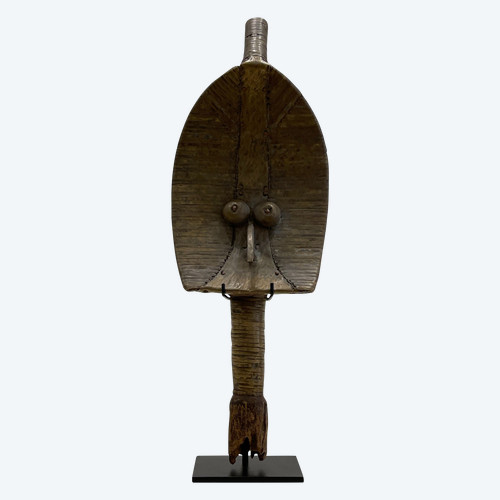
Composite anthropomorphic reliquary with basket, wood, metal, and fibers, attributed to the Kota group (Gabon), atypical variant, late 19th – first half of the 20th century
Attribution: Kota (Gabon), atypical/functional variant
Estimated date: late 19th – first half of the 20th century
Materials: carved wood, copper, hammered steel, braided plant fibers, string, canvas
Dimensions: height 44 cm; maximum diameter approx. 25 cm
Weight: 1,550 g
Lineage reliquary in the Kota tradition, combining an anthropomorphic guardian figure with a circular reliquary basket intended to contain and protect ancestral or ritual objects.
This is a composite and non-canonical form, distinct from the large, prestigious Kota reliquaries with brass plating (Mahongwe, Shaké), but fully consistent with Kota structural and symbolic logic. The guardian figure, carved from dense, dark wood, adopts a strict frontal pose. The narrow, elongated head is topped with a hemispherical headdress partially covered with hammered metal plates (copper and steel), fastened with rivets. These metal elements display an ancient patina, marked by oxidation and wear, attesting to prolonged use.
The deliberately stylized face is dominated by circular, raised eyes, characteristic of Kota guardian figures. The prominent lateral ears reinforce the apotropaic dimension of the whole. The expression is neutral, vigilant, and impersonal, in keeping with the function of guardian of relics.
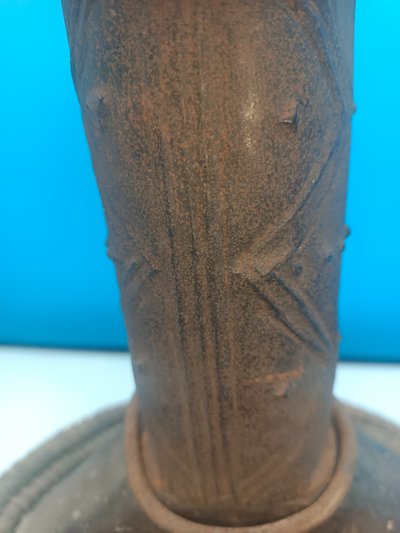
The vertical shaft, slightly quadrangular in cross-section, is decorated with incised geometric scarifications. A copper ring encircles the lower part of the shaft, symbolically marking the transition between the protective figure and the receptacle.
The base consists of a solidly constructed circular basket made of woven plant fibers, serving as a reliquary container. The interior is lined with a stretched canvas, tied with strings, forming an enclosed space intended to hold relics or ritual substances. This basket is not simply a base, but an essential functional element of the object.
In the Kota world, ancestral relics are protected by guardian figures responsible for their oversight and mediation.
In this example, the sculpture plays an apotropaic role, while the basket constitutes the active receptacle. The combination of wood (a living support), fibers (connection and continuity), and metal (power, durability) situates the object within a dynamic and operative conception of the reliquary.
This piece appears to have been used for domestic or lineage purposes, likely linked to a local ritual context, rather than for ceremonial or prestige purposes. The attribution to the Kota group (Gabon) is based on several key criteria:
Bipartite structure: guardian figure + reliquary,
Frontal orientation and circular eyes with a watchful function,
Symbolic importance of the metal, even in the absence of abundant decorative plating,
Presence of a clearly functional reliquary basket.
The absence of continuous brass plating and the atypical morphology indicate a regional or functional variant, without calling into question its belonging to the Kota cultural sphere.
State of preservation
Ancient object in a coherent ritual state:
Patinated wood, with old wear,
Naturally oxidized metals,
Old fibers, strings, and canvas, partially loosened but intact,
Stable structure, without visible heavy restorations.
The condition fully contributes to the authenticity and ethnographic interpretation of the piece.
This reliquary is distinguished by:
Its complex yet legible construction,
The rare coexistence of a guardian figure and a circular reliquary basket,
Its atypical but culturally coherent character,
Its significant documentary value for the study of secondary or local forms within the Kota world.
It constitutes a significant example of a non-canonical Kota reliquary.
Ref: 9OH5QJ6MBF

 English
 Français
  Italiano
  Deutsch
  Very important jewelry matrix – India
800 € EUR
Very important jewelry matrix – India
800 € EUR