This description has been translated and may not be completely accurate. Click here to see the original
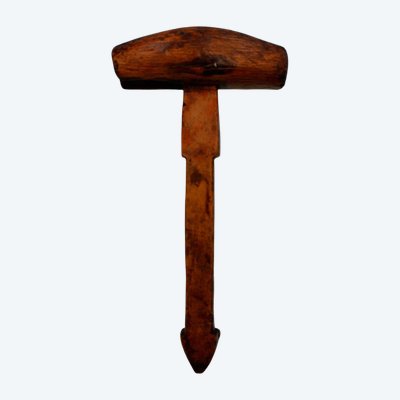
Traditional sugar hammer - High Atlas, Morocco
Carved wood - Rural Berber work
Length : approx. 24 cm - Head : 15cm - 4.5 cm - Weight : 190 g
Estimated dating : early XXᵉ century
This Moroccan sugar hammer, probably from the rural valleys of the High Atlas, is distinguished by its slightly arched head, finely decorated with a deeply incised grid pattern. This motif is typical of Berber domestic tools, where geometric ornamentation served both aesthetic purposes and family or village identification.
The trapezoidal, slightly domed hammer head is well balanced despite its obvious use. The facets show regular wear, a sign of repeated use to break hardened sugar cones (qand), once sold in compact loaves.
The handle, simple and perfectly functional, shows a warm, antique patina, obtained through long years of handling. Its insertion into the head remains stable, even if a slight structural mobility is perceptible - a common phenomenon on old pieces that were used daily.
Sugar hammers were indispensable in rural North Africa until the advent of refined sugar cubes. In the Berber villages of the Atlas mountains, sugar cones were a symbol of hospitality: a fragment was broken to offer sweet tea to guests.
Repetitive use required a sturdy tool, often made by the head of the family or a local craftsman. This model is distinguished by its incised decoration in the form of intersecting lozenges, a motif found on various domestic objects (spoons, neck rests, chests, sticks), and which echoes Amazigh geometric language.
State of preservation
Head with deep geometric incisions still clearly visible.
Even patina from use.
Structural wear not problematic, but slight mobility between head and handle.
No visible xylophagous attack - healthy piece.
Old impact marks consistent with use.
Probable dating
First half of the XXᵉ century.
Clearly predates the industrial diffusion of fragmented sugar (1960s-1970s).
Cultural origin
Berbers from the High Atlas (Morocco).
Function in domestic life: breaking sugar loaves before preparing tea.
Bibliographical and museum references
Jean Besancenot, Arts et Métiers Marocains, Éd. Horizons de France, 1957 - Documentation of numerous Berber rural tools, including similar mallets.
Marie-Louise Nabholz-Kartaschoff, Objets usuels du Maroc pré-moderne, Museum of Anthropology, Basel, 1980.
Musée du Quai Branly - Jacques Chirac, Paris - MAO collections, North Africa section: several domestic wooden hammers (ref. inv. 71.1934.45.12; 71.1932.18.7).
Musée du Patrimoine Amazigh, Agadir - rural tools from the High Atlas on display in the domestic life room.
Maison de l'Artisan, Rabat - Moroccan craft ethnography archives.
Ref: Z05JP1JXCU

 English
 Français
  Italiano
  Deutsch
  XXth century system tables
1.600 € EUR
XXth century system tables
1.600 € EUR