This description has been translated and may not be completely accurate. Click here to see the original
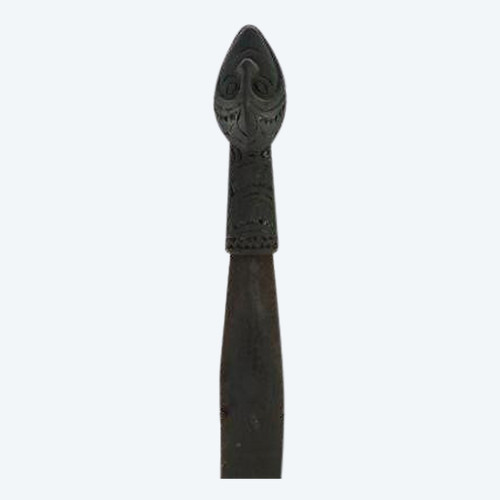
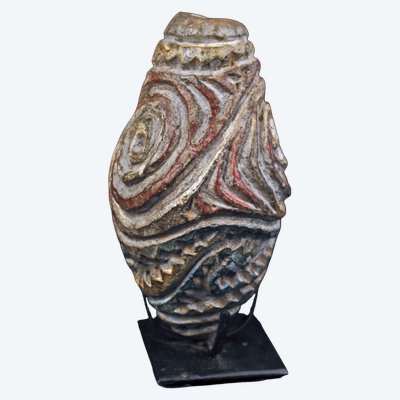
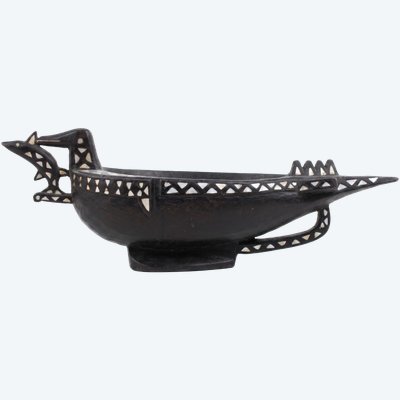
This exceptional piece embodies with rare elegance the refined aesthetic of the Moluccan island cultures. Carved from a mother-of-pearl valve with a smooth patina and deep iridescent reflections, this spoon is distinguished by the delicacy of its incised decoration.
The ornamental register, of calligraphic finesse, unfolds complex geometric motifs—chevrons and reticulated patterns—that structure the surface with a geometric rigor that contrasts magnificently with the organic curve of the shell. The balance of proportions and the quality of the carving testify to the hand of a master craftsman, for whom mother-of-pearl was not merely a utilitarian material, but the sacred embodiment of a strong cultural identity. The documentation of this object gives it major historical importance. Typologically, it belongs to the corpus of traditional "Sendok" spoons, whose origin is frequently associated with the Tanimbar Islands. The rarity of this specimen is directly reflected in the most prestigious international museum collections. Its stylistic similarity to the specimen held at the Museum of Ethnology in Vienna (inv. no. 61013), collected by Theodor Adensamer in 1897, is striking. This reference piece measures 18.5 cm by 5 cm.
This comparison is part of a tradition of scholarly collecting at the turn of the century, similar to the pieces held in the historical collections of the Ambon museums or the typological reference documented in 1925 by the ethnologist Wilhelm Müller-Wismar for the Rautenstrauch-Joest-Museum in Cologne (inv. RJM 36952, convolut RJM 1924/01). By virtue of its craftsmanship, its presumed ritual use, and its place within museum collections, this spoon constitutes a collector's item of paramount importance, a fragment of history etched in mother-of-pearl.
Probably acquired from a previous collection belonging to Alain Bovis.
Ref: LWQ1N4UHS7

 English
 Français
  Italiano
  Deutsch
  Jambhala statue - India
2.500 € EUR
Jambhala statue - India
2.500 € EUR