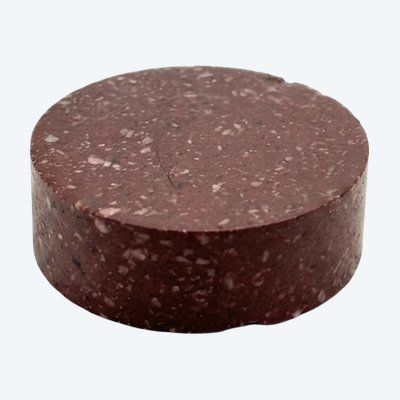

Polished Egyptian imperial porphyry circular base.
Perfect for displaying a small sculpture or archaeological artifact.
Diameter: 4 cm. Height: 1 cm.
Egyptian imperial porphyry is particularly rare: only Roman and later Byzantine emperors could acquire this purple rock, the exclusive property of the Emperor (fiscus caesaris).
The stone's purple color was associated with "Tyrian Purple," the most expensive dye of antiquity.
This rock was all the more rare and precious as it was found in only one place on Earth: Mons Porphyrites, located in the eastern desert of Egypt (Jebel Dokhan). After the fall of the Roman Empire, the exact location of the quarry was "lost" for nearly 1,500 years before being rediscovered by explorers in the 19th century, though it has never been exploited again.
Porphyry is one of the hardest rocks on the planet (7 on the Mohs scale, close to quartz).
In antiquity, it was almost impossible to carve with conventional iron tools. Its extraction required special hardened steel tools and months of polishing with emery to achieve a mirror-like shine. Creating a single 5-meter column alone took several years of uninterrupted work for a full team of elite stonemasons. The cost of transporting it from the remote quarries of the Egyptian desert to Alexandria and then Rome was so high that a cubic foot of imperial porphyry fetched the exorbitant price of 250 denarii—the monthly wage of a skilled worker! (for a piece barely 30 centimeters across).
Because of this difficulty, extraction of new blocks ceased after the 4th century. Almost all of the porphyry that we see today in churches or museums (columns, basins, sarcophagi) is reused pieces from the Roman era.
Ref: N5FFHMTZA1
| Style | Rome and ancient Greece (Art of Rome and ancient Greece Style) |
| Period | 20th century (Art 20th century) |
| Country of origin | Egypt |
| Internal reference | 1761732 |
| Shipping Time | Ready to ship in 4-7 Business Days |
| Location | 75008, Paris, France |
4 commitments to buy with confidence

 English
 Français
  Italiano
  Deutsch