This description has been translated and may not be completely accurate. Click here to see the original
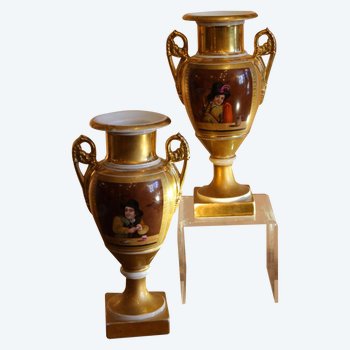
A very large pair of Empire-period gilt and chased bronze pear-shaped vases, signed "THOMIRE À PARIS".
Each vase opens to reveal a wide, flared neck with a molded lip, adorned with a smooth groove and a double ring. The slightly domed shoulder is entirely burnished with agate, creating a mirror-like effect that contrasts with the matte finish of the neck.
Strong, console-shaped handles rise from the shoulder and curl around the neck in broad volutes decorated with floral rosettes. The lower attachments of the handles take the form of bearded Silenus masks, crowned with ivy leaves and bunches of grapes (Dionysian attributes).
The beard of each deity is meticulously reworked strand by strand with a roulette and burin, offering a striking textural contrast with the smooth skin of the face.
The central frieze here reproduces "The Dance of the Bacchantes," a direct reinterpretation of the Borghese Vase, an ancient marble krater from the 1st century BC, now in the Louvre Museum, but which was located in the Villa Borghese in Rome until its purchase by Napoleon I in 1807 (D. Alcouffe, A. Dion-Tenenbaum and G. Mabille, Les Bronzes d'ameublement du Louvre, Dijon, 2004, no. 138, pp. 276-277).
A group of five Bacchantes (or nymphs) draped in classical style, holding hands, are captured in the midst of a choreographic trance.
The lower part of the body is highlighted by alternating broad water leaves with veins and rosettes joined by delicate scrolls.
Each vase is supported by a short, fully gadrooned foot, ending in a ring with water leaves.
The whole rests on a square pedestal, its four sides adorned with an imposing ribboned laurel wreath, a symbol of imperial glory and triumph.
The base terminates in a double plinth, the upper part of which is chased with a frieze of heart-shaped motifs and interlocking water leaves.
Each of the bases, or counter-pedestals, is engraved "THOMIRE À PARIS".
These vases are exceptionally complex in their construction. They were not cast from a single block, but are made up of about fifteen independent bronze sections.
• Maker: Pierre-Philippe Thomire (1751-1843), founder and chaser to the Emperor.
Made between 1805 and 1815, this pair of vases coincides with the golden age of the Pierre-Philippe Thomire factory (located on Rue Boucherat in Paris). Having become suppliers to the Imperial Court, his workshops employed up to 800 workers. This specific model of "Medici vase with Bacchante frieze" was among the most prestigious diplomatic gifts commissioned by Napoleon I for European sovereigns or to furnish the imperial palaces (Tuileries, Saint-Cloud, Fontainebleau).
Our vases are inspired by an antique model with their ovoid body, scrolled handles ending in volutes, palmettes, and applied decoration of draped figures. They are similar to a pair of vases in the Louvre Museum (inv. OA 10220), a similar model of which was sold at Christie’s, London, on January 20, 2005, lot 116.
Their shape is inspired by a model by Odiot for a tea fountain that he presented at the Exposition of Year X (1801) and depicted in the goldsmith’s portrait by Robert Lefèvre in 1822 (Detroit Institute of Art, inv. 81.692).
A pair of vases of a similar model to ours was sold at De Baeque et Associés in Lyon, on March 9, 2019, lot 208. Their decoration is, however, slightly different, one depicting Ganymede and the Eagle and the other Hebe and her cup.
The shape of these vases was widely adapted by Thomire, and examples exist with slight variations in decoration. For instance, a pair of vases forming candelabras was sold at Christie’s, London, on July 7, 2005, lot 405.
A similar pair, also signed "Thomire à Paris," is held at the Mobilier National (National Furniture Collection) under inventory number GML 9808/001.
Born in Paris, Pierre-Philippe Thomire (1751-1843) was the son of a metal engraver. He received exceptional training:
He studied under the renowned sculptors Augustin Pajou and Jean-Antoine Houdon at the Académie de Saint-Luc. This artistic training explains the fluidity and anatomical perfection of the Bacchantes depicted on the frieze of these vases.
He then entered the workshop of Pierre Gouthière, the greatest bronze sculptor and chaser of Louis XVI's reign, where he learned the technique of matte gilding (mercury gilding), a skill he would bring to its zenith.
In 1783, following the death of the bronze sculptor Jean-Claude Duplessis, Thomire was appointed official bronze sculptor of the Royal Sèvres Manufactory. He was tasked with designing the gilt-bronze mounts that adorned the most prestigious fine porcelain vases.
While the French Revolution ruined many artisans due to the disappearance of the nobility, Thomire weathered the period by temporarily converting to arms manufacturing.
The real turning point...
Ref: 4QH4FHMYLG

 English
 Français
  Italiano
  Deutsch
  Royal Banner
1.500 € EUR
Royal Banner
1.500 € EUR