





Would you like more images?


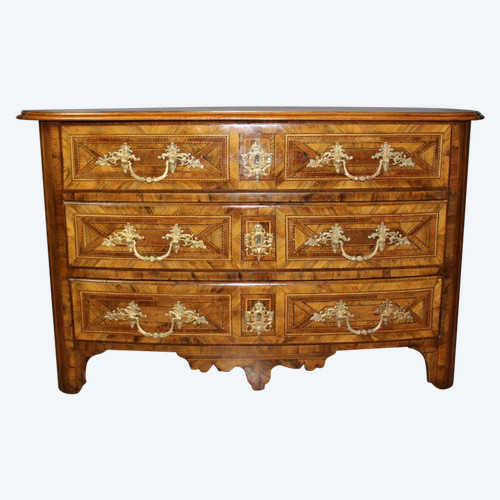
Important Louis XIV period commode, early 18th century Parisian work, circa 1710-1720, made of precious wood veneer and richly decorated with gilded bronzes.
It belongs to those models still fully in the classical vocabulary of the late reign of Louis XIV and the early years of the Regency. Its D-shape, with a protruding back, widely rounded corners and a slightly arched front, gives it a powerful, almost monumental architecture, while preserving its precise proportions. The pronounced rounding of the top accompanies that of the body and reinforces this highly constructed silhouette, where the curve remains controlled by a logic that is still profoundly classical.
This typology is characteristic of the first large Parisian commodes: a piece of furniture as much for show as for use, born in the last years of the 17th century and becoming, at the beginning of the 18th century, one of the privileged fields of cabinetmaking. The Faubourg Saint-Antoine played a key role in the development of these new forms. Cabinetmakers worked in a particularly active environment, where wood, models and know-how circulated, fostering the emergence of high-quality pieces.
The front opens with three rows of drawers, in an old-fashioned arrangement with no top rail: the upper drawers slide directly under the top. This construction, found on early models, still links the piece to the customs of the reign of Louis XIV. The drawers are mounted in walnut, with their antique bottoms, and the frame retains its original integrity. The cabinet also retains its locks, bronzes and old assembly order, a remarkable feature for a chest of drawers from this period.
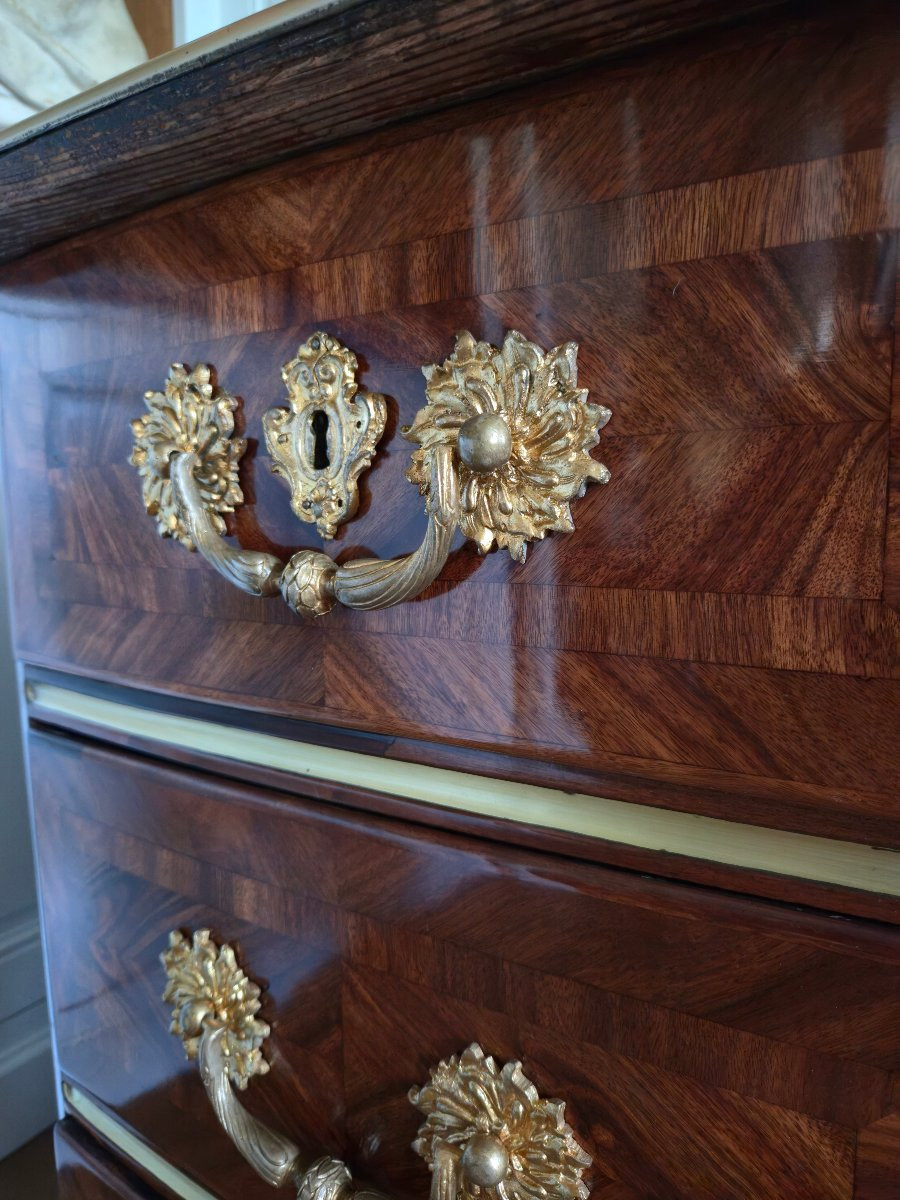
The veneering is one of the most interesting features of the piece. The whole is treated in a continuous geometric frieze, with no clear reserve for the bronzes, but in a composition where panels and frames create a subtle depth. The drawers feature balanced rectangular compositions, playing on the orientation of the fibers and variations in tone. Precious woods such as satinwood, amaranth and rosewood on backs are used, their nuances blending into a warm, reddish-brown color that is deep and vibrant.
This choice gives the furniture a singular presence: it doesn't seek marked opposition, but a richness based on reflections, connections and the reading of the grain. The color, dense and luminous at the same time, dialogues perfectly with the gilding of the bronzes.
The top is a rare element. Unlike many chests of drawers of this period, whose wooden top was replaced by marble, this one retains its original veneered top, encircled by a strong gilded bronze moulding. Its inlaid decoration develops a complex geometric composition of interlacing and circular forms, in the same spirit of depth as the front. Its conservation is an essential point in the appreciation of this piece of furniture.
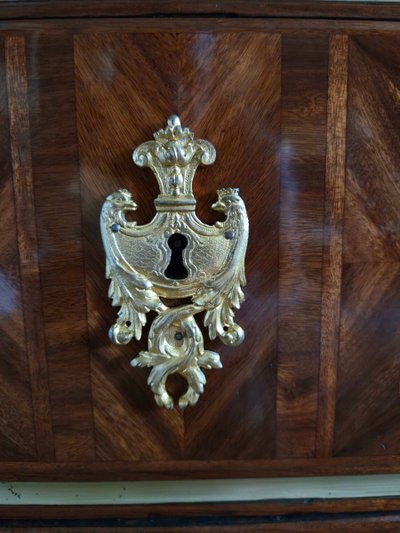
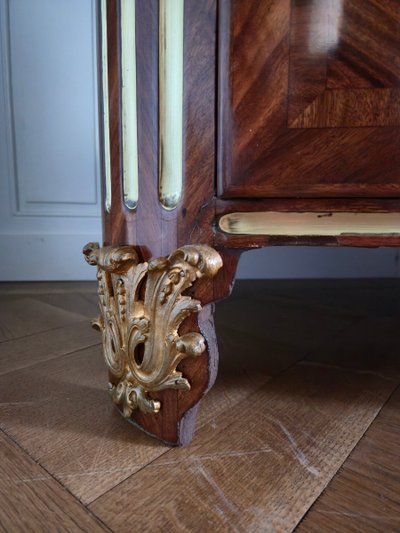
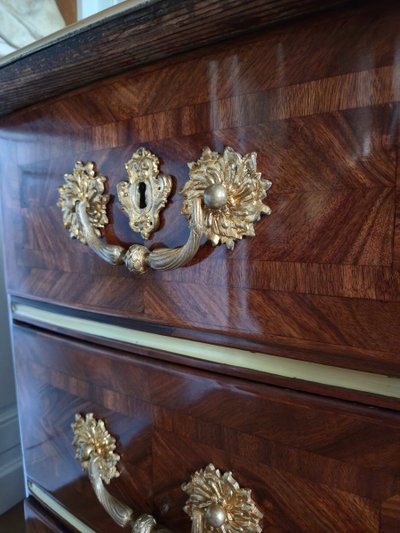
The gilded bronze ornamentation is of the highest quality. Handles with drooping hands, lock escutcheons, acanthus-leaf sabots, the lingotière, as well as copper fluting and rushes structure the piece without weighing it down. The bronzes emphasize the lines, accompany the volumes and contribute fully to the overall balance.
The key escutcheons are decorated with clashing rooster heads, a motif found on some Parisian furniture from the late reign of Louis XIV. The rooster, associated with the representation of the kingdom of France, has a discreet but significant symbolic role here.
The shape of the hooves and handles, and the quality of the chasing, place this upholstery at the level of fine Parisian production of the early 18th century, in a spirit that can be compared to furniture associated with the great Parisian workshops such as Doirat or Criaerd. The commode is not stamped, which is coherent for a piece of this date, as stamping was not yet systematic in the first decades of the 18th century.
Finally, this commode stands out for its state of preservation. It has preserved its frame, back, rear floor, locks, bronzes, veneered top and moulding. The ensemble offers a particularly complete reading of a large Parisian commode circa 1710-1720, still fully Louis XIV in its architecture, but already buoyed by the vitality of Parisian cabinetmaking in the early 18th century.
The bronzes were removed and cleaned, and the old varnish, which obscured the veneers, was removed. A colorless buffer varnish was then applied, restoring the clarity and richness of the woods, as well as the depth and brilliance of the veneers.
Ref: 2BQD18TMWD
| Condition | Very good |
| Style | Louis XIV style (Chests Of Drawers of Louis XIV style Style) |
| Period | 18th century (Chests Of Drawers 18th century) |
| Country of origin | France |
| Shipping Time | Ready to ship in 4-7 Business Days |
| Location | 89260, La chapelle sur oreuse, France |
4 commitments to buy with confidence

 English
 Français
  Italiano
  Deutsch