This description has been translated and may not be completely accurate. Click here to see the original
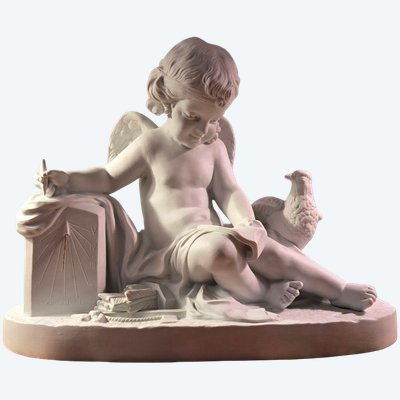
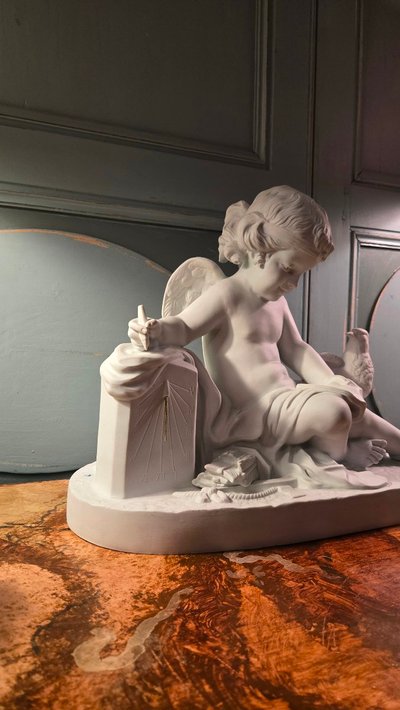
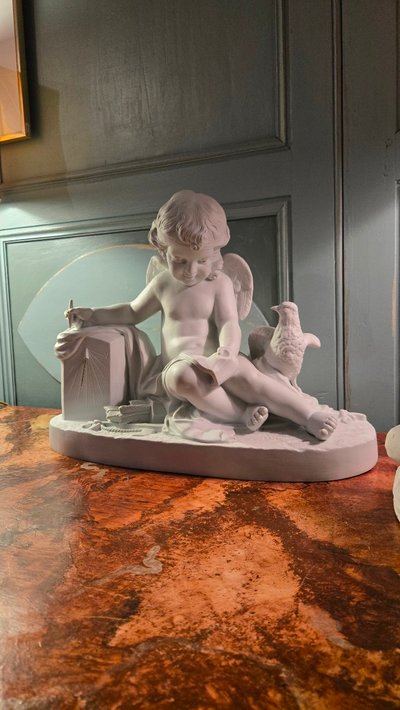
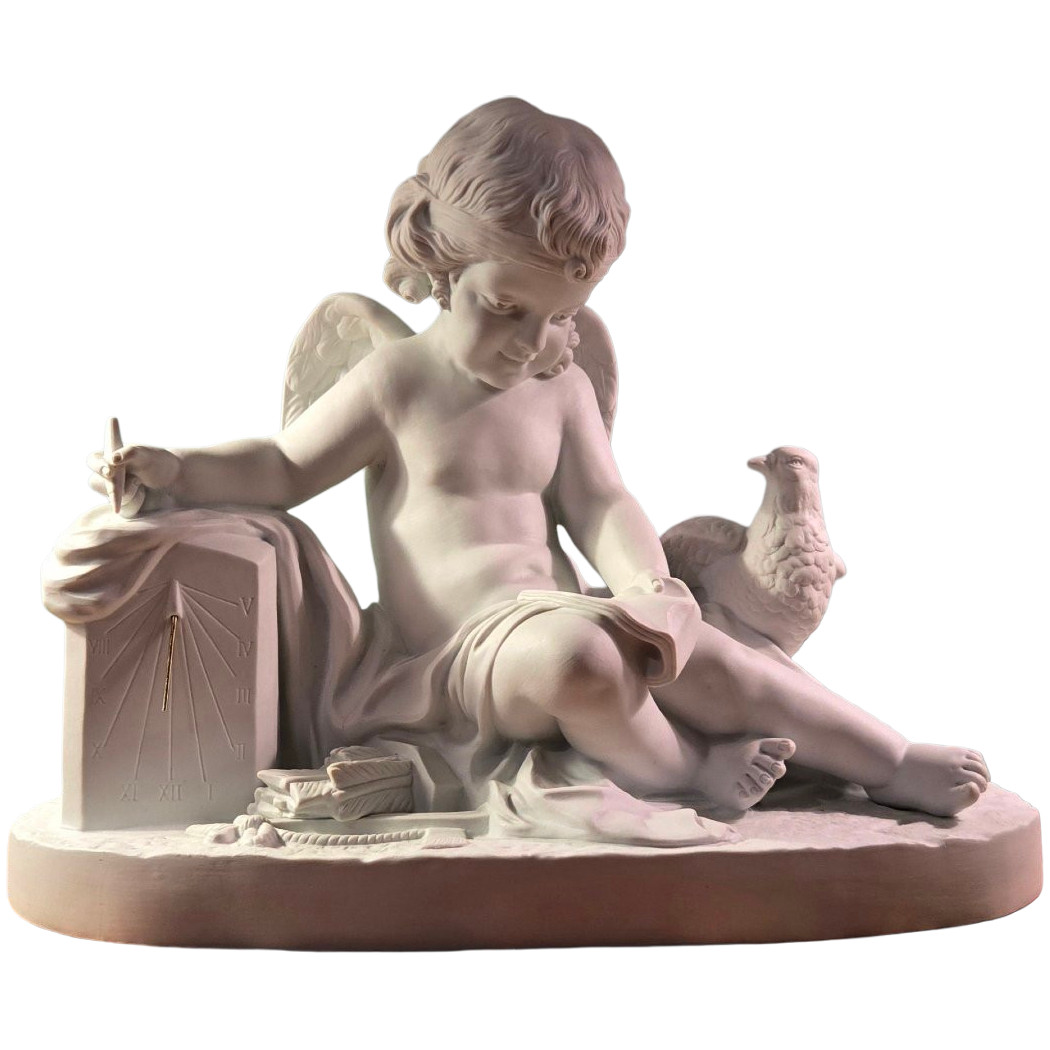
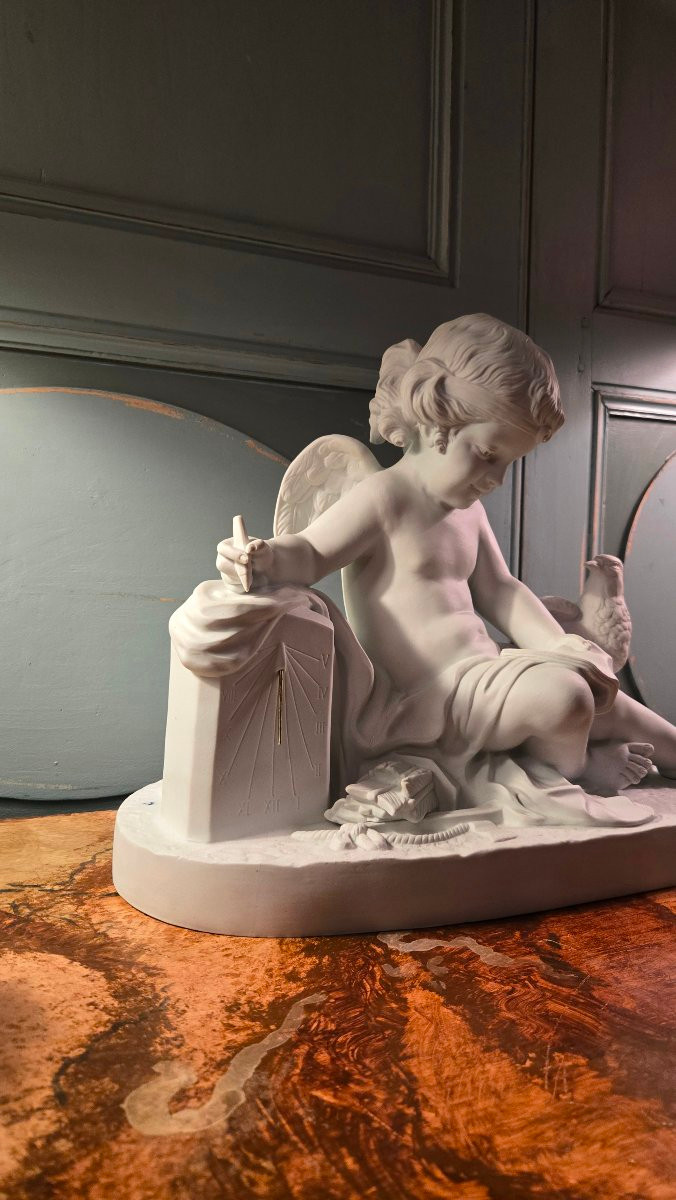
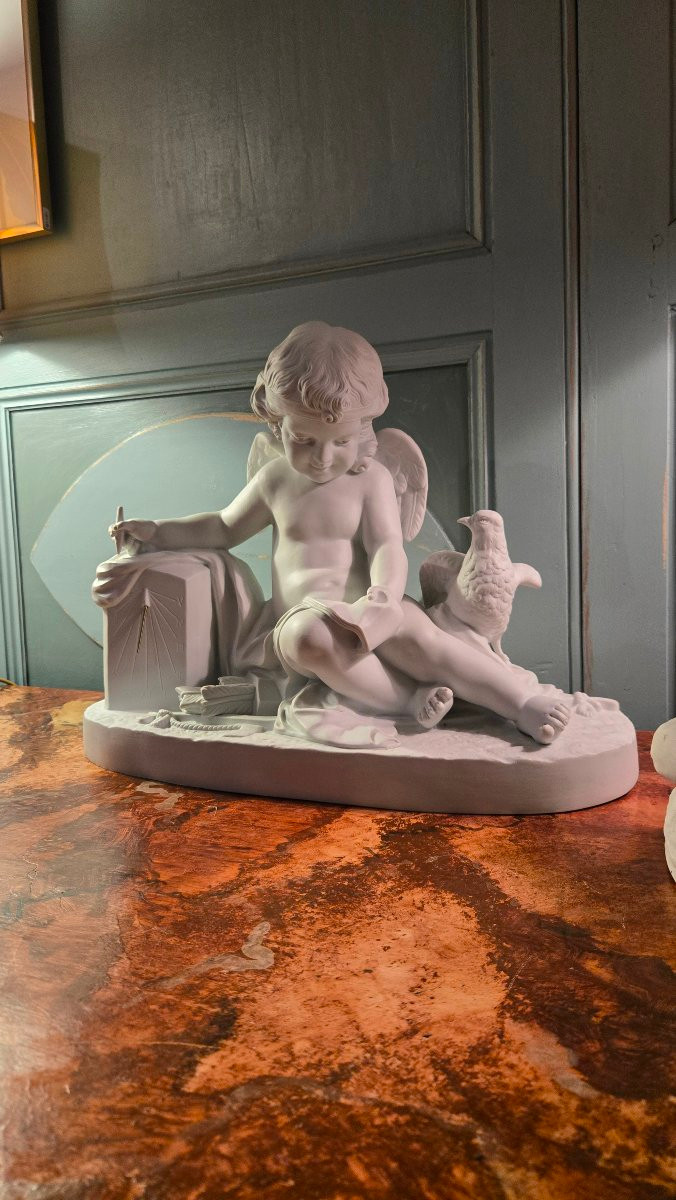
An important sculptural group in white biscuit porcelain depicting Cupid writing, a poetic allegorical composition drawing inspiration from French sculpture of the second half of the 18th century.
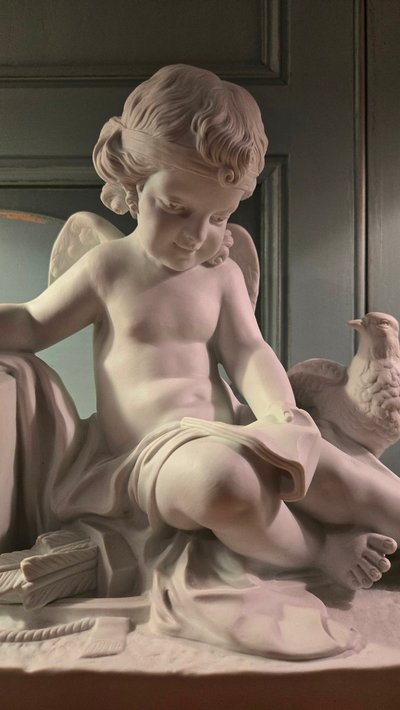
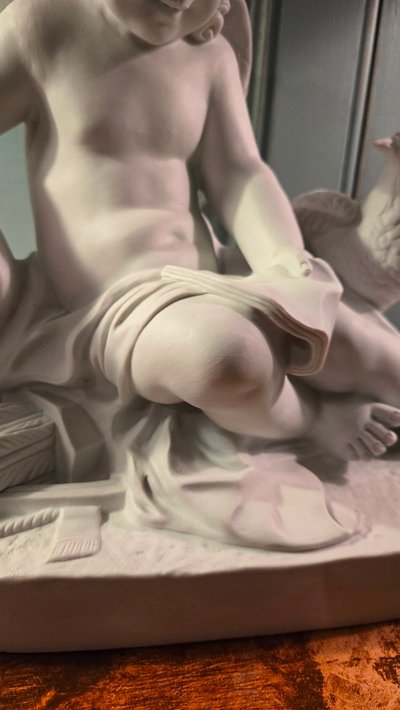
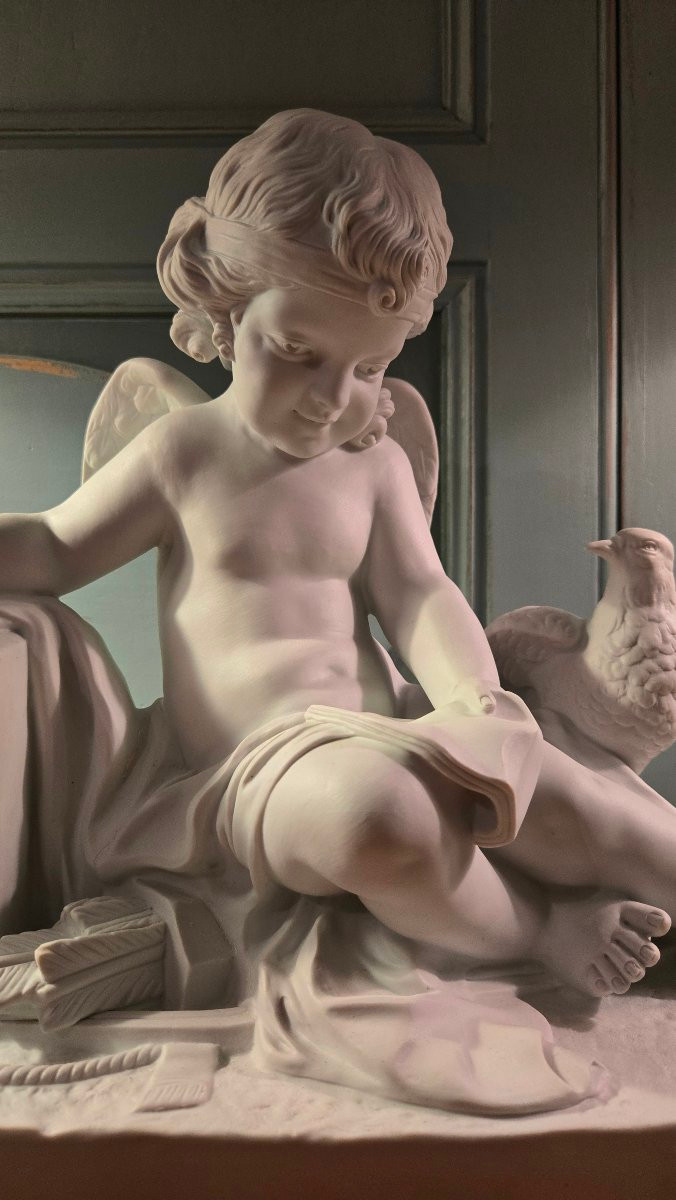
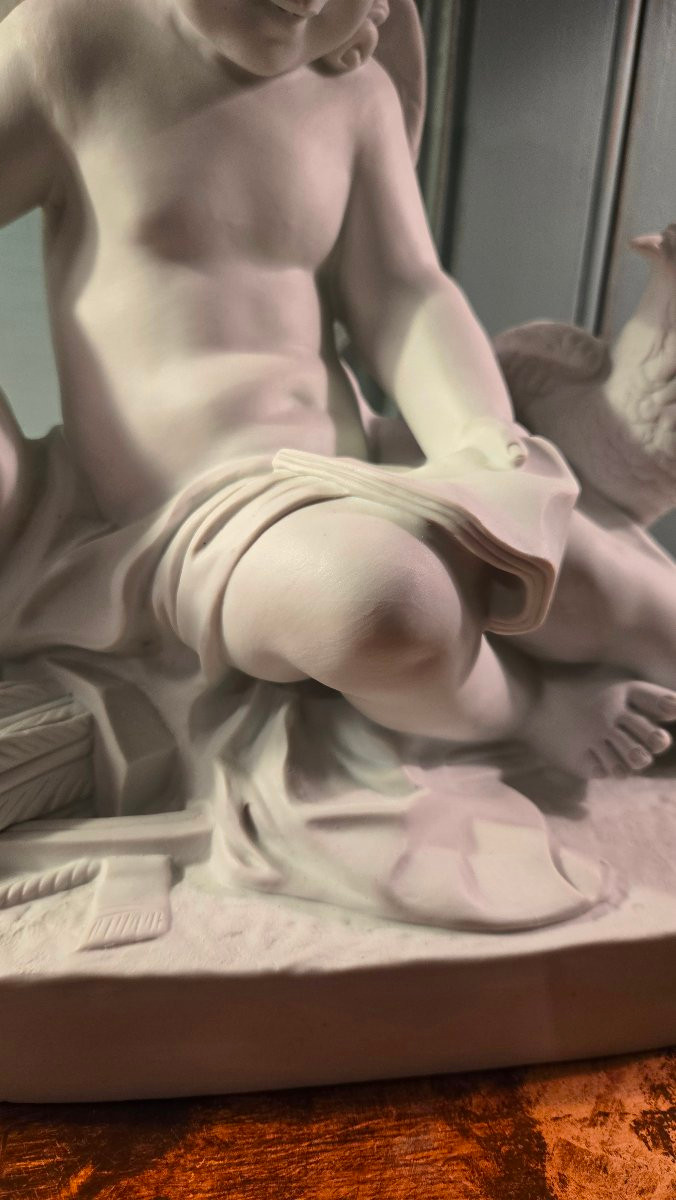
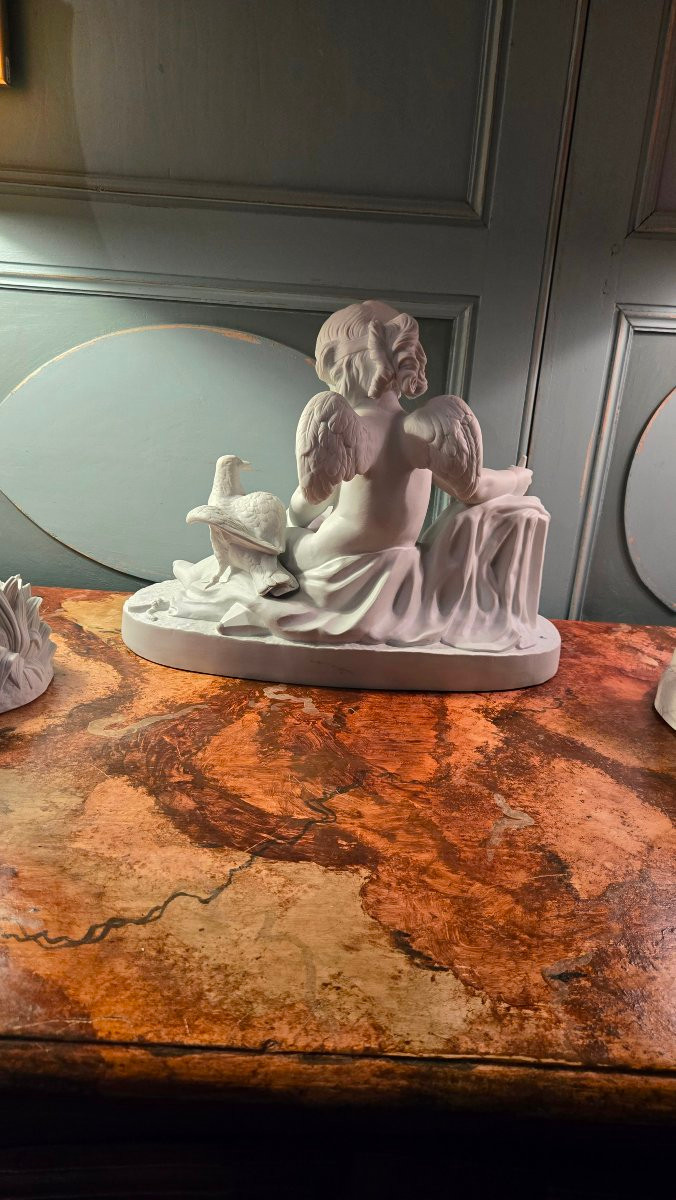
The young winged god is depicted seated on ample drapery, with one leg bent and the other extended. His hair, composed of fine, wavy locks, is held by a band tied at the back of his head. With his face slightly inclined, conveying gentleness and concentration, he holds a stylus in his right hand, while his left hand steadies several sheets resting on his knee.
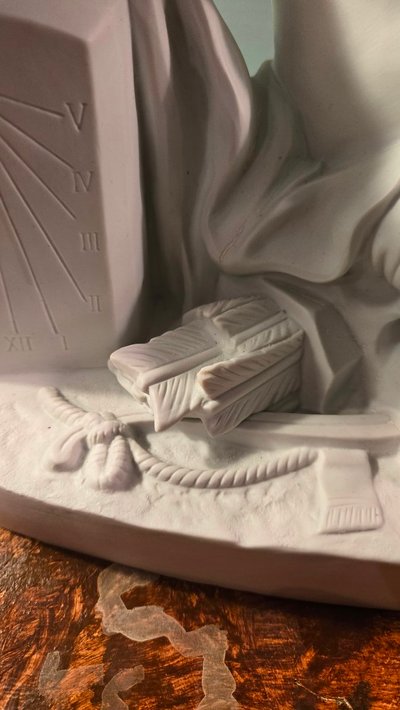
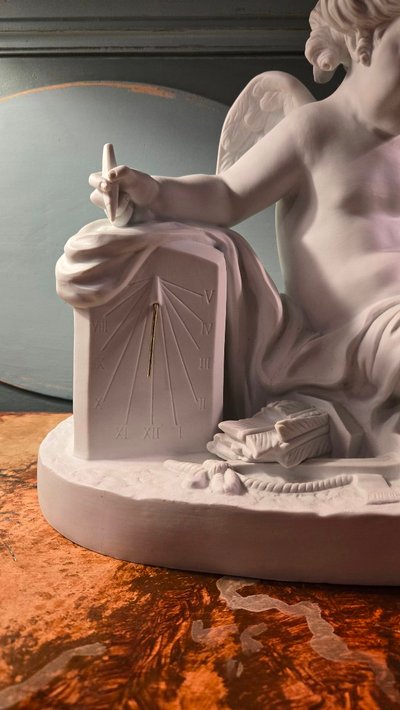
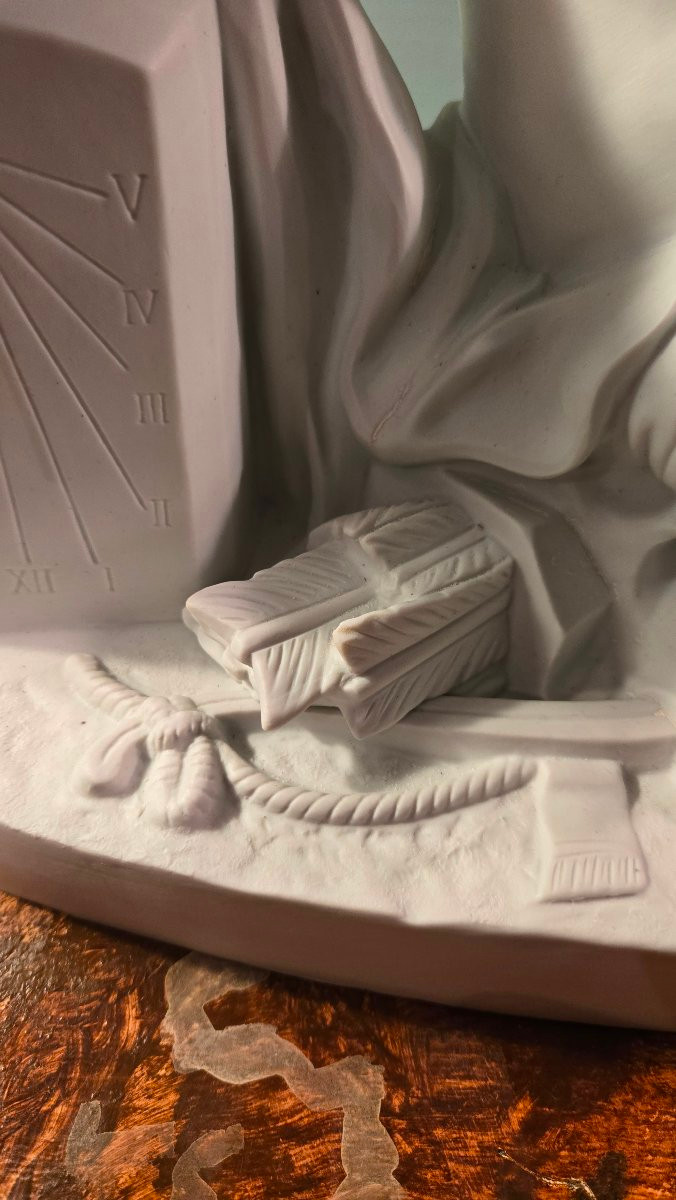
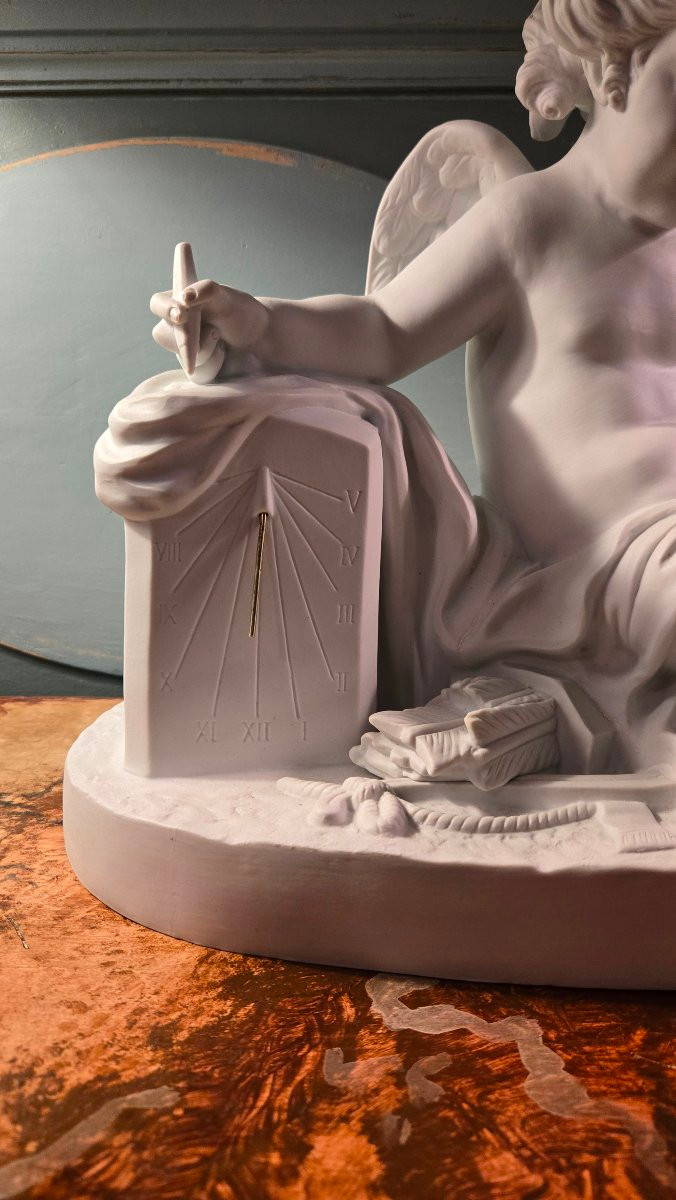
Beside him, a pedestal partially covered with fabric bears a sundial whose hour lines and Roman numerals are finely incised into the porcelain, complemented by a separately fitted metal gnomon.
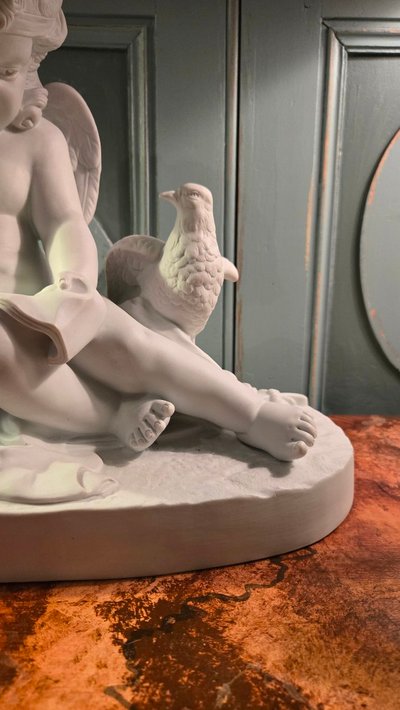
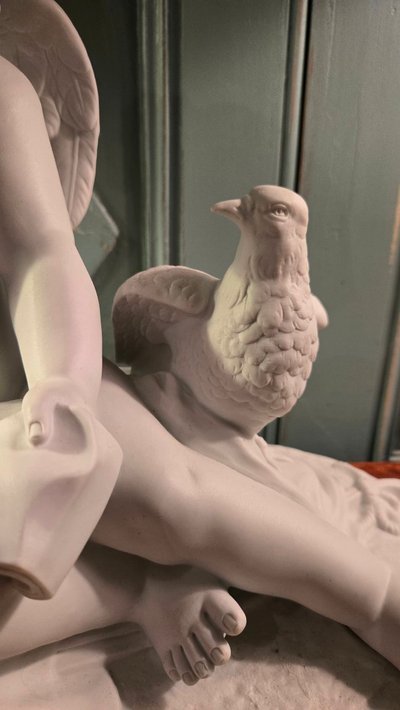
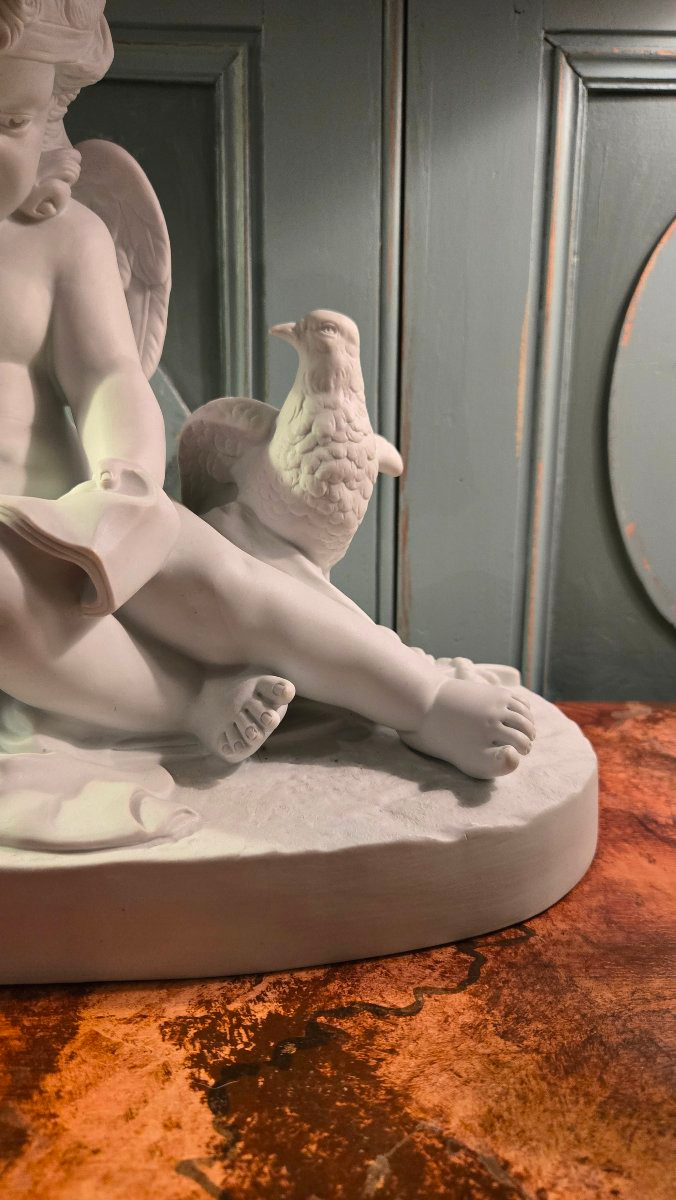
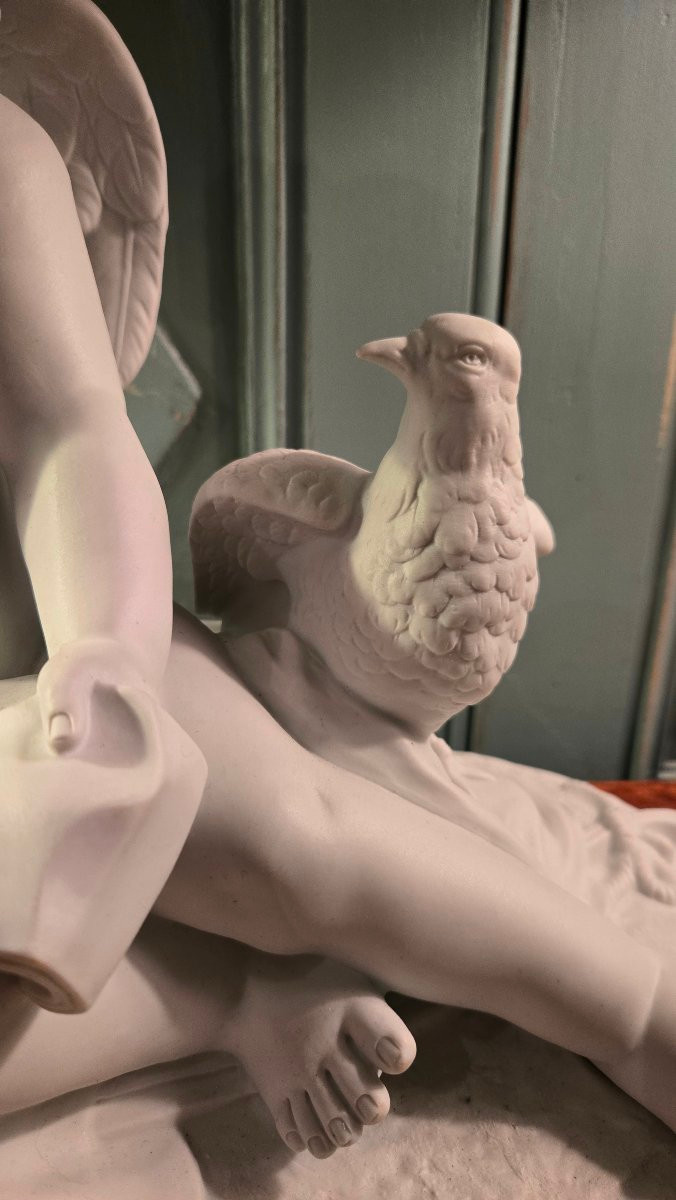
A dove with partially spread wings stands beside him, seemingly awaiting the message it might carry. His quiver, filled with feathered arrows, rests on the base, accompanied by a twisted cord ending in tassels.
Here, Cupid lays aside his weapons to devote himself to writing. The combination of these various attributes lends the composition a particularly appealing symbolic dimension: the dove evokes tenderness and fidelity, the correspondence expresses feelings, while the sundial recalls the inexorable passage of time. The ensemble can thus be interpreted as an allegory of the enduring nature of love in the face of passing time.
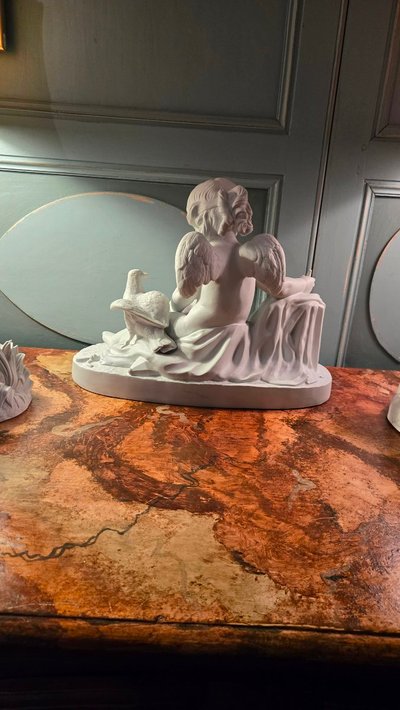
The quality of execution of this biscuit porcelain piece is evident in the finely modelled anatomy, the delicate facial expression, the meticulous treatment of the hair, the precision of the plumage and the supple drapery. Worked entirely in the round, the sculpture offers a balanced composition from every angle. The matt, velvety whiteness of the unglazed porcelain recalls the appearance of carved marble.
This composition, known by the title “L'Amour écrivant”, was also produced in marble versions and adapted for clocks. A particularly close version, made in Carrara marble in the late 19th century and featuring a clock dial in place of the sundial, is notably documented by the gallery Marc Maison with an attribution to Jean-Baptiste Pigalle (1714–1785).
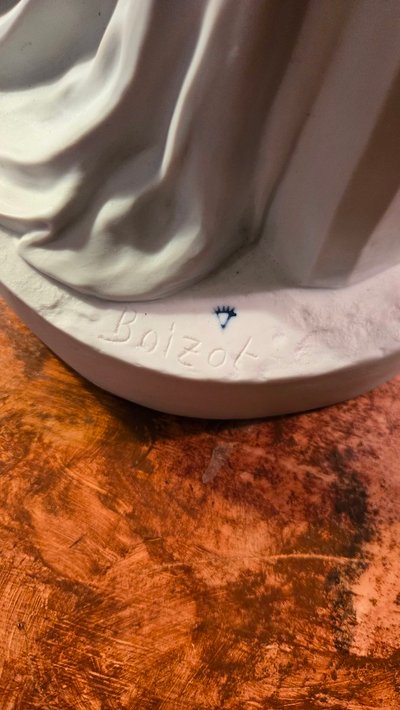
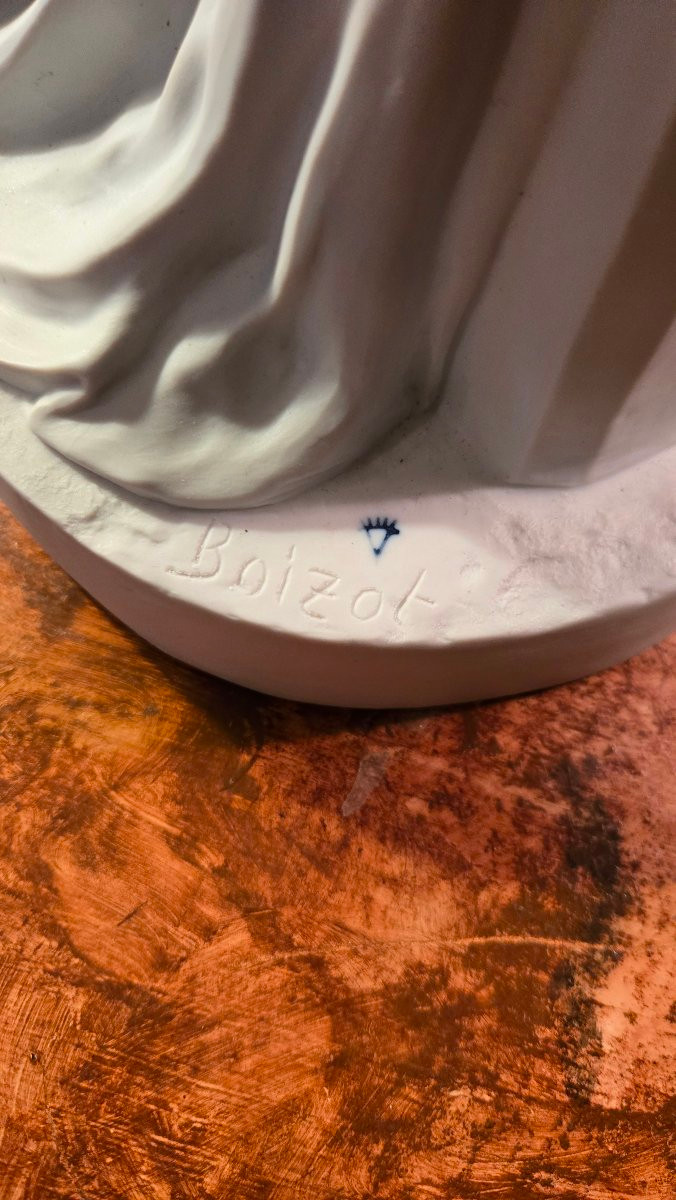
Our example bears the incised signature “Boizot” on the base, referring to Louis-Simon Boizot (1743–1809), sculptor to the king, winner of the Grand Prix for sculpture in 1762 and director of the sculpture workshop at the royal Sèvres manufactory from 1773.
A major figure in French Neoclassicism, Boizot contributed for several decades to the renewal of the manufactory's sculptural repertoire, notably through his mythological and allegorical compositions intended for production in biscuit porcelain.
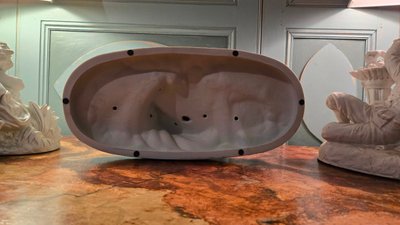
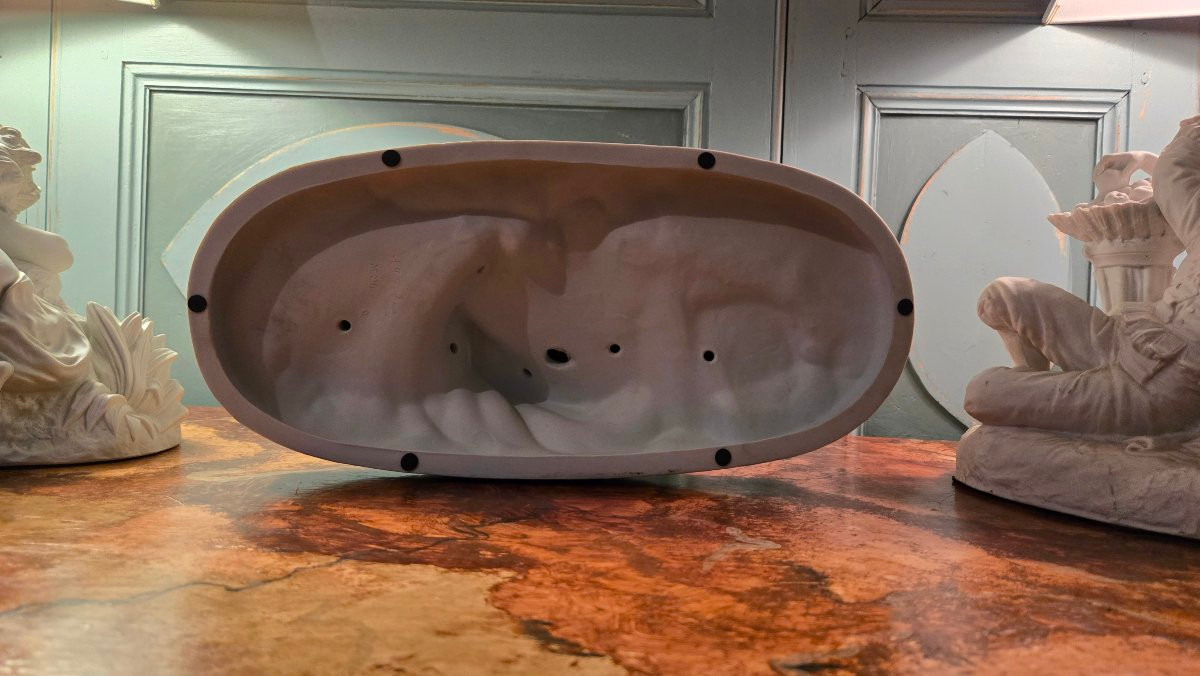
Near this signature is a blue-painted mark resembling a V surmounted by a stylised crown. This mark, together with the manufacturing references impressed beneath the base and the wording “Made in France”, leads us to associate this sculpture with the production of the Villenauxe-la-Grande manufactory, in Aube.
Run in the 20th century by the Tessier family, this manufactory specialised in particular in the production of biscuit porcelain statuary, perpetuating the tradition of the great sculptural compositions of the 18th century and reproducing models by celebrated artists such as Falconet, Houdon and Boizot.
French edition of the 20th century, attributed to the Villenauxe-la-Grande manufactory.
This biscuit porcelain piece has survived in perfect condition, particularly noteworthy given its dimensions, the fineness of its modelling and the fragility of its many attributes.
Dimensions :
Height: 34.5 cm
Width: 45 cm
Depth: 21 cm
Ref: KPBVO7KPXI

 English
 Français
 Italiano
 Deutsch
 JAPANESE fan...
230 € EUR