

Would you like more images?


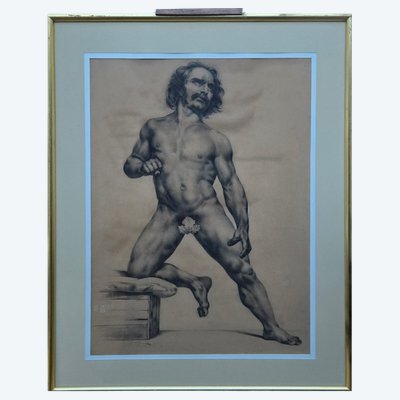
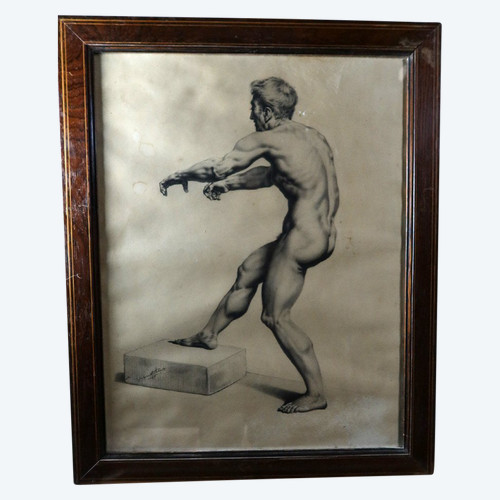
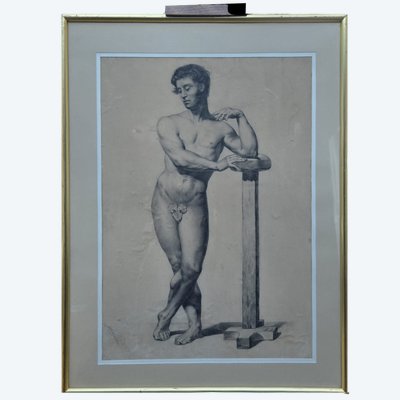
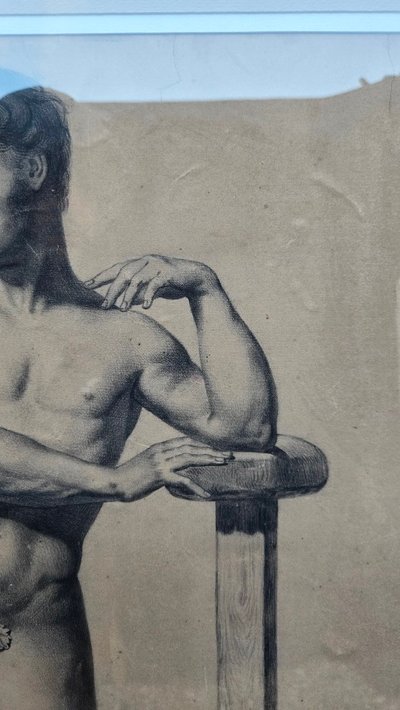
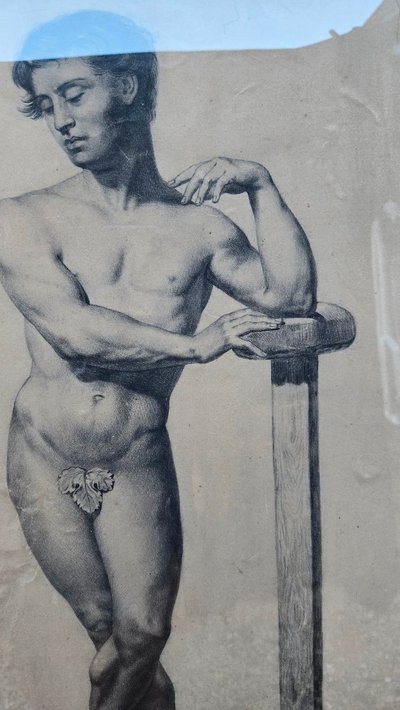
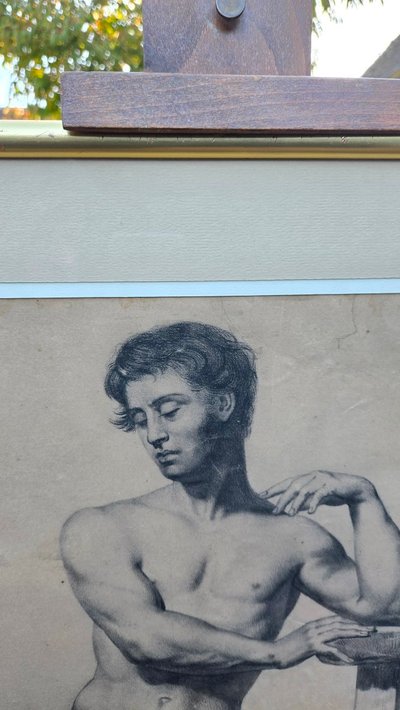
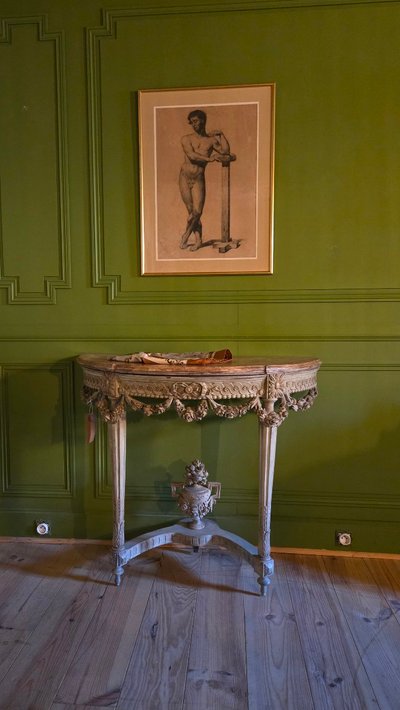
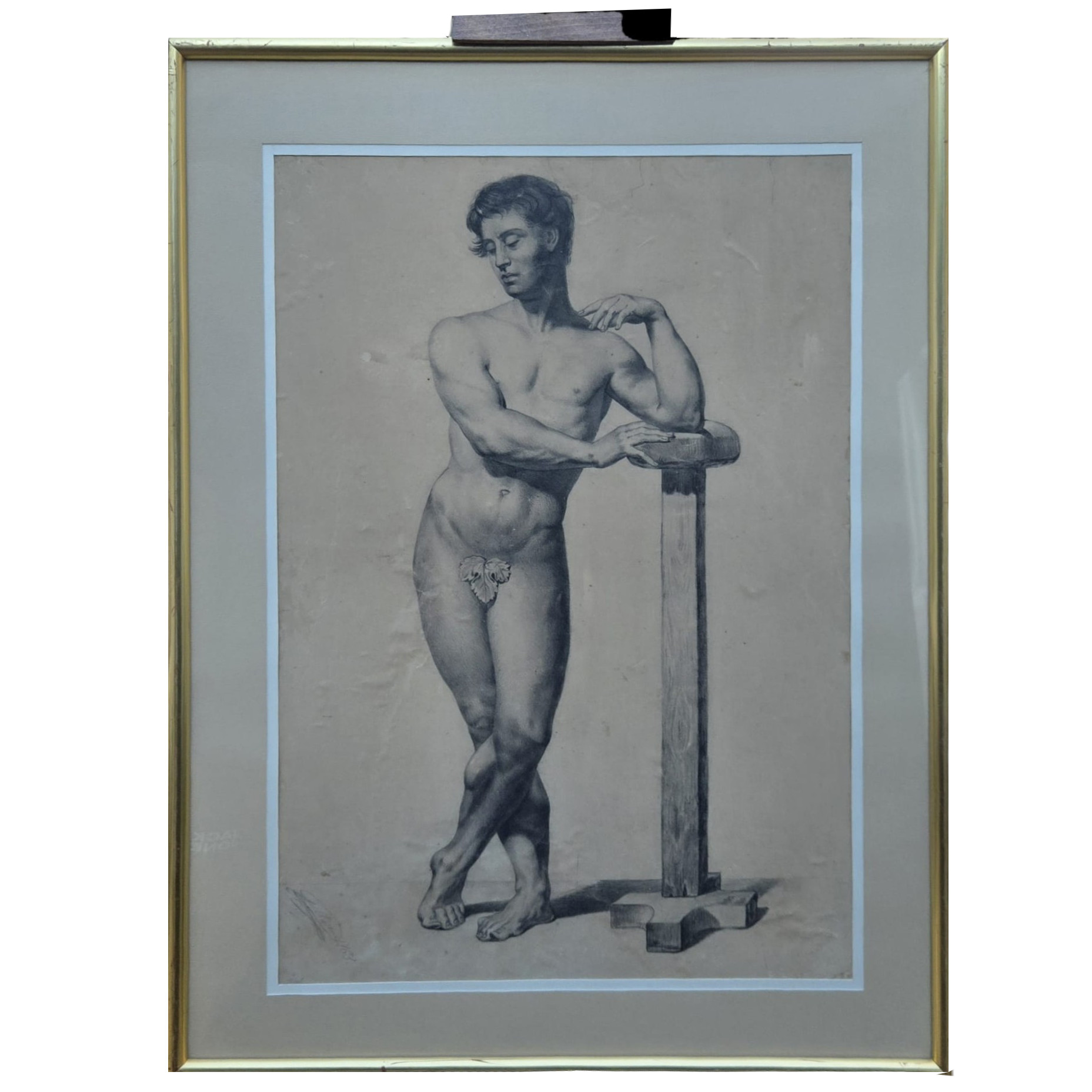
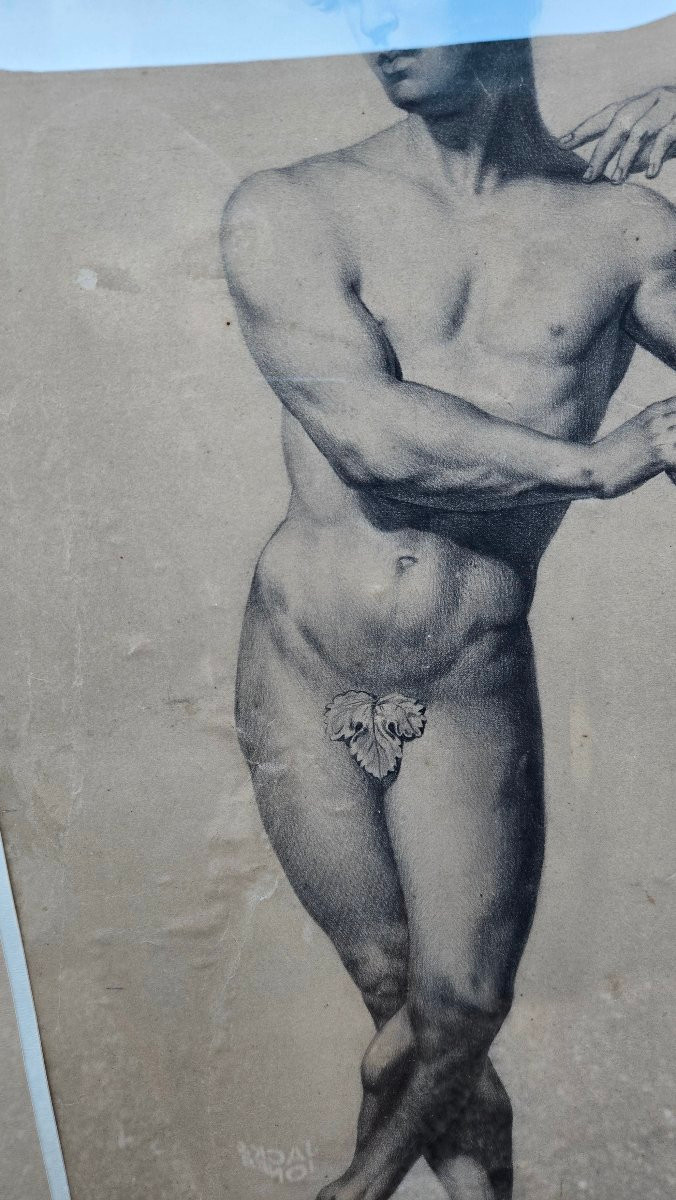
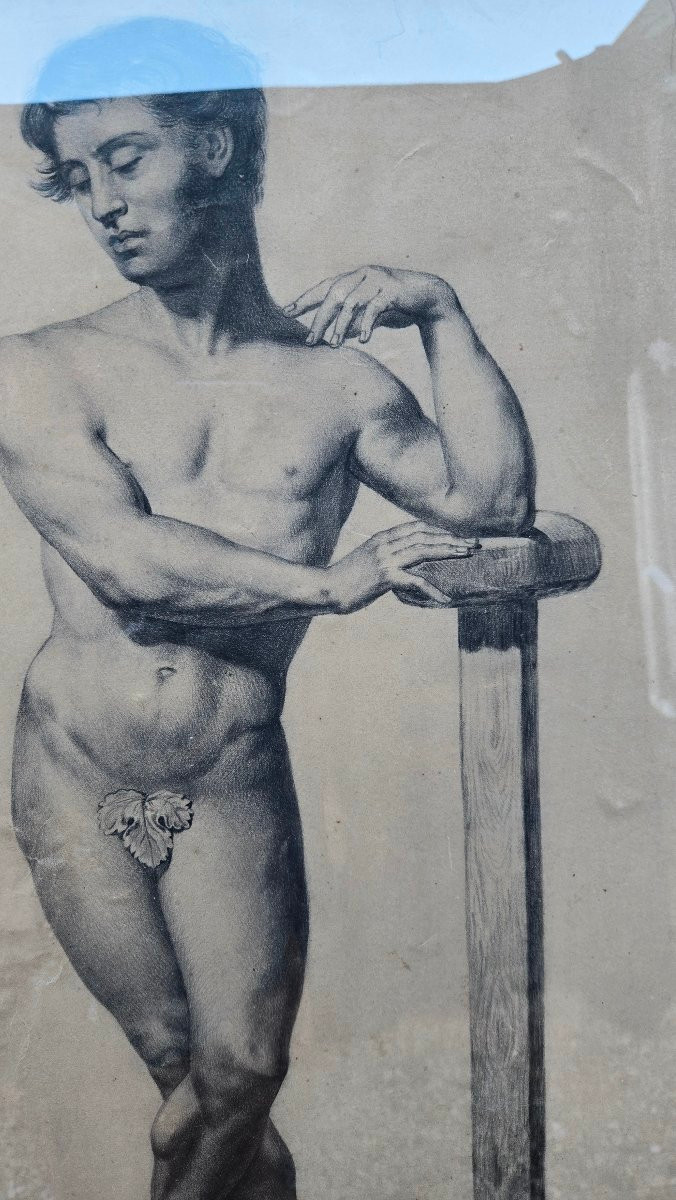
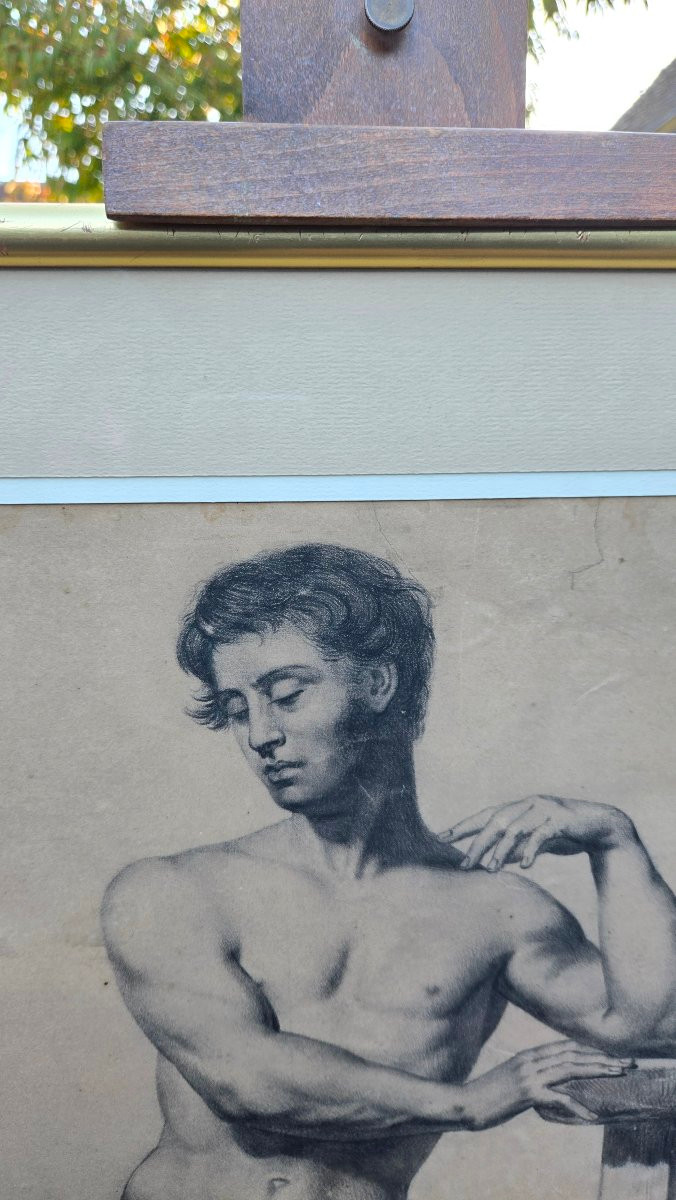
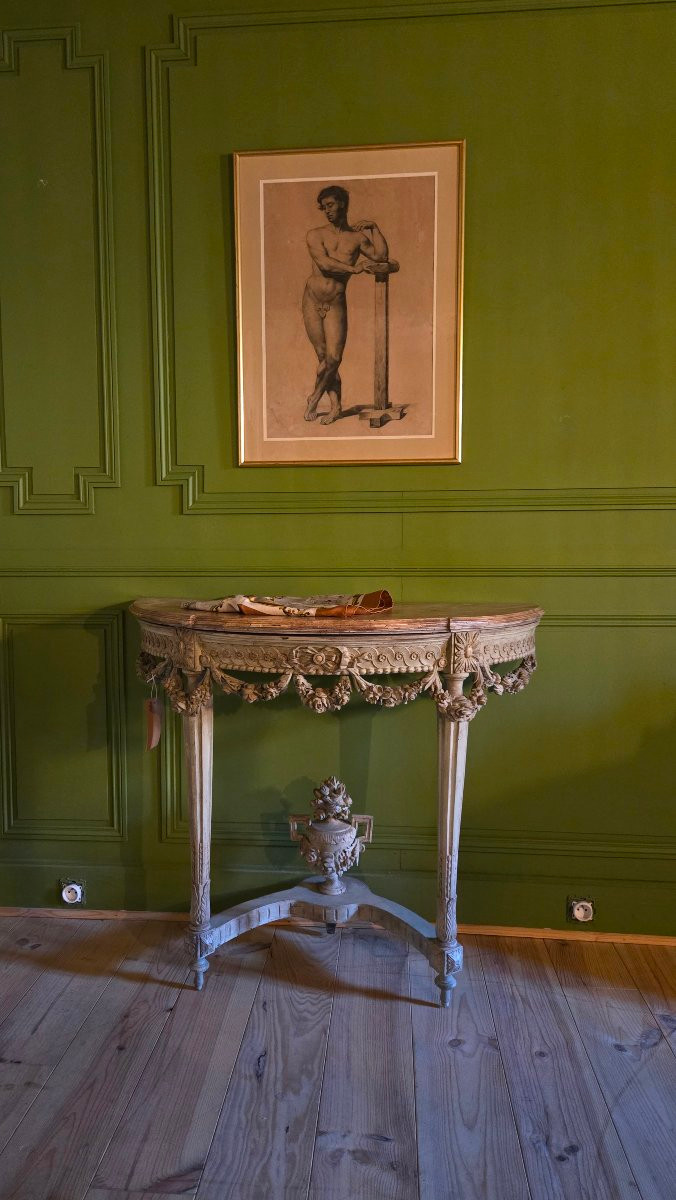
A 19th-century academic drawing, signed “Geltzer” and dated 1863, depicting a young nude man standing and leaning against a studio easel, executed in black pencil or black chalk on paper.
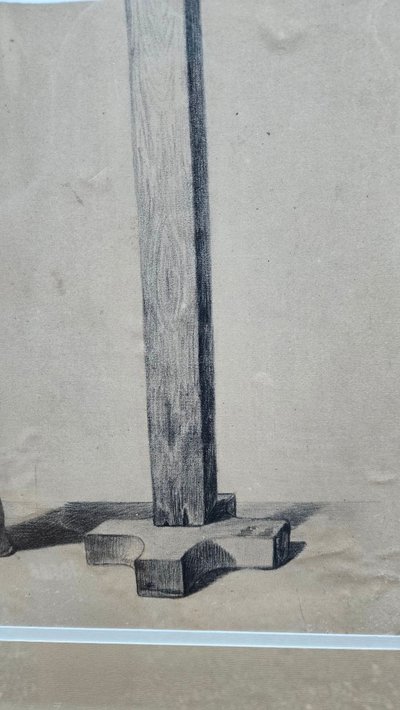
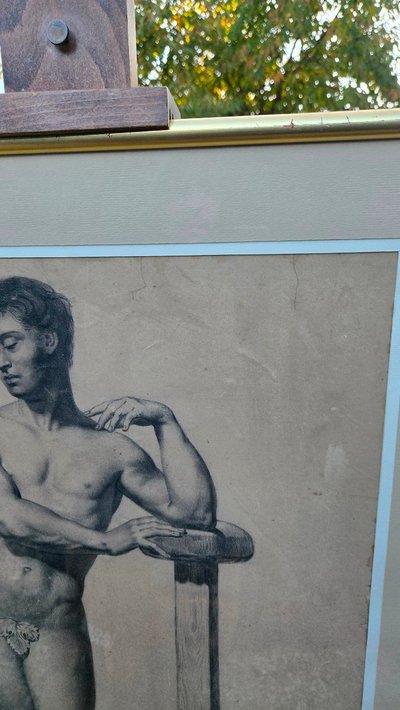
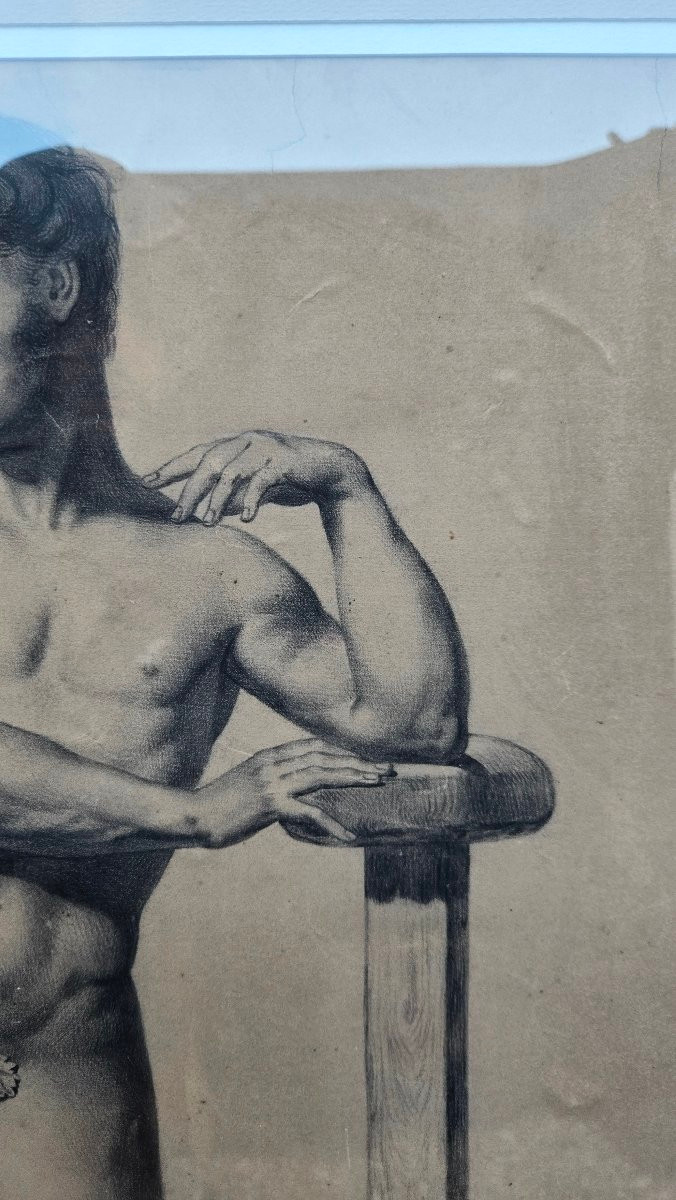
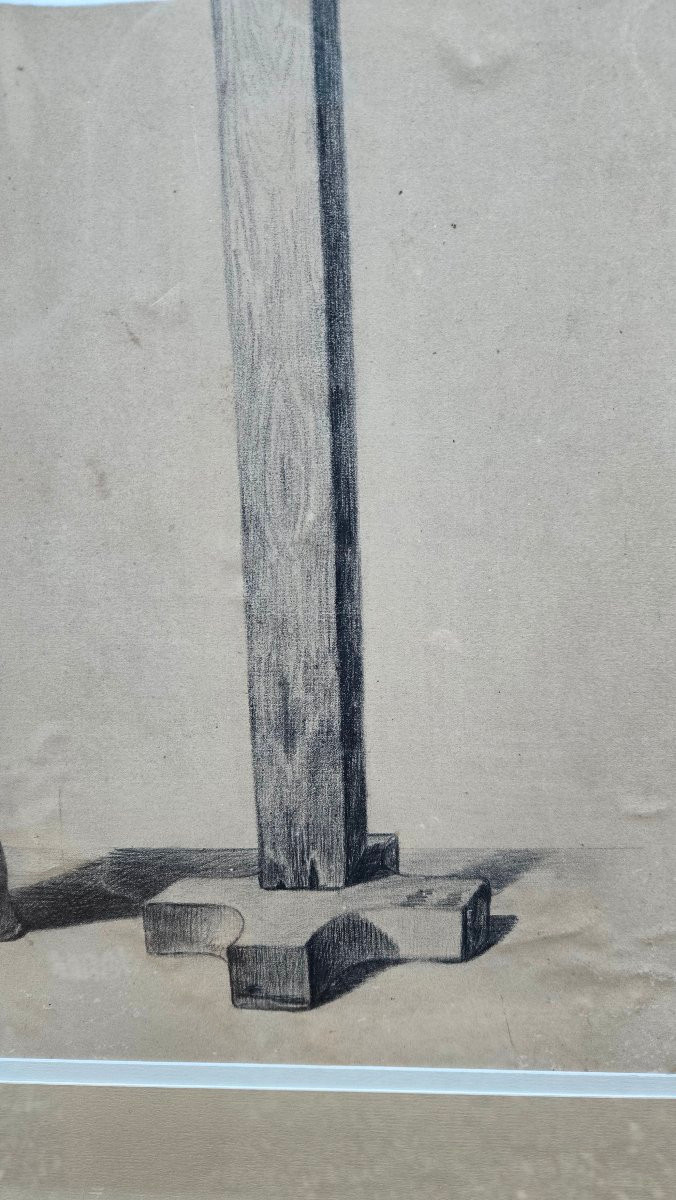
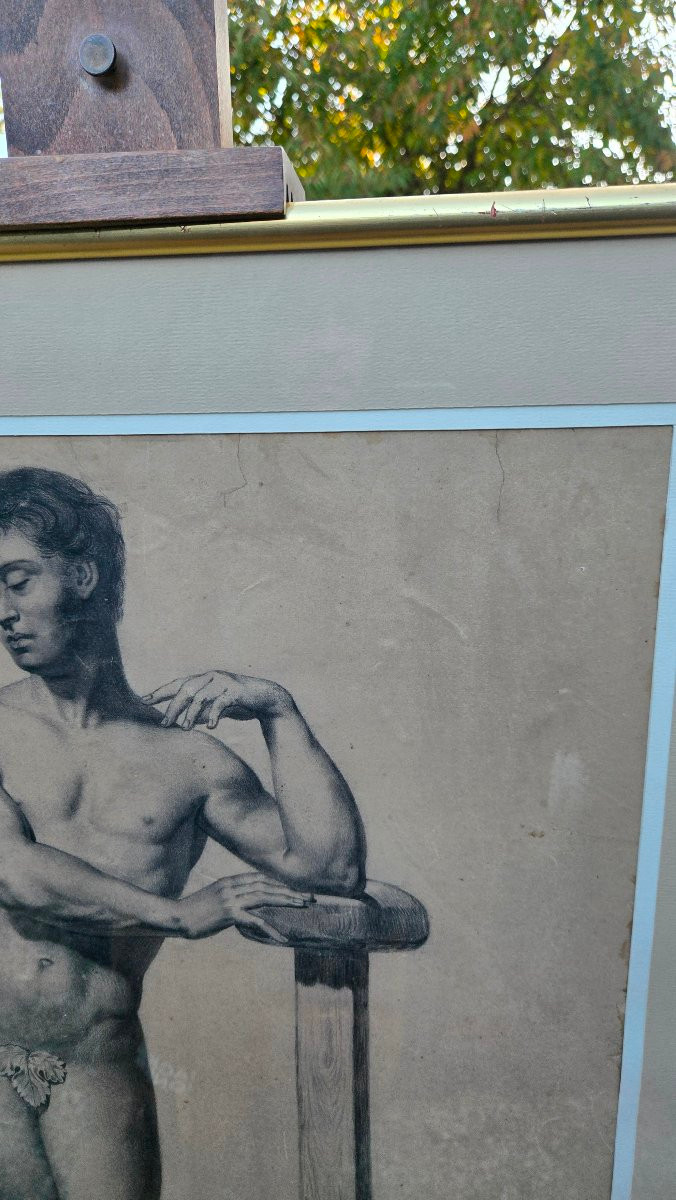
The model is depicted from the front, his body slightly turned and tilted toward the right side of the composition. He is leaning on a vertical wooden support, topped by a rounded horizontal element and resting on a cross-shaped base.
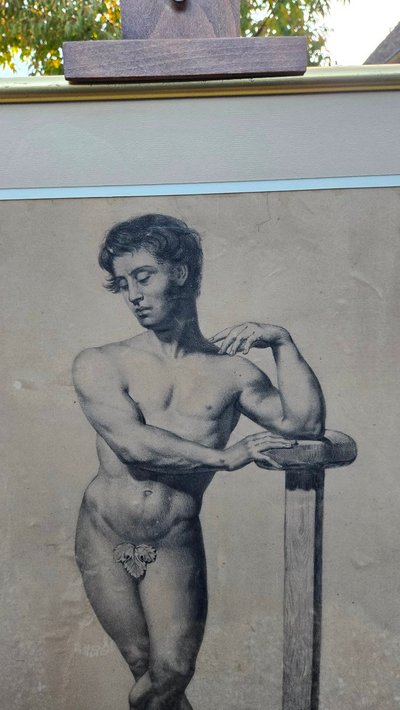
His left arm is bent, with his elbow resting on the support, while his hand curves gently toward his shoulder. His right arm crosses the front of his torso, with his hand resting on the edge of the same support.
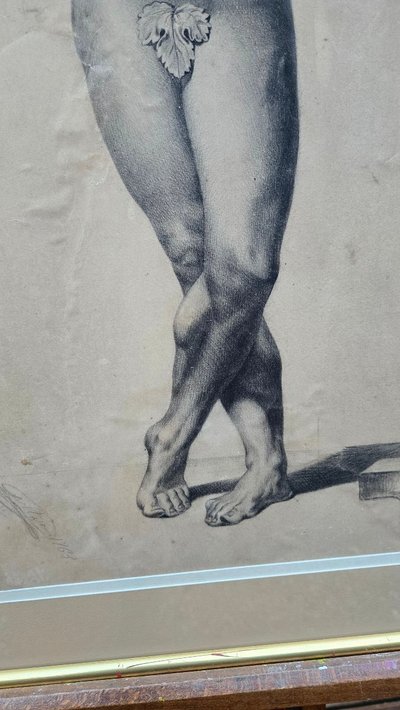
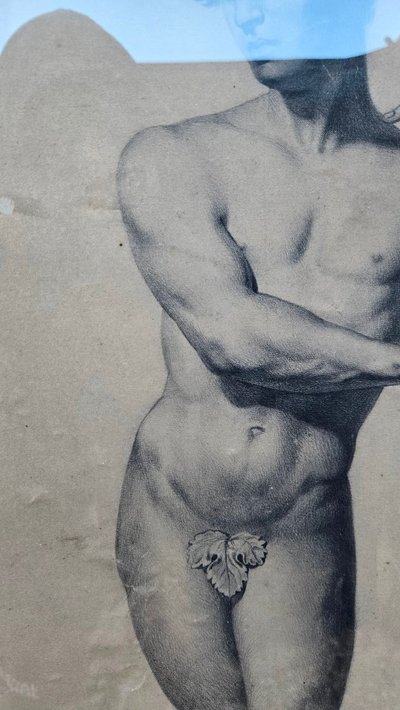
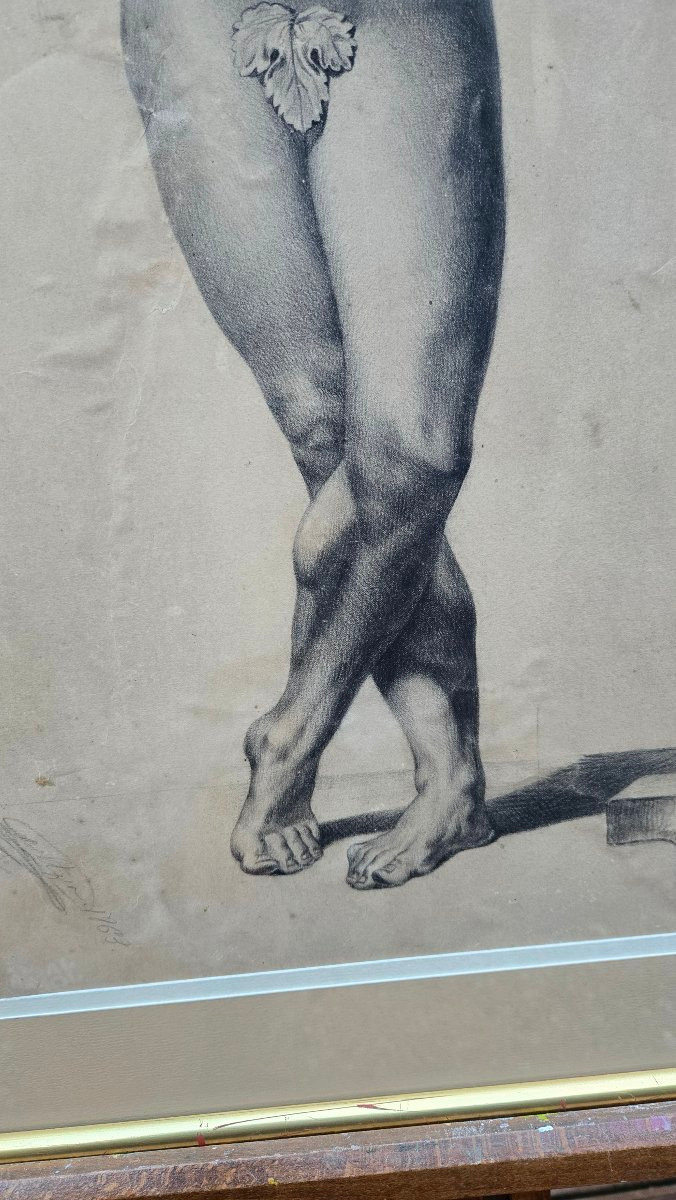
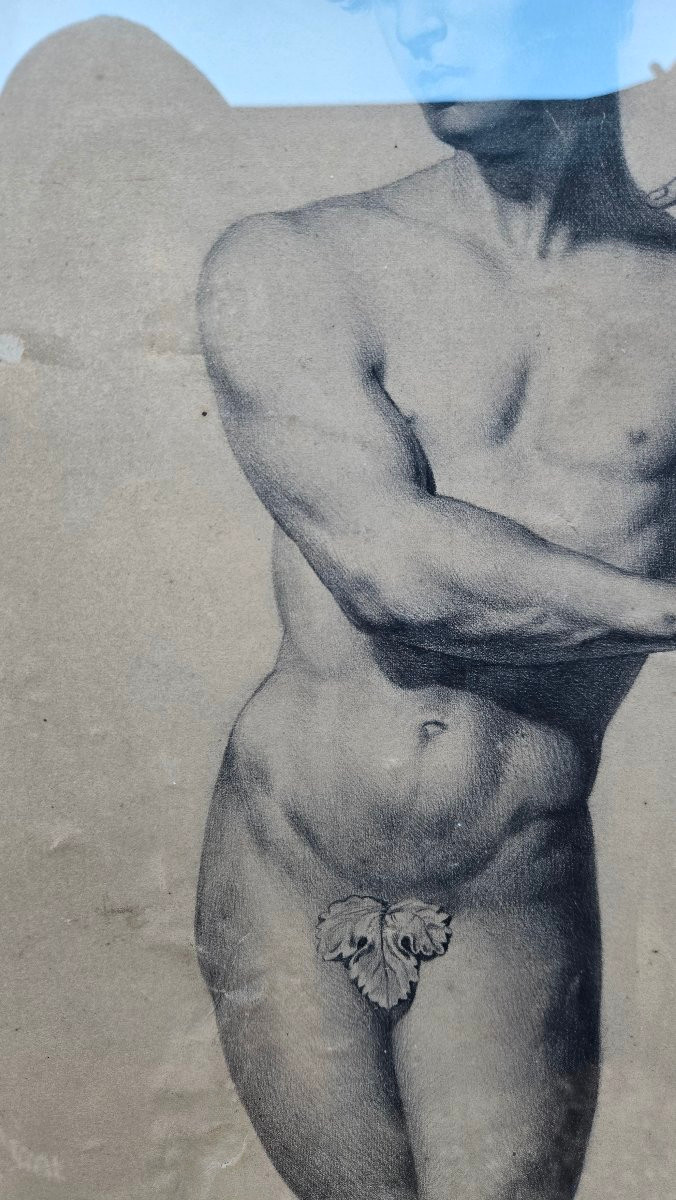
His legs are crossed, with one bearing most of his body weight while the other is positioned slightly forward, creating a sway of the hips and a natural tilt of the pelvis.
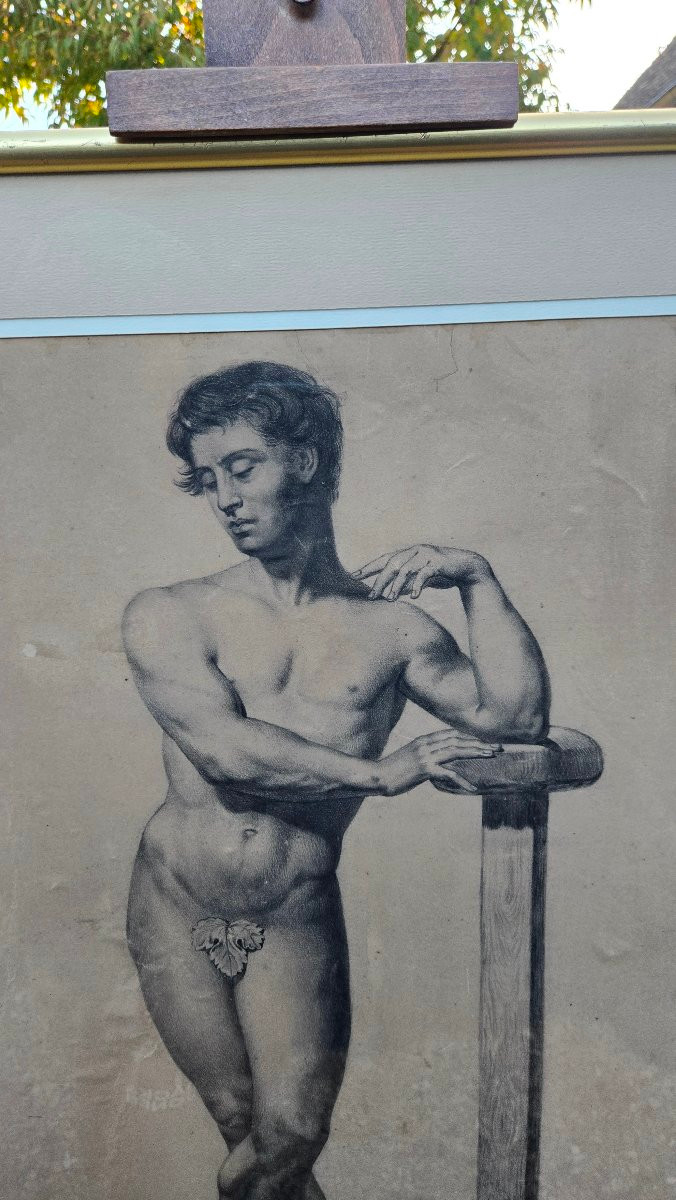
His head, slightly tilted and turned to the left, reveals a youthful face with regular features and downcast eyes. The short, wavy hair frames the forehead and temples.
This relatively relaxed posture contrasts with the more demonstrative poses of some male academic models. It nevertheless allows for the study of the anatomical changes caused by the shift in body weight, the twisting of the torso, and the position of the arms.
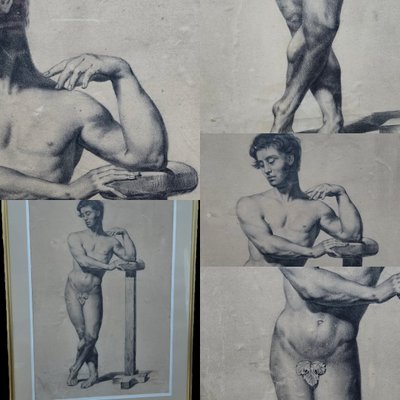
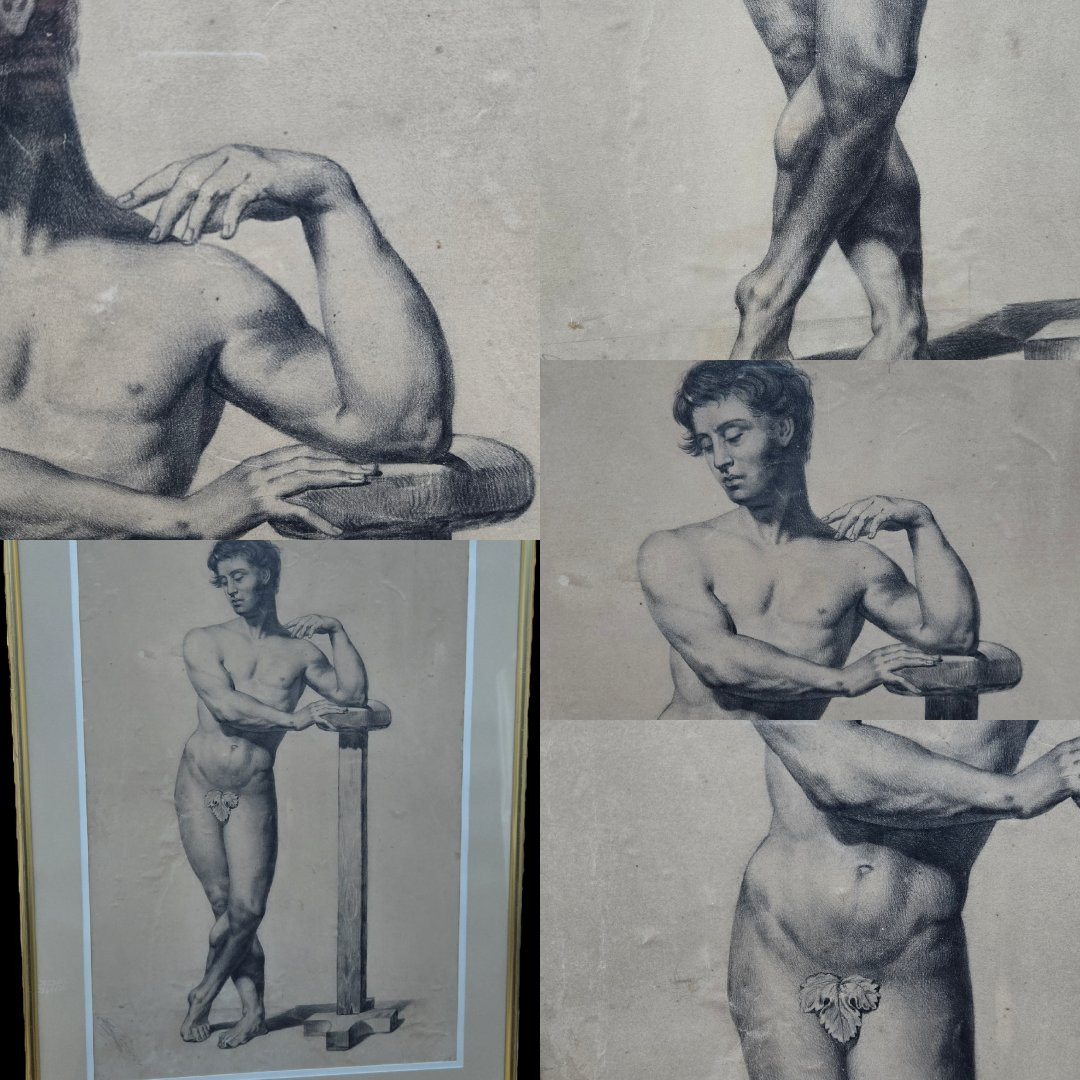
The artist’s technique relies on a network of fine, dense hatching, the density of which varies to render muscular contours and the transitions between light and shadow.
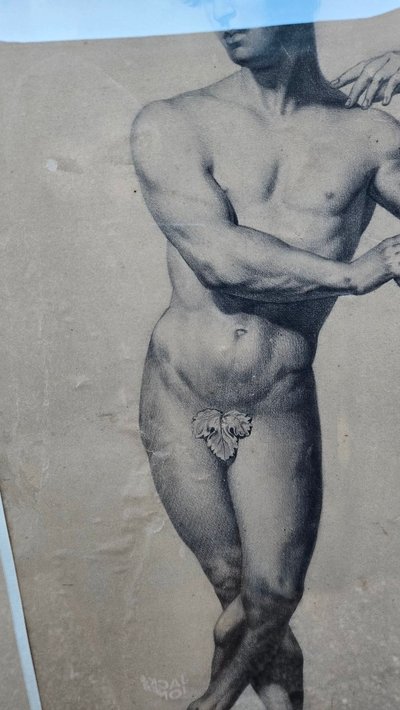
The rendering of the shoulders, arms, chest, and abdomen demonstrates a careful observation of anatomy. The contours are gradually reinforced in the shaded areas, while certain parts of the body are merely suggested by lighter strokes.
Particular attention is also paid to the hands, knees, and crossed feet, as well as to the depiction of the wooden support, whose grain and joints are indicated in the drawing.
A fig leaf conceals the model’s genitals. It is not possible to determine with certainty whether this element was part of the original composition or the result of a later alteration.
Historical Context and Academic Training
This work is part of the tradition of academic drawing practiced in the 19th century, particularly in European fine arts schools and academies.
The study of the human body was then one of the foundations of artistic training. Students gradually learned to master proportions, joints, foreshortening, and the rendering of volume by working from prints, plaster sculptures, and eventually live models.
Studies of male nudes, commonly referred to as “academies,” played an essential role in this training.
The composition presented here features a resting pose, built around a lateral support and crossed legs. This type of posture allowed students to study the effects of contrapposto, a principle inherited from ancient sculpture, in which the body’s weight rests primarily on one leg, causing a shift in the orientation of the pelvis and shoulders.
The drawing also illustrates the importance placed on modeling through light and shadow, which allowed for the rendering of anatomical volumes without the use of color.
No print corresponding exactly to this composition has been identified to date. It may be a study executed from a live model or a copy based on an engraved model that has not yet been found.
A Set of Three Male Nude Studies
This drawing is part of a set of three male nude studies, all of the same dimensions, all signed “Geltzer” and dated 1862 or 1863.
One of these compositions, titled *The Soldier at Rest*, is based on a model drawn by Marc Antoine Hervier and engraved by Alexis-François Girard.
Research has led to the discovery of this composition in the collections of the museums in Bruges, where two studies based on the same print—created by students of the Bruges Academy of Fine Arts in 1833 and 1838, respectively—are preserved.
This discovery confirms that this engraved model was used in the institution’s teaching during the first half of the 19th century.
The presence of this same composition among the three drawings signed “Geltzer” suggests that their creator may have received artistic training in Bruges.
This hypothesis, however, remains to be confirmed, as there is currently no documentation that formally establishes the artist’s identity or his enrollment at the Academy.
Signature and Date
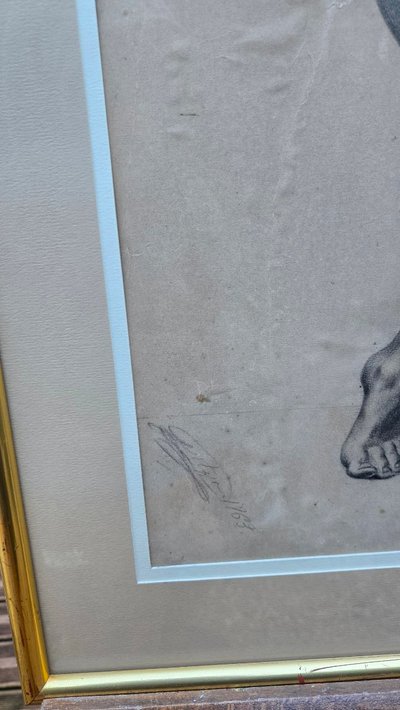
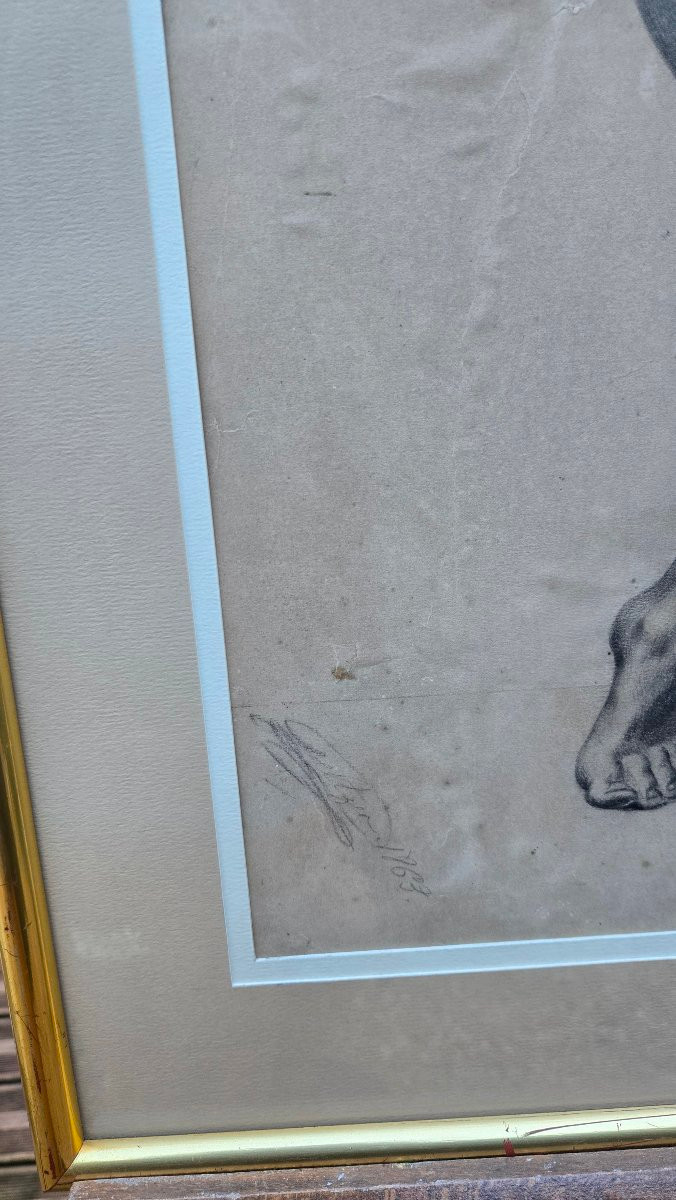
The drawing bears, in the lower left corner, the handwritten signature “Geltzer,” accompanied by the date 1863.
The identity and career of this artist have yet to be documented.
Condition and Framing
The drawing is in good overall condition, with some old creases, small marks, and slight tears.
Ref: QDIJFP6J6B
| Condition | Very good |
| Style | Second Empire style, Napoleon III style (Drawings of Second Empire style, Napoleon III style Style) |
| Period | 19th century (Drawings 19th century) |
| Country of origin | France |
| Shipping Time | Ready to ship in 4-7 Business Days |
| Location | 89260, La chapelle sur oreuse, France |
4 commitments to buy with confidence

 English
 Français
 Italiano
 Deutsch