This description has been translated and may not be completely accurate. Click here to see the original
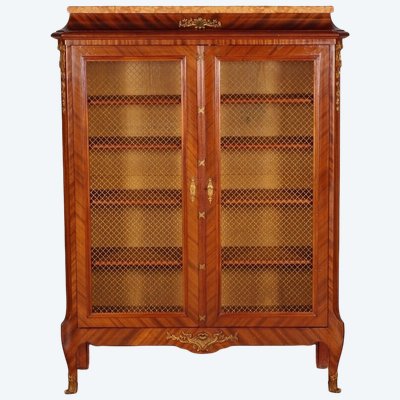
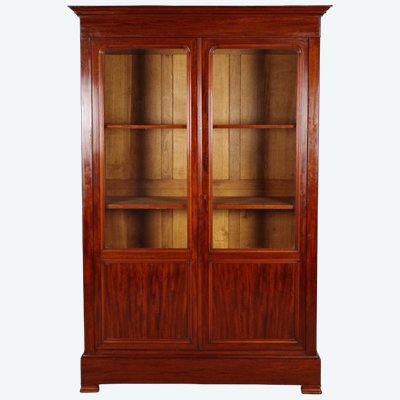
This substantial three-quarter-length bookcase belongs to the Parisian production of the Regency period, a particularly fruitful transitional phase in the history of French furniture during which the architectural rigor inherited from the reign of Louis XIV gradually softened to foreshadow the forms of the Louis XV style.
The piece opens with two arched doors revealing an interior fitted with three adjustable shelves. Its silhouette is enlivened by a molded cornice, softened corners highlighted with brass fluting, and gilt bronze ornamentation. The whole retains the characteristic combination of Regency furniture where symmetry remains fundamental while the decoration is progressively enriched with curves, scrolls, and motifs inspired by the plant world.
The veneer is made of rosewood, an exotic wood among the most prized by Parisian cabinetmakers in the first third of the 18th century. Used both during the Regency and at the beginning of Louis XV's reign, this wood is distinguished by the richness of its grain and the depth of its natural contrasts. The cabinetmaker chose to highlight the inherent qualities of the wood rather than employing complex marquetry. The sides are veneered in rosewood, composed of carefully joined sheets forming two symmetrical sets arranged book-like around a central axis.
An examination of its construction reveals a frame made entirely of softwood. Research on the major Parisian workshops of the first third of the 18th century, particularly on the work of Charles Cressent, has shown the frequent use of fir and other softwoods in the construction of frames intended to hold precious veneers. The age of the wood is clearly evident in the hand tool marks, grooves, and overall patina visible throughout the structure.
Completely demountable, the bookcase consists of a base, two side panels, two doors, and a back panel composed of two large panels positioned on either side of a wide central rail. The whole is topped with a molded cornice forming the crown of the piece. The structure is held together by four antique wrought-iron tie rods. This type of demountable construction was frequently found on important pieces of furniture from the period and facilitated their transport and reassembly.
The interior retains its original racks, carved directly into the wood, allowing the shelves to be adjusted in height. This feature is characteristic of 18th-century bookcases. The edges of the shelves are veneered, and the central shelf has a crossbow-shaped cutout, a form particularly representative of the decorative vocabulary of the Regency period.
The locks are also noteworthy. The piece retains a substantial cremone bolt lock for securing the main door at the top and bottom, as well as a forged espagnolette bolt for the second door. These elements are characteristic of the locking systems used on high-quality furniture from the first third of the 18th century.
A close examination of the piece reveals that it underwent restoration and adaptation during the 19th century. The hinges currently in place are later than the original construction, as are the old glass panes and their retaining frames. The doors may have initially been screened, a feature frequently found on Parisian Regency bookcases, before being glazed during this modernization.
Some old veneer repairs are also visible. The interior of the side panels retains several conservation interventions carried out according to traditional cabinetmaking practices. These interventions, consisting of inlaying pieces of wood into the thickness of the panels to stabilize certain natural wood movements, demonstrate careful maintenance of the piece while preserving the original elements. The shelves have also likely been modified in the past.
Some decorative bronze mounts were replaced or supplemented during this 19th-century restoration. The bronze elements we consider to be antique are primarily the corner mounts, the feet, and the keyhole escutcheons. These various alterations do not detract from the overall appearance of the piece but contribute to its preservation history.
This bookcase belongs to the family of three-quarter-length bookcases described in specialized literature. Lighter than a large two-tiered bookcase, it was designed to house books as well as porcelain, bronzes, curiosities, or collector's items displayed in the apartments of the
Ref: JXRBUFL0XY

 English
 Français
  Italiano
  Deutsch
  Crow pouch
800 € EUR
Crow pouch
800 € EUR