This description has been translated and may not be completely accurate. Click here to see the original
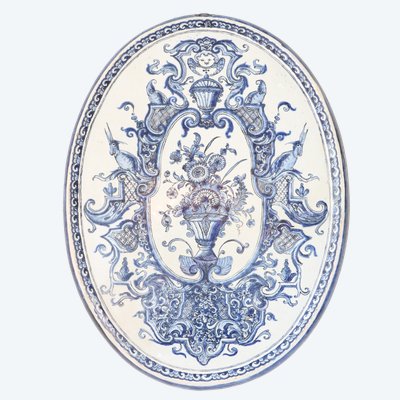
A very rare marble marquetry table (probably from an altar) featuring likely Siena yellow, Campan red griotte, Turquin gray, Carrara white, violet brocatelle, ancient Greek green, lapis lazuli, and mother-of-pearl. The composition presents a complex interplay of stylized flowers and interlacing patterns in perfect symmetry. Italian work, from Naples.
In the style of Cosimo Fanzago (1591-1678).
Early 18th century.
Usual restorations, later frame, mounted on a Plexiglas base to create a table.
H. 211 x W. 110 x D. 4.5 cm and H. 73 cm (with base)
Marble marquetry is a type of hardstone work (called pietra dura in Italian). It was very popular in Italy, particularly in Rome, and later in Florence. This taste for polychrome marbles then spread to Naples, the most important city in Southern Italy, at the beginning of the 17th century. It was very prevalent in churches, particularly on altar frontals. The architect Cosimo Fanzago was one of the leading figures of this Neapolitan school. His work is characterized by the use of a wide variety of marbles and mother-of-pearl, such as that found on our tabletop. He also used "giallo," a technique that creates a red chiaroscuro effect on the stone by heating it, a technique also used in our piece.
France was not to be outdone in its appreciation of hard stone. Indeed, under Louis XIV and with the founding of the Gobelins Manufactory, cabinets displayed in grand residences were adorned with this marquetry. Spain, too, followed the Italian talent. However, Italy remained the driving force thanks to the workshops established by the Medici family in Florence in 1588.
Ref: I2OZ3NM9LE