This description has been translated and may not be completely accurate. Click here to see the original
Superb and large engraving enhanced with watercolor by François Flameng; late 19th century
entitled "The Baths of the Ladies of the Court in the 17th Century," dated
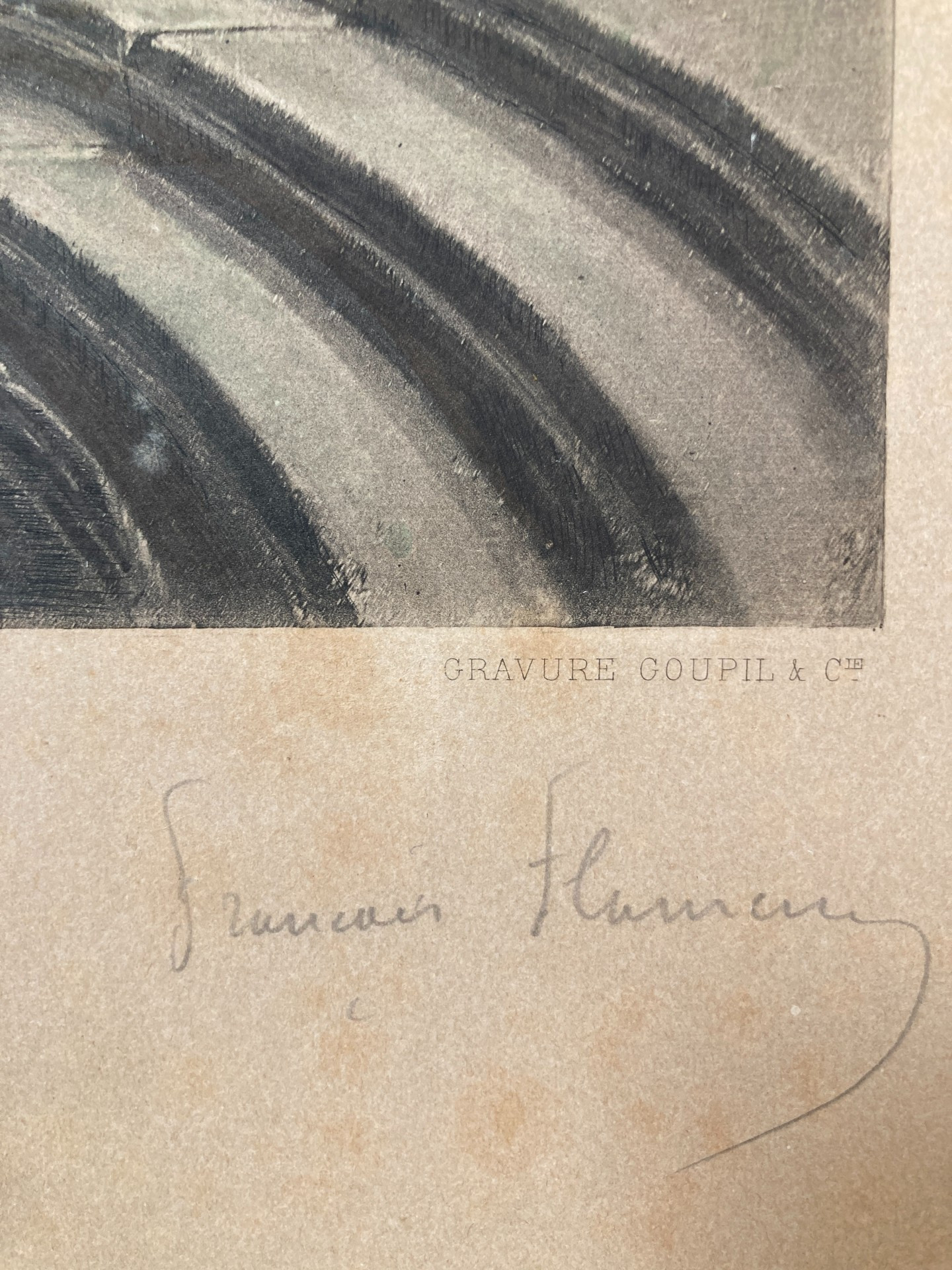
Signed lower right by François Flameng,
Lower left: Printed by François Flameng
Lower right: Goupil & Cie Engraving
Center: Printed and published April 1, 1887 by BOUSSOD VALADON & Company, successors to GOUPIL & Cie, Paris, London, The Hague
Dimensions: Image: 52/66 cm x Sheet: 64/74 cm
Condition: Unframed engraving mounted on vellum.
Our engraving is in good condition; the image is impeccable, with only a few minor foxing spots and some bleaching in the sheet below the image and title. Restoration by a professional is recommended.
Asking price: €440
Biography:
Son of the renowned painter and engraver Léopold Flameng, he learned painting from his father before entering the École des Beaux-Arts in Paris, studying in the studios of Alexandre Cabanel, Pierre Edmond Alexandre Hédouin, and Jean-Paul Laurens.
In 1875, he made his debut at the Salon des Artistes Français with his painting "Le Lutrin" (The Lectern). Appreciated by Tsar Alexander III, who purchased his painting "Baignade des dames de la cour au XVIIIe siècle" (Bathing of the Ladies of the Court in the 18th Century), he was invited to Gatchina, Russia, in 1894 to paint a series of portraits of aristocratic figures and members of the imperial court.
In 1900, he created the decorative panel "Paris" for the main hall of the restaurant Le Train Bleu at the Gare de Lyon in Paris.
François Flameng was appointed professor at the École des Beaux-Arts in Paris in 1905, where he taught many students. He became a member of the Académie des Beaux-Arts that same year, replacing William Bouguereau.
François Flameng (1856-1923), a master of eclecticism
With *The Call of the Girondins*, Flameng began his revolutionary cycle, a series of five paintings created between 1879 and 1885. These were followed by *The Conquerors of the Bastille* in 1881, *Camille Desmoulins* in 1882, *The Massacre at Machecoul* in 1884, and *Marie Antoinette Going to Her Execution* in 1885, which, receiving a rather cold reception at the Salon, concluded the cycle. Flameng thus distinguished himself in this first part of his career as a recognized history painter, aided in this by the Under-Secretary of Fine Arts, Edmond Turquet. Flameng had married Turquet's daughter, Henriette, in 1881, and it was thanks to Turquet that he received the commission for the Camille Desmoulins for the sum of 12,000 francs. However, the artist did not limit himself to these "grand works," which conveniently benefited from the approaching centenary of the French Revolution, and he also began, in the 1880s, to exhibit genre scenes in the Neo-Rococo style. This style was very fashionable at the time, when the 18th century was attracting and captivating, and it suited Flameng all the better because, as a talented colorist and meticulous craftsman of detail, he could offer charming and well-researched scenes.
Amidst a prolific and active output, one work achieved far greater success than the others: The Bath of the Ladies of the Court: 18th Century.
The painting was exhibited at the Salon in 1886 and captivated the Goupil firm, art dealers who were then capitalizing on the Neo-Rococo trend among collectors. It was resold in 1888 to Emperor Alexander III of Russia, who, like other members of the Russian imperial family, was an admirer of Flameng's work.
Ref: 56KNSDMMPK

 English
 Français
  Italiano
  Deutsch
  Ancestor statue, Nias Island, Indonesia
620 € EUR
Ancestor statue, Nias Island, Indonesia
620 € EUR