Would you like more images?

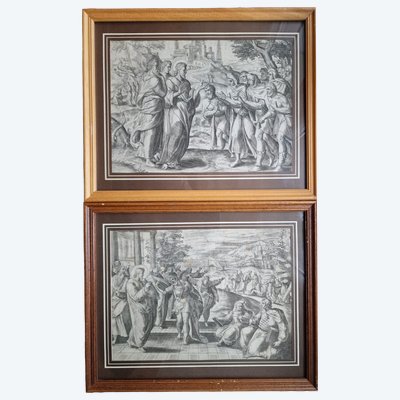
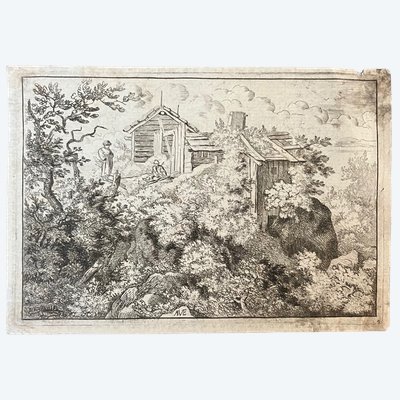
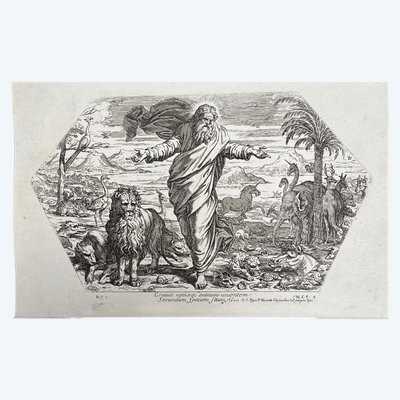
These engravings are part of a series of 25 prints called "les gueux" or "les mendiants", "les barons". Numbered 12 and 16, they were published with the 23 others between 1622 and 1623 in Nancy (France). Number 12 depicts a beggar (a person living on alms) dressed in a simple cloak, head and feet uncovered. Number 16 shows a beggar woman standing on crutches. Dimensions: Sheet: 5.9 x 9.05 inches Visual: 3.93 x 5.9 inches Jacques Callot was a 17th-century draftsman and engraver from Lorraine. He is considered one of the masters of engraving. His engravings are characterized by great sharpness and deep inking. The scenes depicted are very numerous on fairly small surfaces. He began his apprenticeship in Rome in 1609. He joined his friend Israël Henriet. He met artists such as Antonio Tempesta, an aquafortist. He entered the workshop of Philippe Thomassin, who taught him the technique of burin engraving. At the end of 1611, he moved to Florence, under the Medici protectorate. He produced 15 of the 29 plates entrusted to Antonio Tempesta, where he experimented with etching. He then became the engraver for the festivities organized at the Uffizi Palace. From 1621, he returned to Lorraine. He then published picturesque series based on his memories of Italy, the Bali and the Gobbi. He also produced a series entitled The Beggars. He also began work on a 490-plate series entitled Le Livre des Saints, published after his death. During this period, he also produced a sequel entitled Les Bohémiens, as well as Les Supplices. His main work remains a series of eighteen engravings entitled Les Misères et les malheurs de la guerre. This work deals with the devastation caused by the Thirty Years' War (1618-1648).
Ref: NZLV3HAWOX
| Condition | Very good |
| Style | Louis XIII style (Engravings, Prints of Louis XIII style Style) |
| Period | 17th century (Engravings, Prints 17th century) |
| Country of origin | France |
| Artist | Jacques Callot |
| Width (cm) | 15 |
| Height (cm) | 23 |
| Depth (cm) | 1 |
| Internal reference | LU2663326445542 |
| Shipping Time | Ready to ship in 4-7 Business Days |
| Location | 76210, Beuzevillette, France |
4 commitments to buy with confidence

 English
 Français
 Italiano
 Deutsch