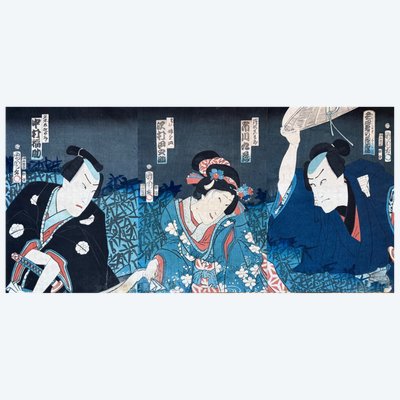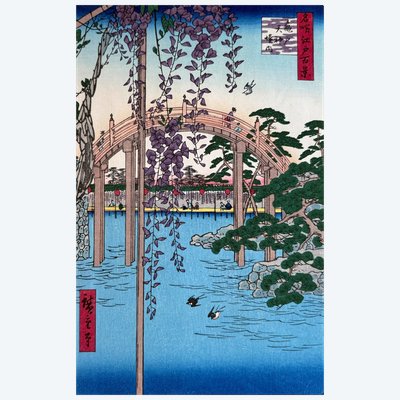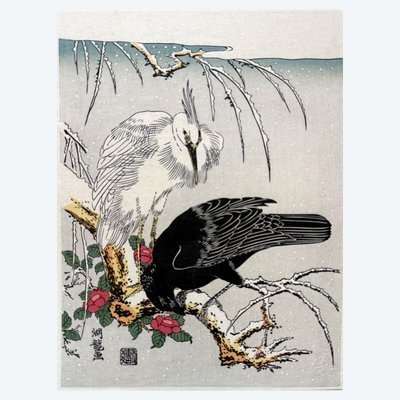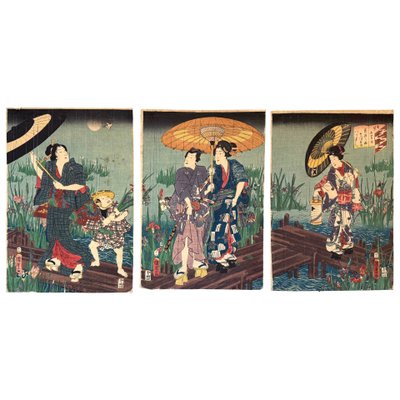
With this triptych by Toyohara Kunichika, the eye is immediately drawn into the sumptuous world of kabuki theater, a world of splendor, color, and presence. In the center, the Sanbasō dancer dominates the composition with his imposing striped headdress and vibrant sleeves, while the two richly dressed figures on either side frame the scene as if in a theatrical apparition. Everything is designed to capture the eye: the deep blues of the background, the intensity of the reds, the profusion of floral motifs, and the delicacy of the faces combine to create an image of great visual power. One moves from one panel to the next as if following the rhythms of a ceremonial dance, drawn in turn by the fabrics, the poses, and the silent tension that unites the characters. More than a simple scene of actors, this print revives the spectacular refinement of Meiji-era kabuki. This is a work that immediately commands attention and captivates with both its decorative brilliance and its elegance.
About this edition: This multicolored ukiyo-e triptych by Toyohara Kunichika illustrates a scene from Ayatsuri Sanbasō, an emblematic subject of the Japanese theatrical repertoire. The composition brings together three actors depicted with all the splendor and tension characteristic of Meiji-era kabuki. The faces, the richly ornamented costumes, and the intensity of the flat colors give the whole a spectacular presence, characteristic of Kunichika's finest prints. The work retains all its decorative power, despite slight soiling that does not detract from the legibility or the overall brilliance of the triptych.
Artist: Toyohara Kunichika
Title: Sanbasō
Japanese Title: 操り三番叟
Romanization: Ayatsuri Sanbasō
Format: Triptych
Technique: Japanese woodblock print
Edition: Meiji era original
Dimensions: Three panels, each 36.2 × 24.5 cm
Condition: Slightly soiled
Origin: Japan
About the artist: Toyohara Kunichika is one of the great masters of late 19th-century Japanese prints, particularly admired for his kabuki scenes and actor portraits. His work is distinguished by the intensity of its expressions, the boldness of its compositions, and an exceptional sense of color. With Sanbasō, he fully deploys this art of printed theater: a spectacular, refined image, immediately legible, yet rich enough to hold the viewer's gaze for a long time. The subject of Sanbasō occupies an important place in Japanese theatrical iconography, which further enhances the appeal of this triptych.
Ref: SHGWSGTK5C
| Style | Asian Arts (Engravings, Prints of Asian Arts Style) |
| Period | 19th century (Engravings, Prints 19th century) |
| Country of origin | Japan |
| Artist | Kunichika |
| Length (cm) | 36.2 |
| Height (cm) | 24.5 |
| Materials | Paper |
| Shipping Time | Ready to ship in 2-3 Business Days |
| Location | 75008, Paris, France |
4 commitments to buy with confidence

 English
 Français
 Italiano
 Deutsch