This description has been translated and may not be completely accurate. Click here to see the original
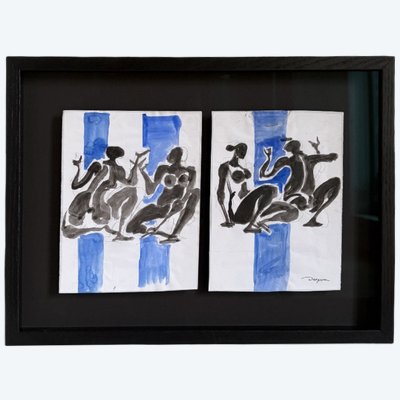
Jacques Despierre (1912-1995)
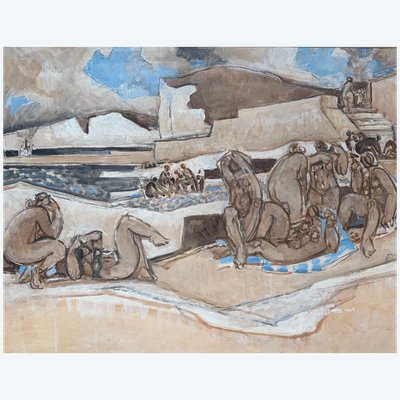
Santorini, 1976
Color lithograph
Signed and numbered out of 150
75 x 54 cm
(Stained oak frame and museum glass)
"The Greek sun erased the structural lines imposed on me by certain French landscapes; it erased them with its heat, its light, the shimmering of its facets, its prisms, and also with my desire to rediscover a kind of synthesis of light through black and white."
Despierre
Son of the painter Edmond Ceria, Jacques Despierre was introduced to painting at a very young age. He began his studies at the Académie Colarossi, then at the Académie Scandinave, where he studied under Charles Dufresne, who emphasized the necessity of a structured architecture in the composition of a painting. Despierre entered the École des Beaux-Arts in 1929, studying in Lucien Simon's studio. At the Louvre, he admired Chardin, Corot, and especially Delacroix. At his father's request, Despierre also began learning engraving and illustrated his first book in 1930.
His friendships with Gruber, Tailleux, Tal Coat, Lasne, Brayer, Humblot, and especially Rohner fostered a spirit of emulation. In galleries, Despierre discovered Picasso, Bonnard, and Matisse, and later met Jacques Villon, Charles Despiau, and Marcel Gromaire, whom he admired. Thanks to the architect Jean-Charles Moreux, he discovered that "the surface is simultaneously a concrete and abstract phenomenon," a subject he explored further through reading Mattila Ghycka. His first exhibition was held at Jeanne Castel's gallery in 1938, the same year he won the Paul Guillaume Prize. During and after the war, he produced decorative art: painted furniture and tapestries for Jacques Adnet, frescoes for the Faculty of Pharmacy in Paris, and later for the ocean liners La Marseillaise and Ile de France, among others. Numerous public institutions continued to commission his work throughout his career.
Despierre exhibited regularly at the Galerie Charpentier, the Galerie de l'Elysée, and later at the galleries of René Drouet and Marcel Guiot (on two occasions). His work received rave reviews, particularly from Waldemar Georges, George Besson, Pierre Cabanne, and Jean Bouret. In 1969, Despierre was elected a member of the Académie des Beaux-Arts, and the following year, the Galerie de Paris dedicated an exhibition to his work, featuring views of the Loire River, Greek gardens, and bathers. Seven years later, the Wildenstein Gallery exhibited a collection of Greek landscapes and paintings of horses. Tributes were paid to him as early as 1973 at the Monnaie de Paris (Paris Mint) and the following year in Saint-Étienne. Exhibiting at numerous Salons such as Tuileries, Automne, Comparaisons, Peintres Témoins de leur Temps, and École de Paris, Despierre was a founding member of the Salon de Mai, which bears his name.
Like Renaissance artists, Despierre embraced all techniques: he created murals and mosaics, illustrated books, designed carpet and tapestry cartoons for the Mobilier National (National Furniture Collection) and vase decorations for Sèvres porcelain, created the stained-glass windows for Notre-Dame de Liesse, and designed 80 medals for the Monnaie de Paris. Popular with young people and a natural teacher, Despierre succeeded Gromaire as head of the mural art workshop at the École des Arts Décoratifs (School of Decorative Arts), where he introduced the teaching of fresco and mosaic techniques.
His works are notably preserved at the Centre Pompidou, the Musée d'art moderne de Paris, the Musée des Beaux-arts d'Orléans, the Musée de Grenoble, the Mobilier National and the Victoria & Albert Museum.
Ref: C6HZKE0XNL