This description has been translated and may not be completely accurate. Click here to see the original
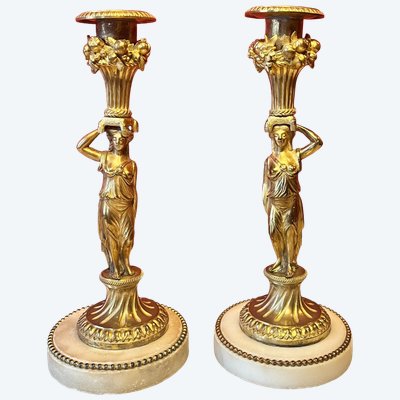
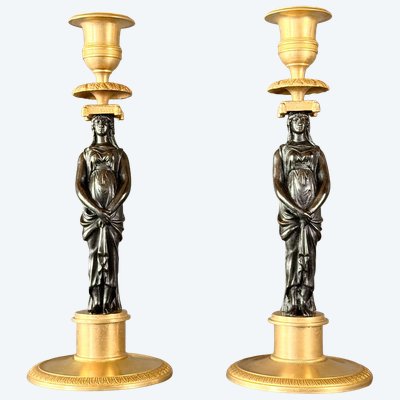
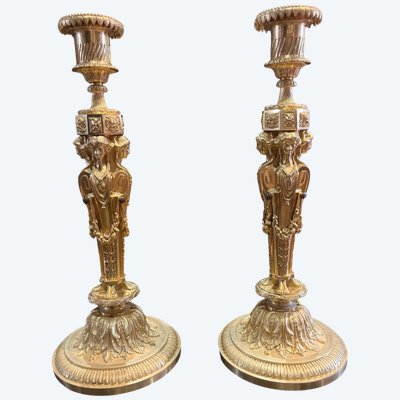
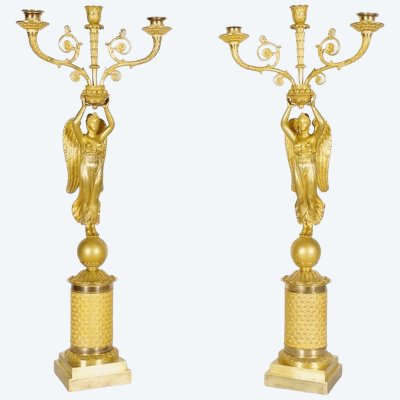
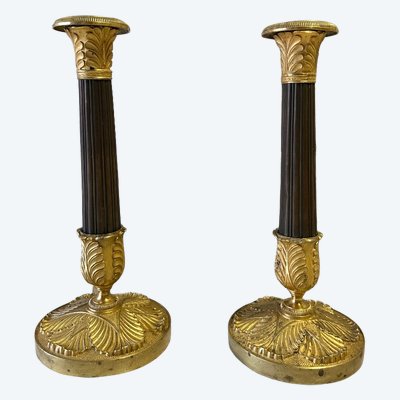
Pair of large bronze candlesticks with two patinas (gold and brown); the shaft depicts two caryatids—women draped in the classical style, each holding a cushion and a kalathos on her head, upon which the binet rests; cylindrical gray marble pedestal adorned with chains on a square base, in the “Retour d’Egypte”* style, dating from the Consulate period (1800) to the early 19th century.
These candlesticks are in very good condition and are of exceptional quality.
Please note: slight scratches and signs of age, tiny micro-chips on the edge of the marble; see photos.
* The “Retour d’Egypte” style:
Egyptian influences have been prominent since the Battle of the Pyramids and the capture of Cairo in July 1798 by General Bonaparte. Napoleon organized a scientific and cultural expedition to Egypt, bringing together men of the arts and sciences. The publication of the expedition’s findings: *“Description de l’Égypte,”* begun in 1802 and finally published in 1826, was brimming with new insights, inspired numerous artists, and offered an unexpected vision of these mysterious regions that transformed the French cultural landscape through architecture and the decorative arts. A veritable fashion trend spread from France to all of Europe, even as far as Russia. Houses, fountains, and interiors were decorated in the Egyptian style. This contemporary style of the Consulate era was called the “Return from Egypt.” This style lasted only a very short time (about ten years) before being replaced by the Empire style. New ornaments then appeared: heads adorned with the nemes, scarabs, sphinxes, winged lions, caryatids, and lotus motifs were widely incorporated into classical-style furniture; as well as in many objects: the Sèvres porcelain manufactory created Egyptian-style tableware sets, sphinxes were used as andirons or inkwells, and candelabras were supported by Egyptian women. The legs of chairs are generally sabre-shaped at the back and turned or shaped like animal hooves at the front, thus evoking Egyptian models. The crook-shaped backrest is common; it would disappear during the Empire period.
See ProAntic Magazine Article
Dimensions
Height 41.5 cm
Base 10 cm x 10 cm
300 407
All photos are available at:
www.antiques-delaval.com
Ref: TTLH2NEJID

 English
 Français
 Italiano
 Deutsch
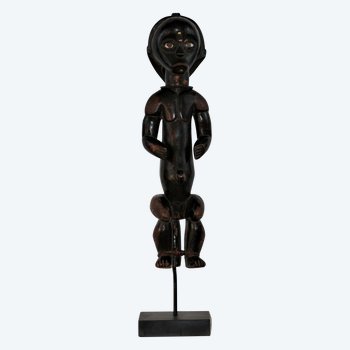
 Fang sculpture, Gabon
580 € EUR