This description has been translated and may not be completely accurate. Click here to see the original
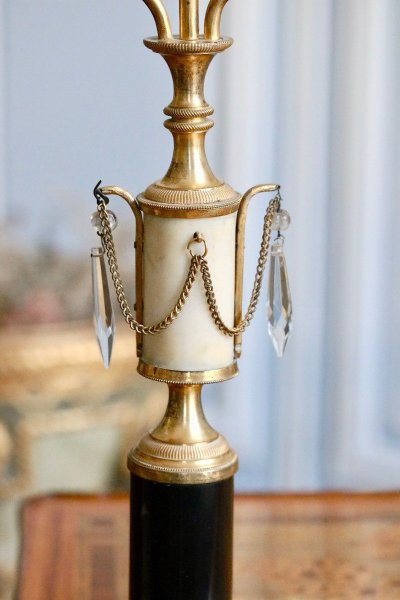
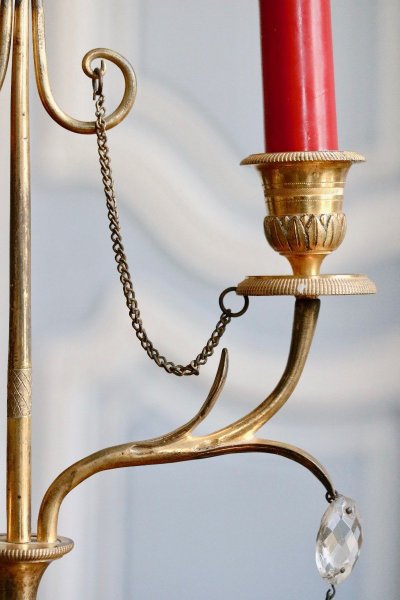
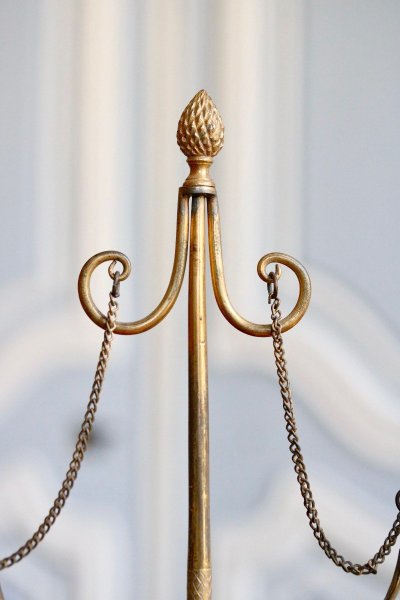
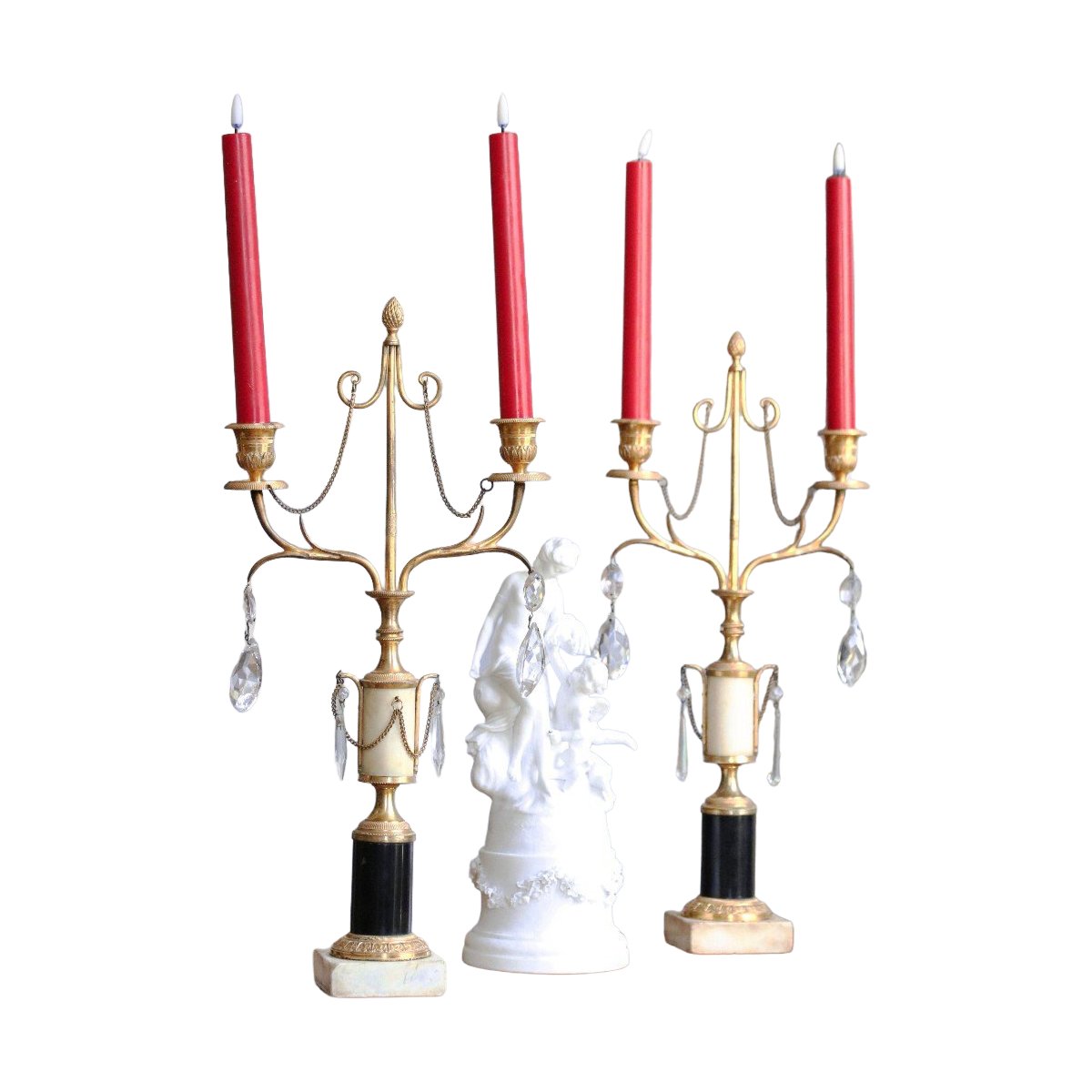
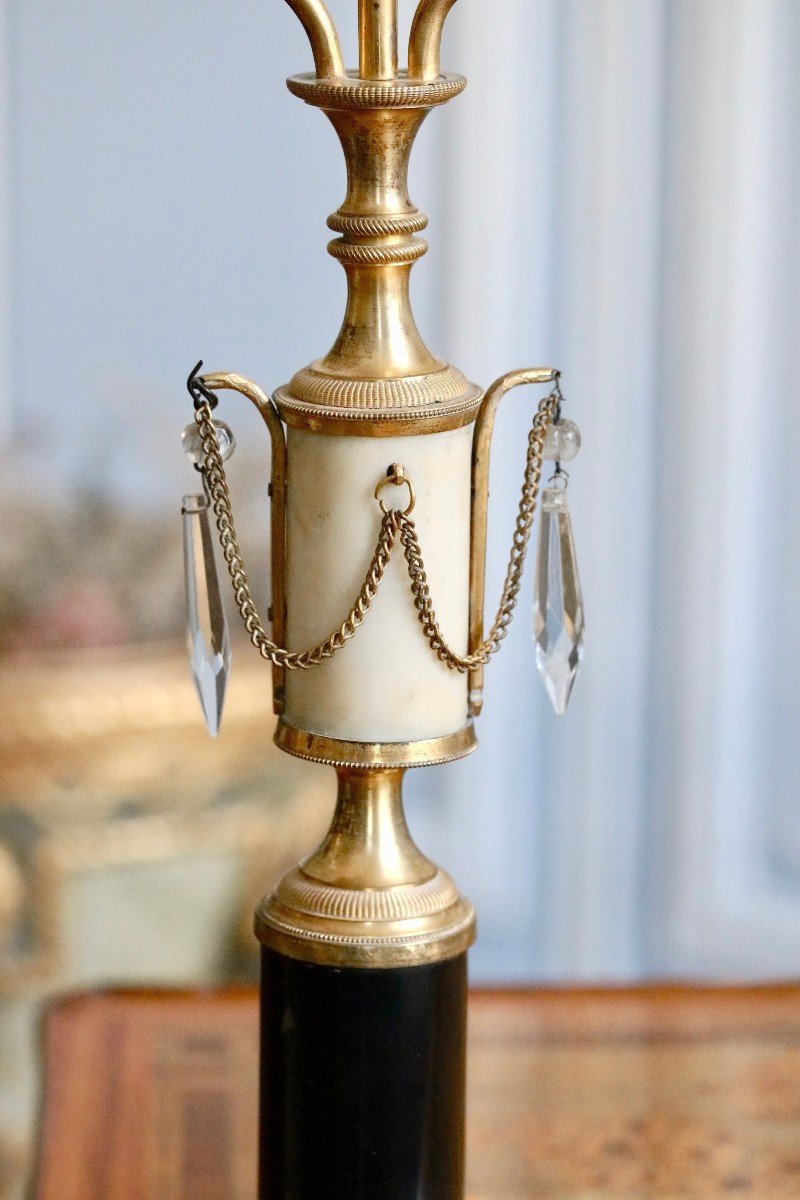
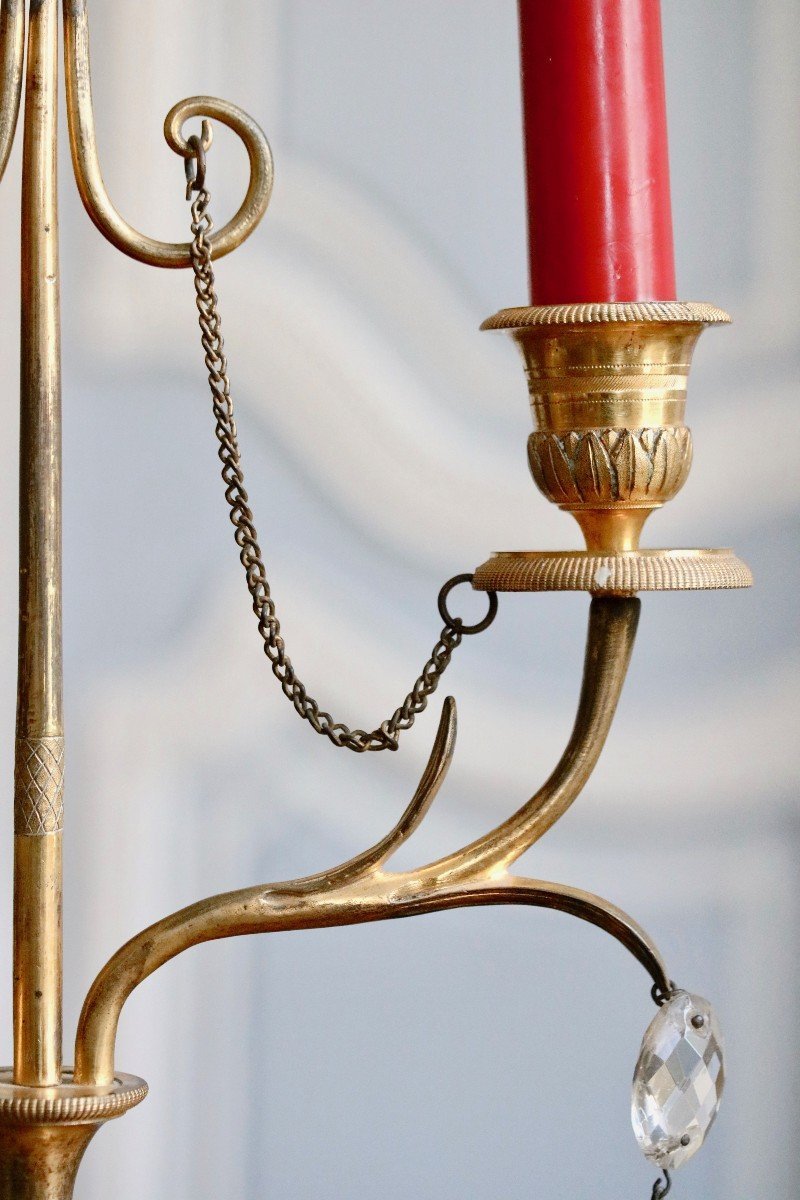
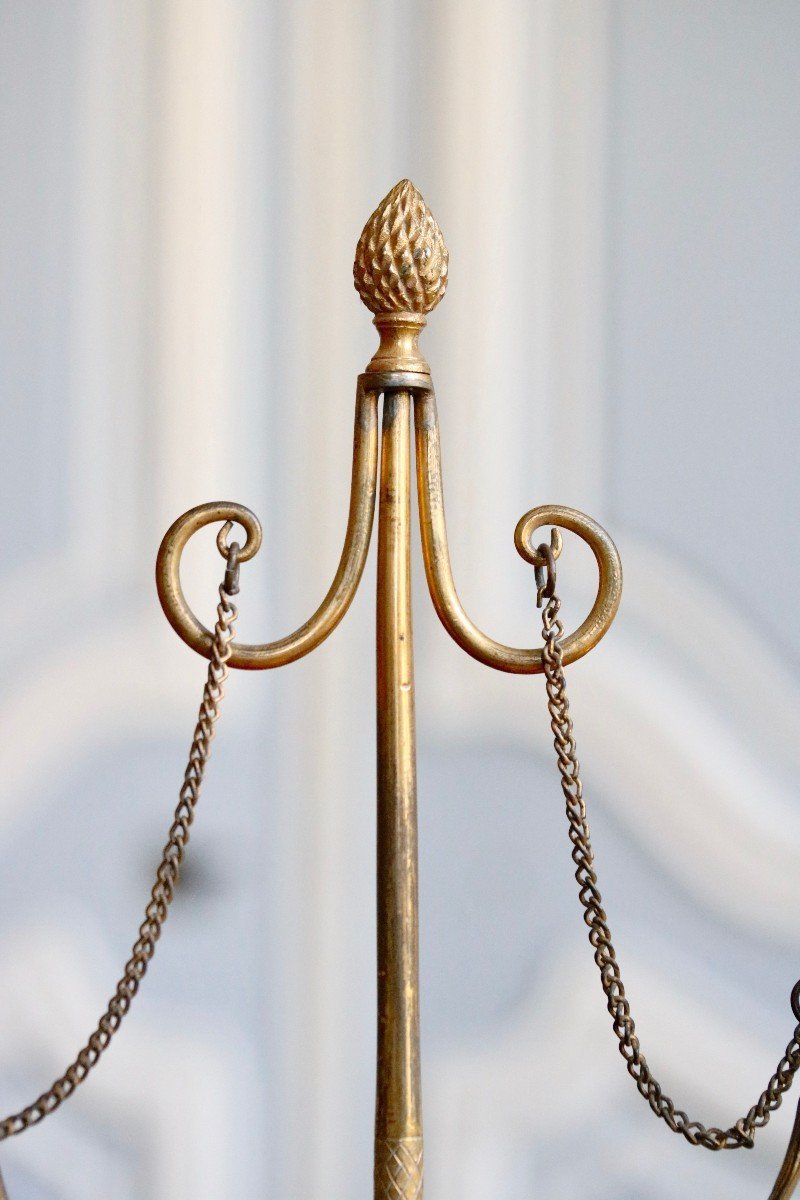
A pair of two-light candelabra in gilt and chased bronze, adorned with crystal drops. Each candelabra is surmounted by a pine cone. The candle holders are decorated with palmettes. The stem is composed of shortened columns, one in white marble adorned with gilt chains and crystal drops, the other in black marble. The candelabra rest on a circular base mounted on a square plinth of white marble.
Swedish work
Louis XVI period
Usual restorations
H. 48.5 x W. 17 cm
The pair of candelabra presented here is a perfect example of the evolution of candelabra design from the 1770s onward. Although Swedish, these candelabra clearly show a French influence. Thus, the complex, lively, and natural forms of the Rococo style gave way to classical forms: circular and square models appeared, and angles became increasingly prominent during this period. Candelabra were no exception, as this pair demonstrates: the stem of shortened columns supported by a circular base in the form of a torus and plinth, itself resting on a marble base, is characteristic of the Neoclassical evolution of the late 18th century, inspired by classical forms.
We cannot discuss this pair of candelabra without mentioning the artistic relationship between France and Sweden. This relationship did not begin in the 18th century: throughout the Middle Ages, exchanges between these two Catholic countries were facilitated by Cistercian monks. The construction of cloisters and churches in Sweden was thus regular, at least until the advent of the Protestant Reformation, which began in the first half of the 16th century in Sweden, during the reign of King Gustav I Vasa (reign: 1523-1560). With patronage no longer coming from the Church, the monarchy took over. It was under Gustav I, on the occasion of the renovation of his palace, that the first name of a French artist is mentioned. This French influence would only increase over the decades, with the 18th century seeing the rise to prominence of one of the most Francophile Swedish artistic families: the Tessins. Nicodemus Tessin the Younger was the first member of this family to employ French artists, such as Bernard Fouquet and René Chauveau, for the renovations of the Royal Palace in Stockholm, which began in 1688. Carl Gustaf Tessin, Nicodemus's son, was also one of the most influential ambassadors of Swedish art in France. He left Sweden in 1714, at the age of 20, for his first stay in Paris to complete his studies. He returned to Paris between 1728 and 1729 as ambassador to secure French support in the war between Sweden and Russia, but his true interest lay in art rather than politics. He formed friendships with many French artists of the time, such as Chardin and Boucher, from whom he acquired several works. Tasked with decorating the Royal Palace of Stockholm, a responsibility he inherited from his father upon his death in 1728, he drew inspiration from his father's working methods: employing French artists, such as the sculptors Michel Lelièvre and Pierre David, and the painters Thomas-Raphaël Taraval and Nicolas Deslaviers, who decorated it in the style now known as "Louis XV." Relations between France and Sweden are also documented through the memory of political ties with the Francophile Queen Christina of Sweden in the 17th century, as well as through literature, particularly that of Voltaire, who wrote *History of Charles XII, King of Sweden*, published in 1731.
Ref: UT27ALDO26

 English
 Français
 Italiano
 Deutsch
 Light stand, 17th century.
1.200 € EUR