

Would you like more images?


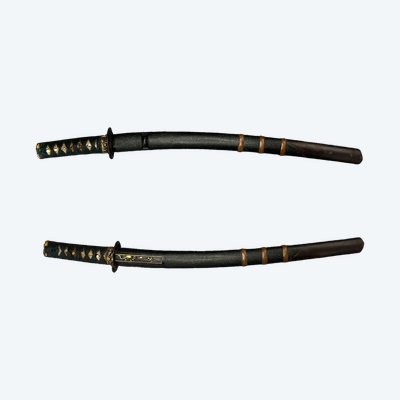
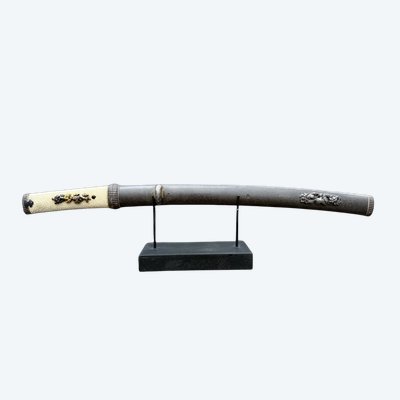
SABER called Wakizashi
Japan - Edo period (1603-1868)
Steel, wood, lacquer, copper, horn, gold, shakudo
Nagasa: 39.4; Nakago: 12.2 cm
Sori: 0.9 cm
Hira Tsukuri type blade, Mune Takashi, Hiro Suguha type Hamon.
Yaki Zume type boshi.
Nakago Funa Gata and Ha Hagari Kuri Jiri.
Daitsuki-niju-habaki in copper.
Wooden saya covered with ringed black lacquer.
Kojiri, Kuri Gata and Koi Guchi in lacquered buffalo horn.
Shitodome in chiseled brass.
Tsuka ito in wood, covered with shagreen, braided with blue silk.
Kogatana with copper Kotsuka, inlaid with Ashinaga-tenaga in golden robes – a pair of yōkai from Japanese folklore, composed of two complementary beings: Ashinaga-jin (足長人), with disproportionately long legs, and Tenaga-jin (手長人), whose arms are exceptionally long. Their first mention appears in the Japanese encyclopedia Wakan Sansai Zue. When depicted together, they symbolize mutual aid and cooperation, each compensating for the other's limitations with their own abilities.
Iron Menuki.
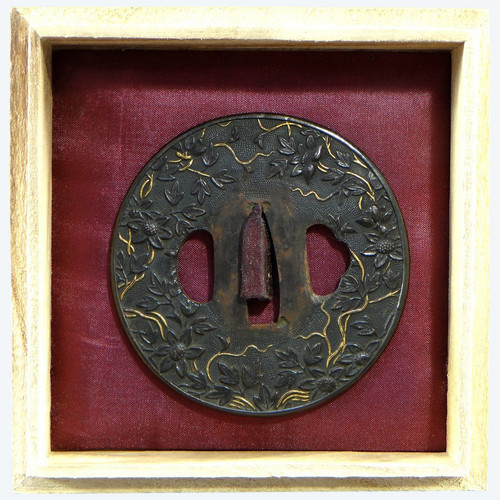
Iron Tsuba Mokko Gata, inlaid with copper plum blossoms highlighted in gold, a bird flying above them; a stream is engraved on the reverse.
Copper Fuchi engraved with a tree and a kakemono highlighted with shakudo and gold.
Chiseled copper kashira depicting a Buddha whose earlobe is held by a small man.
Chiseled copper seppa.
Ref.: 6419
Text and photos © FCP CORIDON
Ref: LBRVAN0OBF
| Condition | Very good |
| Style | Asian Arts (Swords, Bladed weapons of Asian Arts Style) |
| Period | 18th century (Swords, Bladed weapons 18th century) |
| Country of origin | Japan |
| Shipping Time | Ready to ship in 2-3 Business Days |
| Location | 93400, Saint-Ouen, France |
4 commitments to buy with confidence

 English
 Français
  Italiano
  Deutsch