This description has been translated and may not be completely accurate. Click here to see the original
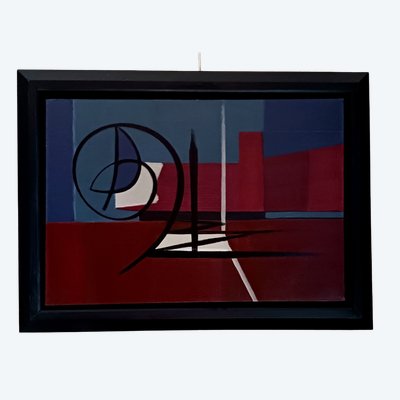
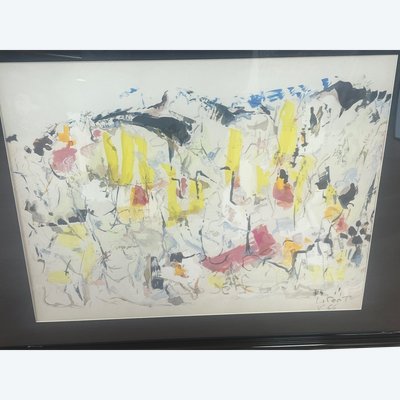
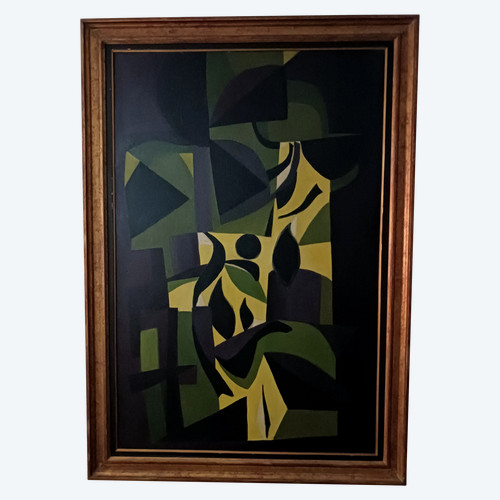
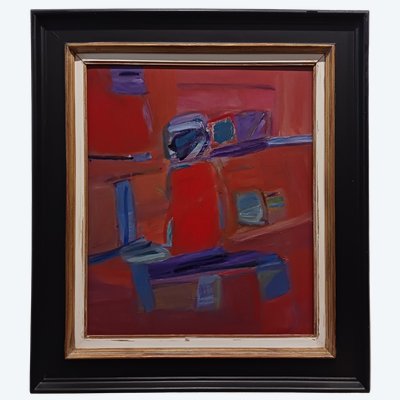
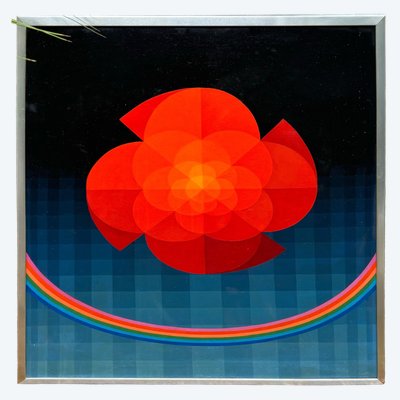
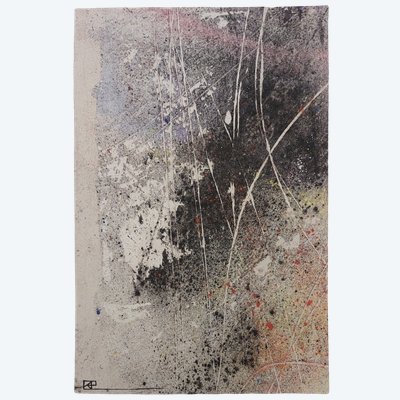
Painting by Carlo Marangio (acrylic on paper). In superb condition. Presented with a frame; it will be shipped without the glass (too risky given the size of the artwork and its framing; the frame, which is included, shows some signs of wear). Auction record (live auction): over 2,000 euros.
Dimensions of the artwork: 47 / 63 cm; with frame: 66 / 82 cm.
Carlo Marangio is an Italian painter, an Expressionist in his youth who later turned to abstraction; he was born on May 29, 1936, in Lecce. After studying fine arts in Lecce and then in Florence, he lived in France from 1960 to 2006. He has lived in Milan since 2006.
Biography
A native of Puglia, Carlo Marangio studied at the Ciardo-Pellegrino Art Institute in Lecce, then at the National Art Institute (it) in Florence. His early works—still lifes and landscapes of the Salento region—earned him two first prizes in regional group exhibitions and a selection to participate in the Biennale of Young Artists in Rome.
In 1960, after graduating and following a solo exhibition in Milan—where he had settled—that earned him the encouragement of art historian Franco Russoli (then director of the Brera Art Gallery), with nothing to his name but 1,000 lire, Carlo Marangio traveled to Paris intending to stay only briefly, hoping to fulfill his dream: to admire Leonardo da Vinci’s *Mona Lisa* up close at the Louvre. In reality, he settled there and lived for nearly half a century, returning to Milan only in 2006.
Carlo Marangio would then classify his entire body of work under the title *Objects in Space*, thereby challenging the idea of pure abstraction and asserting, on the contrary, the persistence of his interest in representation. The fruits and vegetables from his early still lifes are not actually absent but rather unrecognizable; “their original, natural forms are fragmented and reconstructed in different configurations, yet the invisible presence of the table is always felt.” This shift in Carlo Marangio’s work—which can be traced to his simultaneous encounter with new artistic movements in Paris—is not perceived by Jean Cathelin as a radical break with figuration, but rather as a synthesis “of the sense of movement in the Italian Futurist school, the sense of stillness arising from Giorgio Morandi’s metaphysical investigations, and Alberto Magnelli’s pure plastic research”: objects are stripped of any anecdotal weight or literary association to become pictorial elements within a recreated order, designed to satisfy the eye and the mind.
In the apparent break represented by *Objects in Space* in Carlo Marangio’s work, Roberto Sanesi observes, to the detriment of sensual concerns, a more expressionist formulation based on the clarity of the sign, suggesting that “these compositions, with their constant dismantling and reconstruction—simultaneously agitated and motionless—and their vaguely concentric structures, assert a sort of Cubist appropriation of space.”
Ref: AVMRD8HA8T

 English
 Français
 Italiano
 Deutsch
 Jean PIAUBERT
12.700 € EUR