This description has been translated and may not be completely accurate. Click here to see the original
Reference:
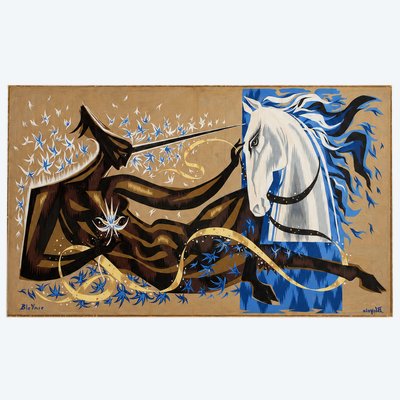
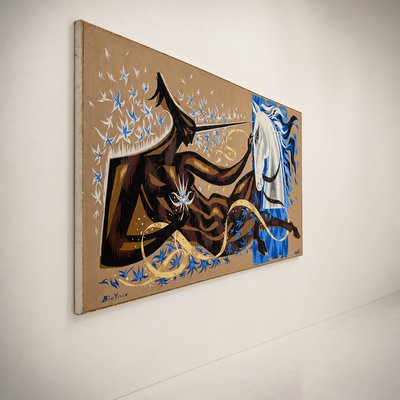
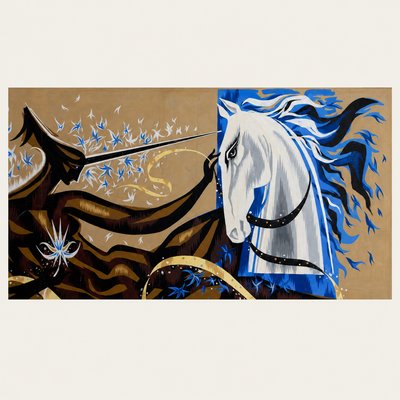
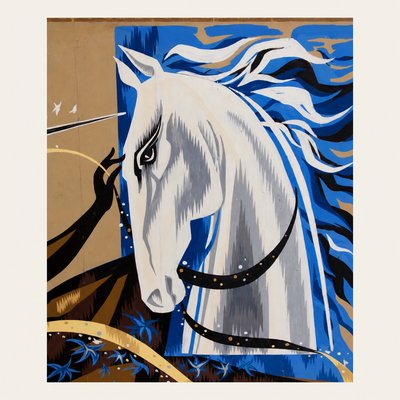
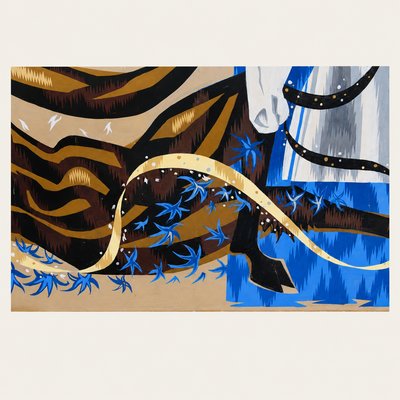
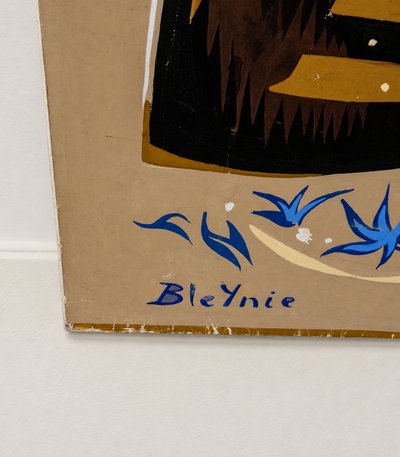
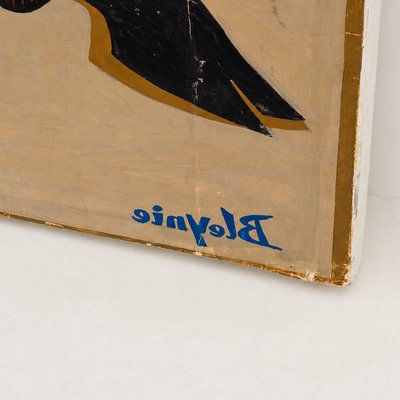
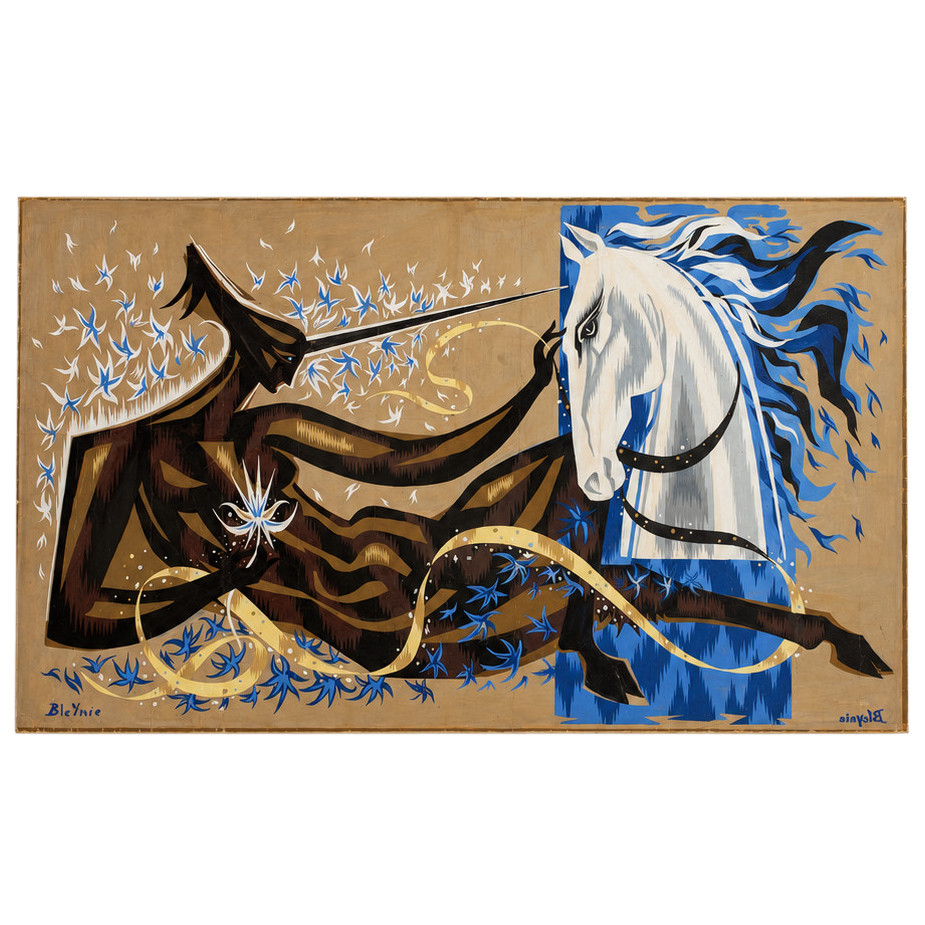
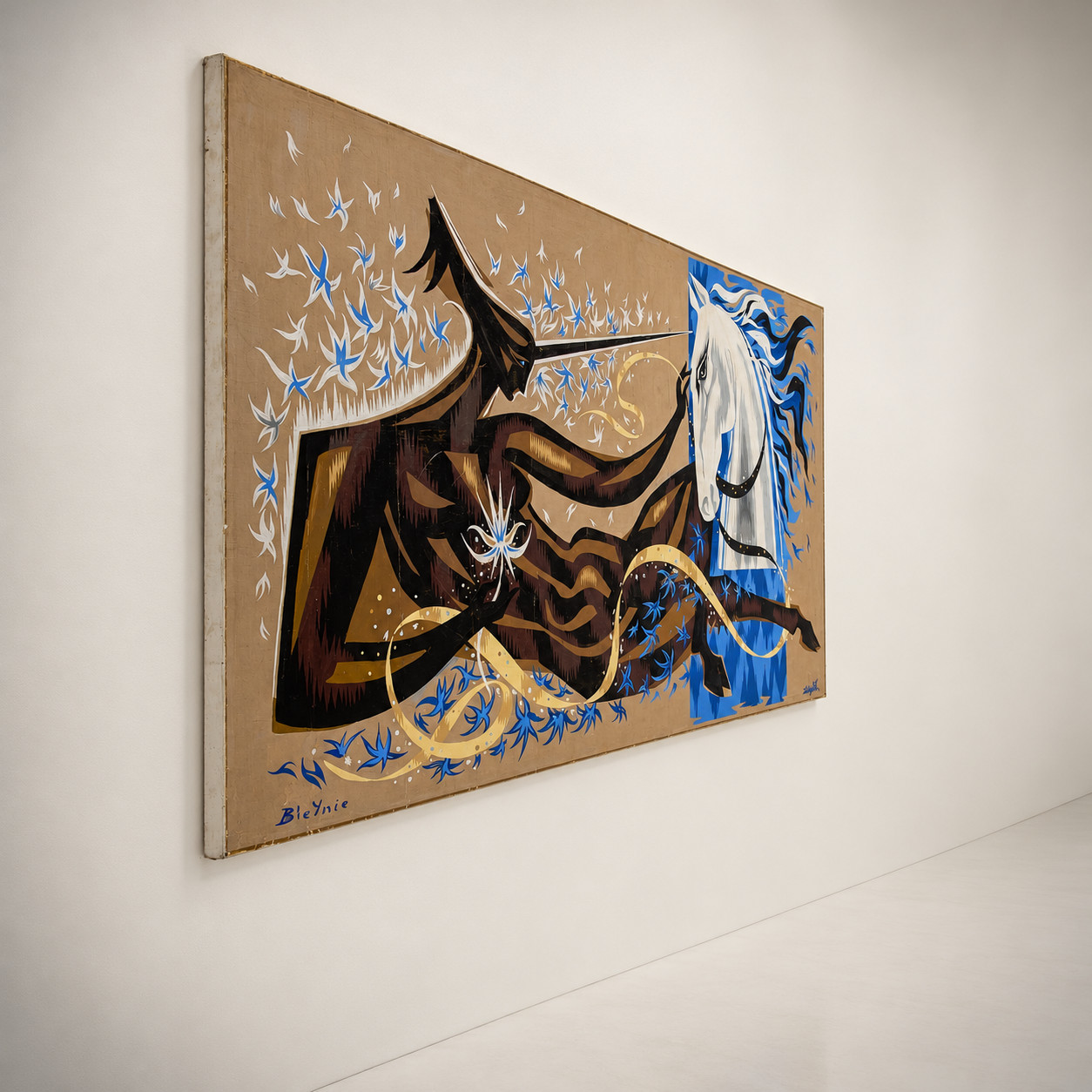
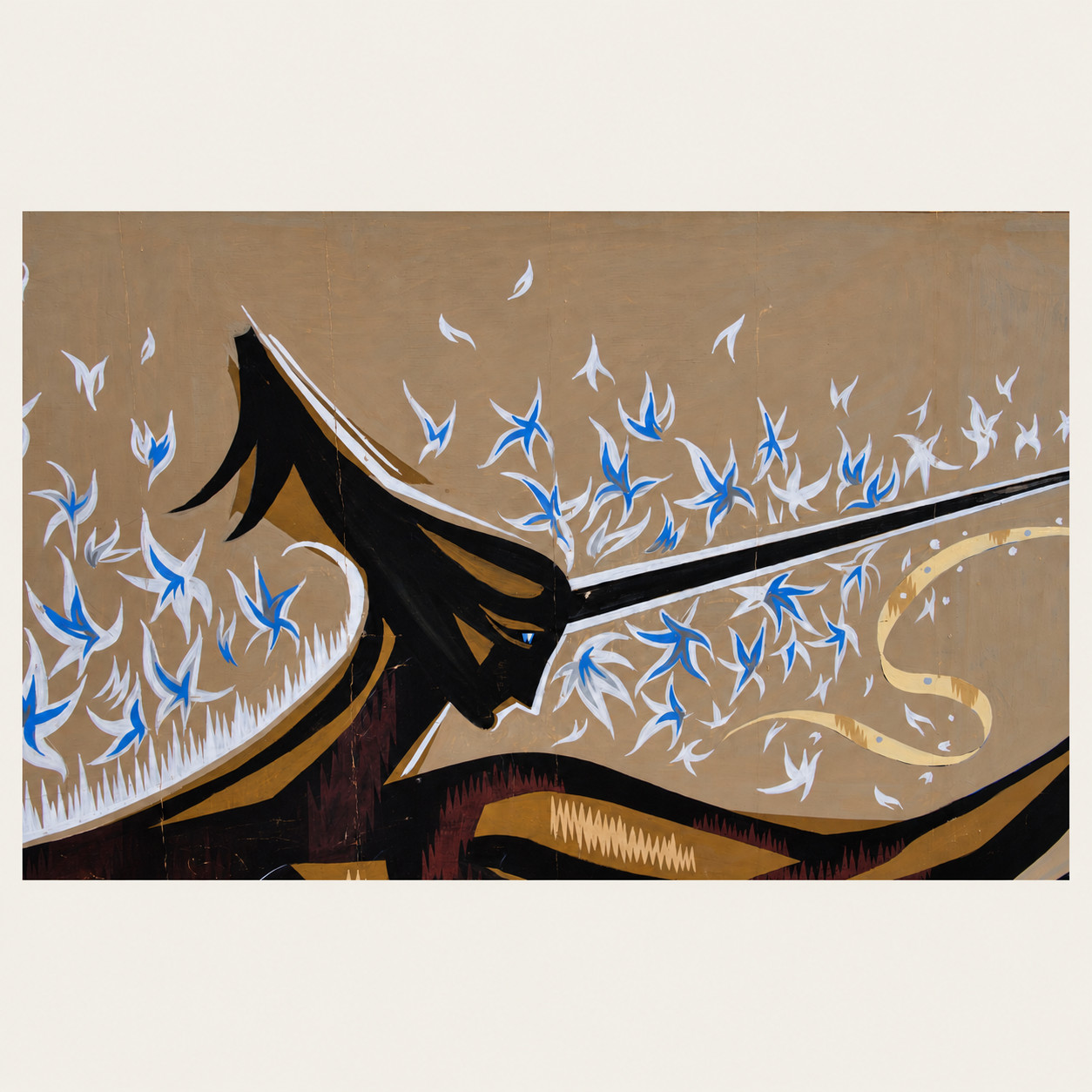
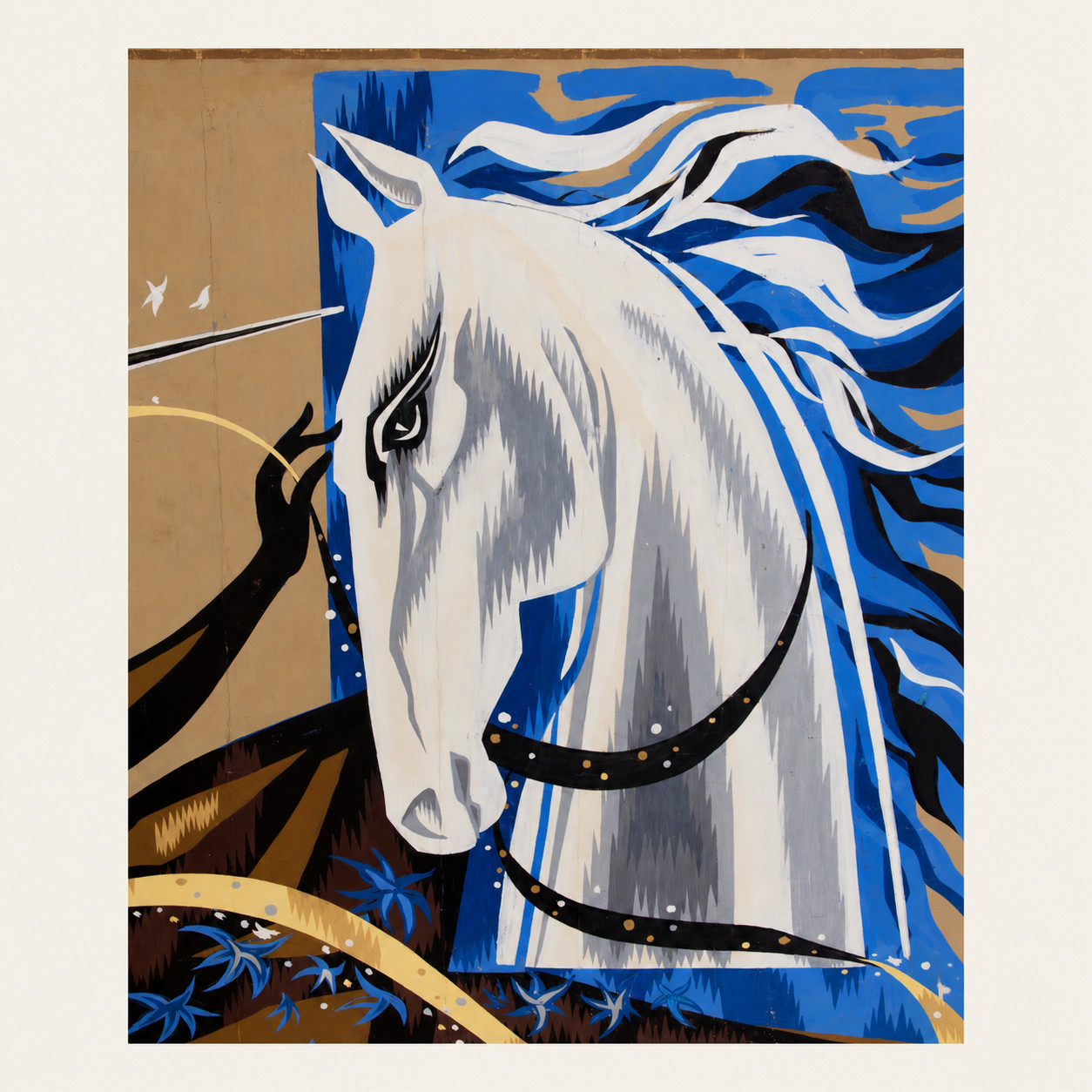
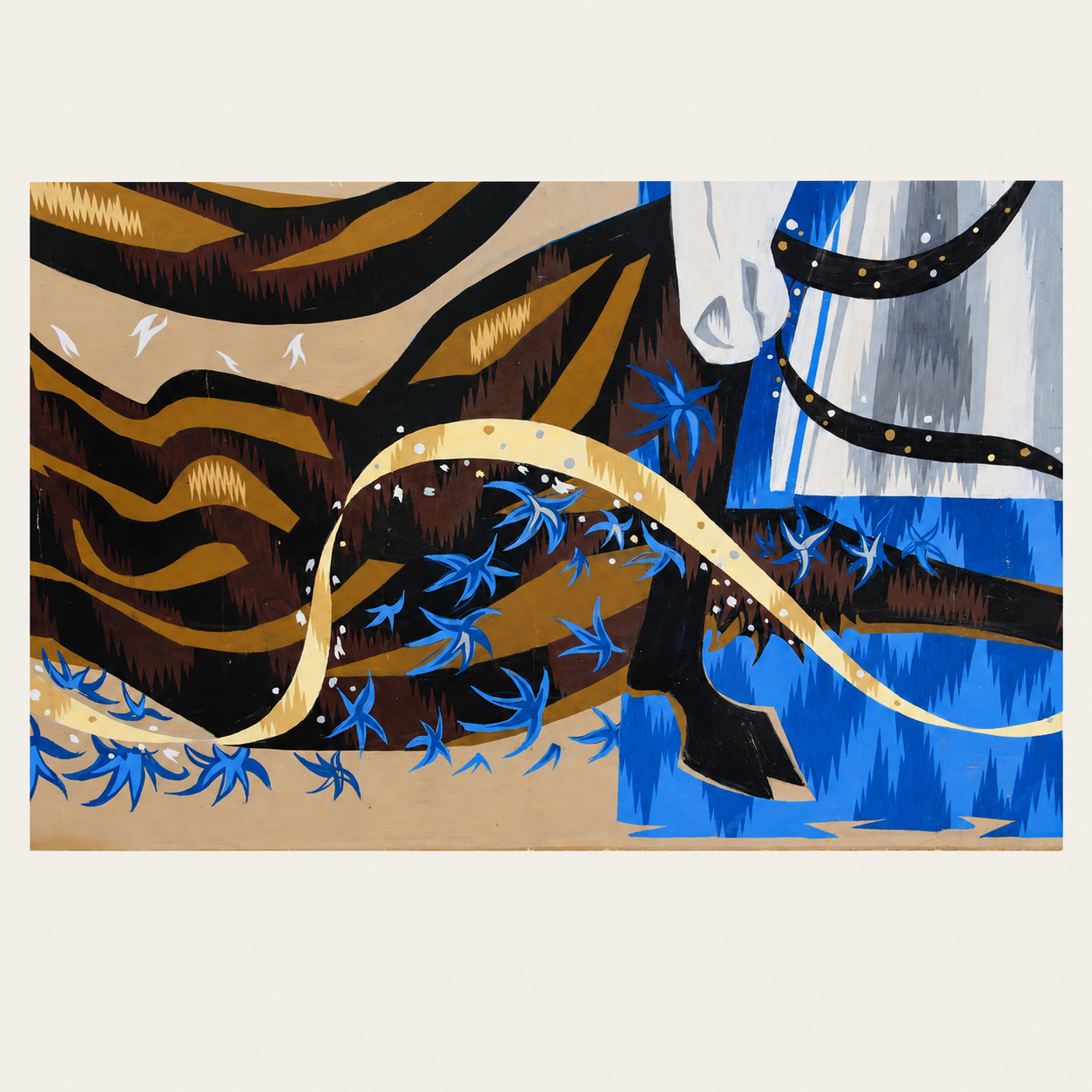
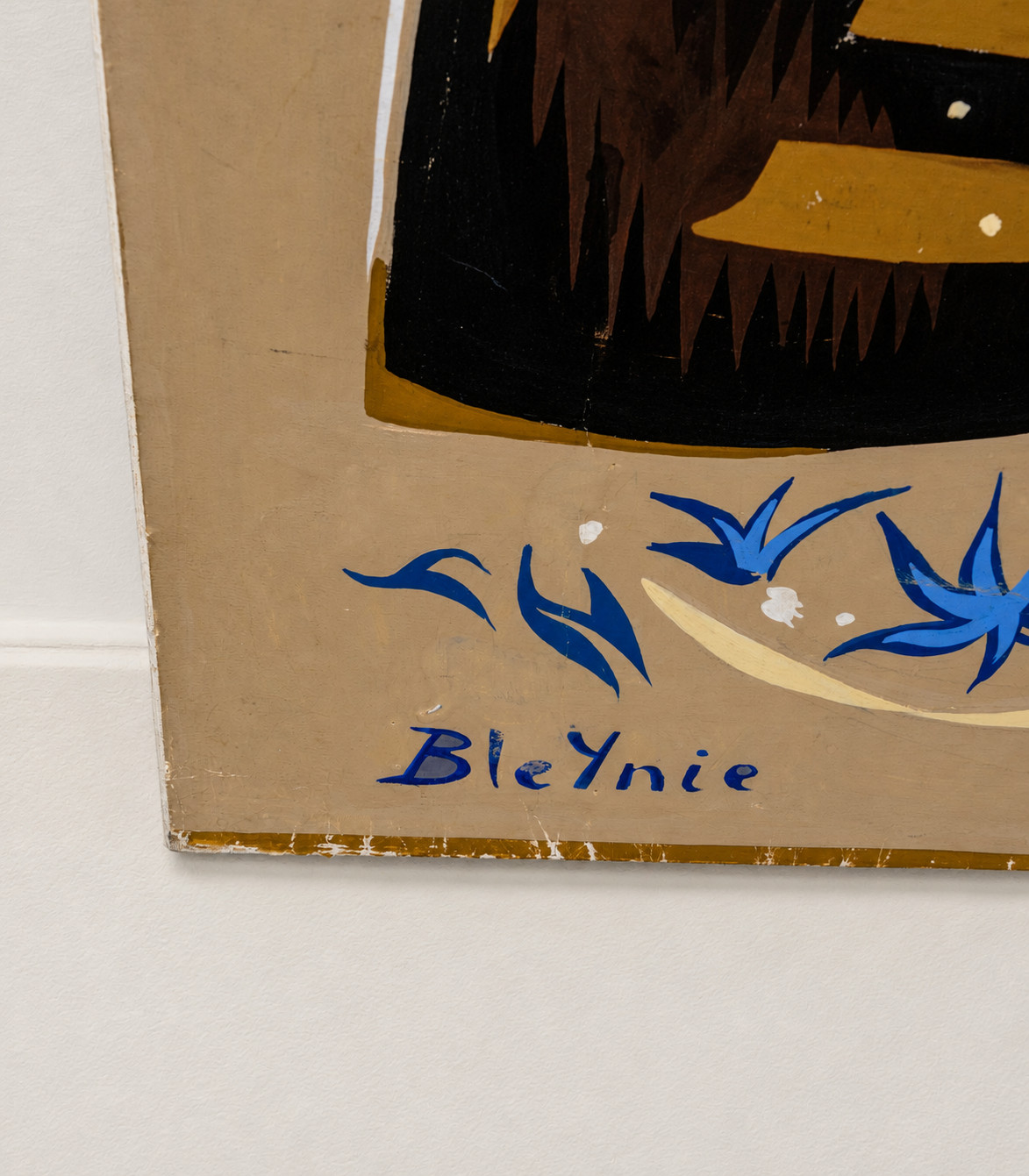
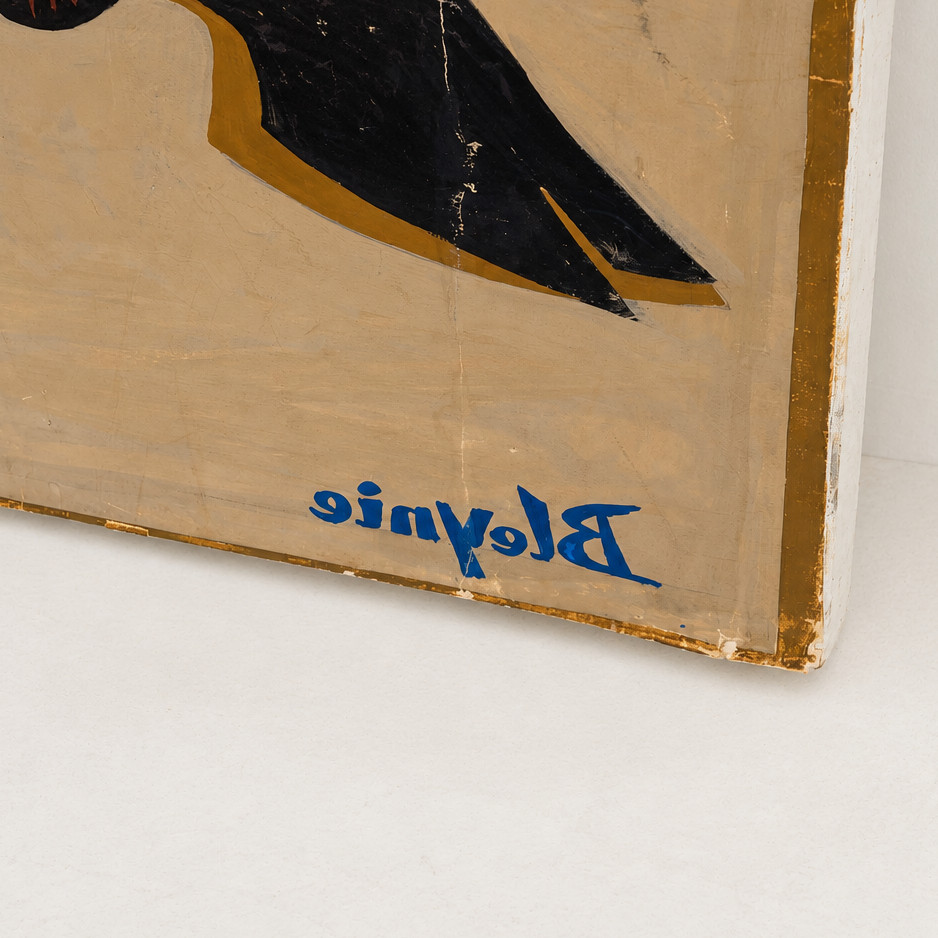
This composition by Claude Bleynie depicts a hybrid female figure, reclining opposite a white horse, in a world bordering on the wondrous and the fantastical.
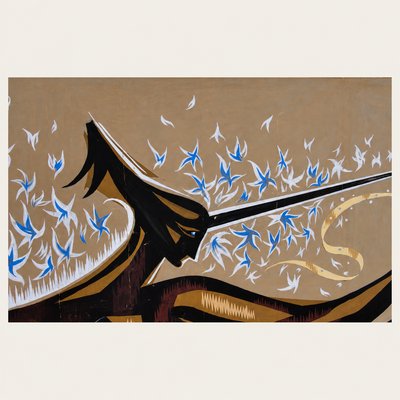
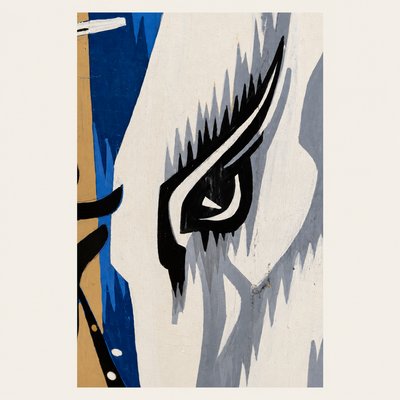
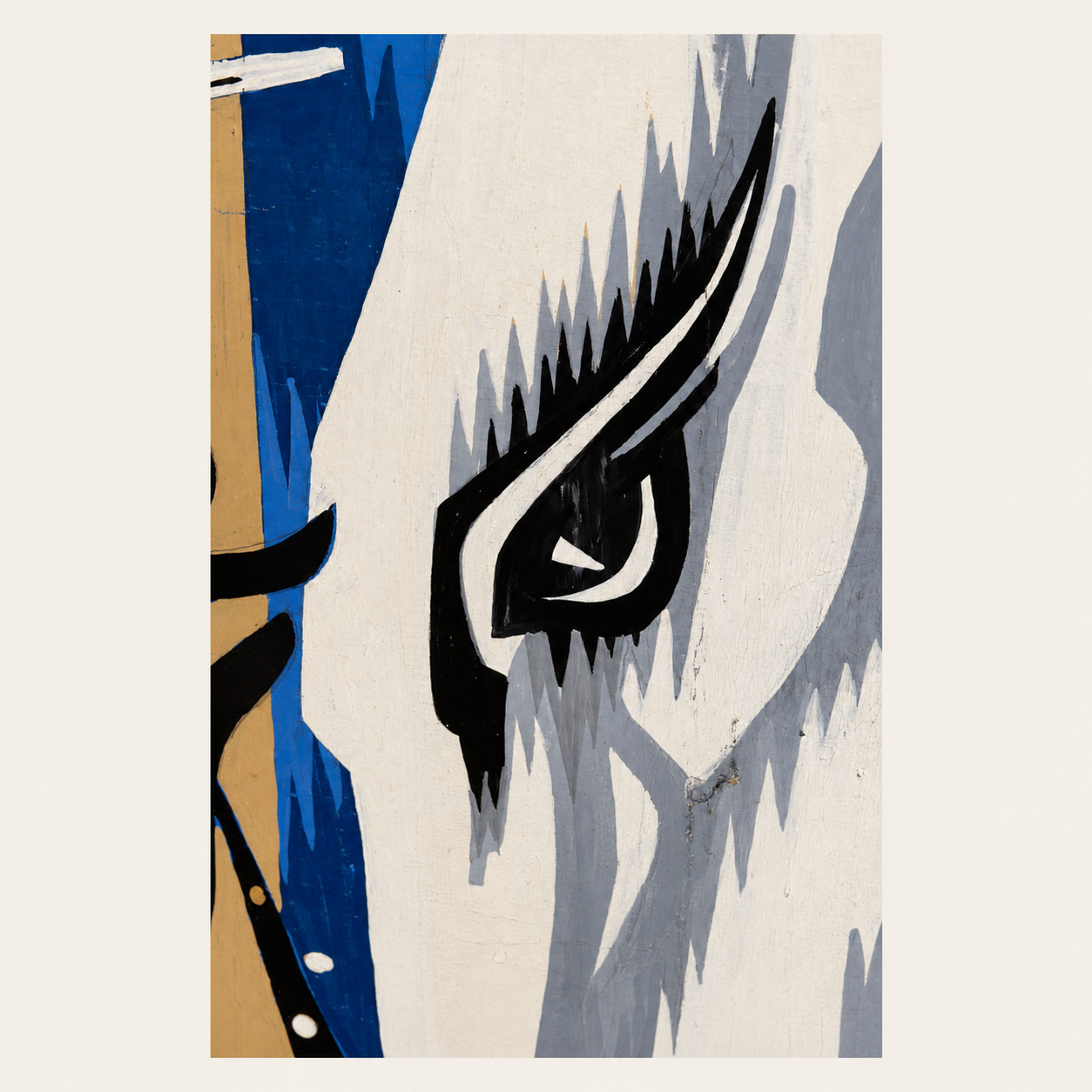
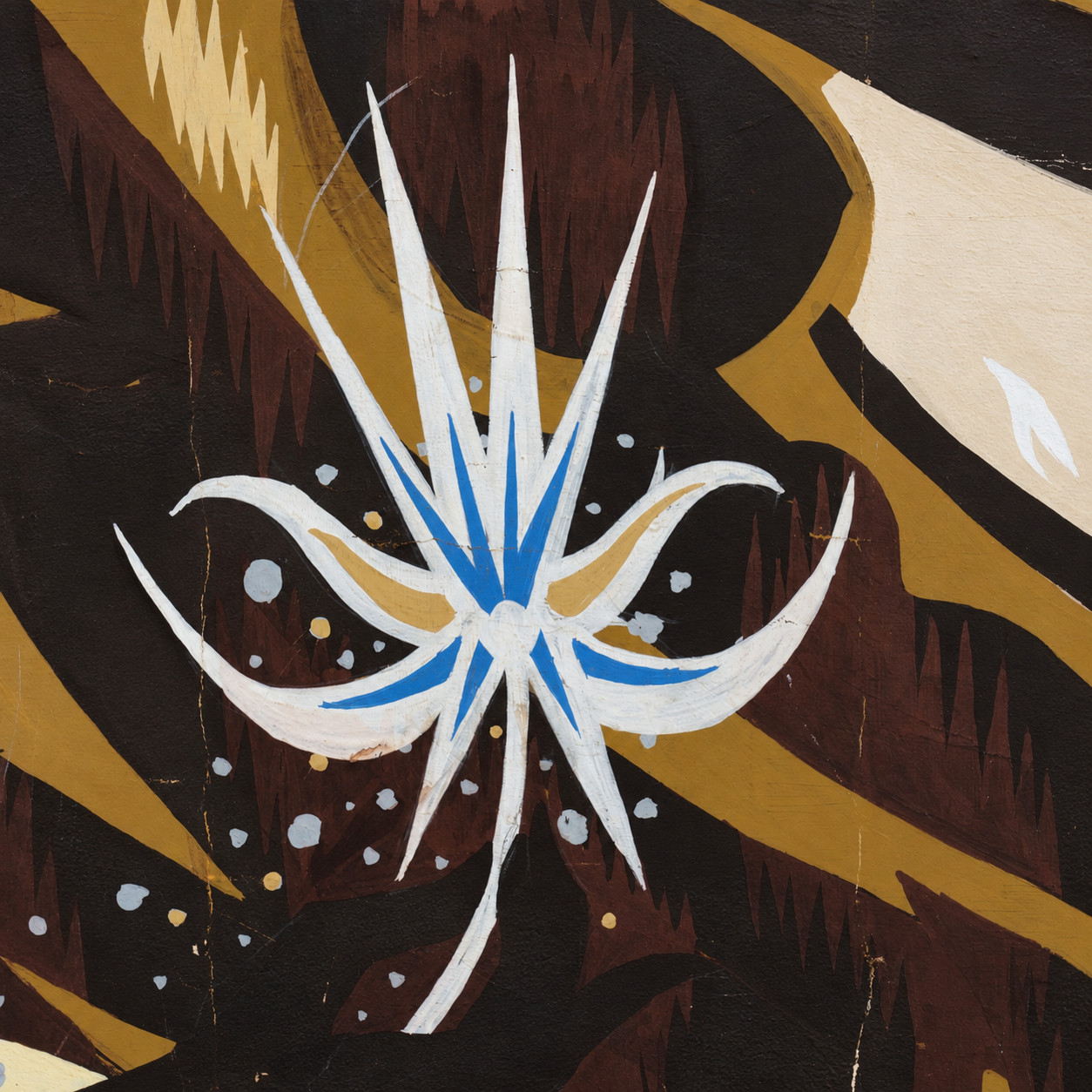
The work is distinguished by its assertive graphic style, combining angular forms, sinuous lines, and a palette dominated by ochres, browns, and blues. The contrast between the dark silhouette of the unicorn-woman and the luminous head of the horse structures the composition, while stylized vegetation enlivens the whole.
Conceived as a tapestry cartoon, this work demonstrates a decorative approach in which the simplification of forms, the rhythm of lines, and flat areas of color play a crucial role.
Biography:
CLAUDE BLEYNIE (1923–2016)
Born in Paris in 1923, Claude Bleynie was a French painter, tapestry designer, ceramicist, and decorator, associated with the revival of mural art and Aubusson tapestry in the second half of the 20th century. Trained at the École des Beaux-Arts in Paris, where he studied until 1942, he was notably taught by the painters André Lhote and Jean Souverbie. He was initially interested in painting and ceramics before gradually dedicating himself to the decorative arts and textile design.
In 1952, his meeting with Jean Picart Le Doux, a major figure in modern French tapestry, marked a decisive turning point in his career. Through him, he discovered the expressive possibilities of the tapestry cartoon, a discipline in which he soon developed his own personal style. From 1958 onwards, Claude Bleynie exhibited at the La Demeure gallery in Paris, a key venue for the dissemination and recognition of contemporary tapestry. He also participated in several events dedicated to mural art and its renewal.
His particularly prolific textile production includes more than 300 tapestry cartoons, primarily produced by the Andraud workshops in Aubusson. He also collaborated on large-scale decorative projects, notably for the ocean liner France, for which he designed carpet cartoons for the luxury suite "Île de France." His artistic world combines poetic figuration with great ornamental freedom. Fantastic birds, horses, female figures, and stylized flowers and plants compose an imaginary repertoire where nature readily blends with mythology and the marvelous.
His compositions are characterized by slender silhouettes, assertive graphic rhythms, and intense chromatic contrasts. The flat planes of color, the sinuous lines, and the decorative organization of the surface reflect a search for balance between painting, drawing, and textile architecture. Alongside tapestry, Claude Bleynie pursued a career as a ceramicist and decorator. He also designed theater sets and, particularly in the 1970s and 1980s, explored sculpture, permanent compositions, and lighting fixtures.
His work occupies a unique place among the creators who contributed to the renewal of French decorative arts after the war. It testifies to a conception of tapestry as a monumental art, capable of combining pictorial expression, symbolic imagery, and artisanal expertise. Several of his creations are held in the collections of the Mobilier National (National Furniture Collection), notably Printemps Versailles (1958) and Les Parques (1959).
Bibliography: FAŸ-HALLÉ, Antoinette, Cinquante ans de céramique française (1955–2005). A National Collection, Paris, Réunion des Musées Nationaux, 2005, pp. 161–201. A reference work on ceramic collections, cited in the entry on Claude Bleynie.
Aspects of Contemporary Figurative Tapestry, exhibition, Bibliothèque Forney, Paris, January 4–February 4, 1968. Introductory text focusing in particular on Claude Bleynie and his fantastical world.
PRÉVET, Alain, “Gargoulettes,” Catalogue of Contemporary French Ceramics in the Musée de Sèvres, entry published November 1, 2007. Réunion des Musées Nationaux – Grand Palais / Cité de la Céramique.
MOBILIER NATIONAL, The Fates, Claude Bleynie, 1959, tapestry cartoon, inventory number A 42.
MOBILIER NATIONAL, Springtime at Versailles, Claude Bleynie, 1958, Aubusson tapestry, Andraud-Dethève workshop, inventory number GMTT 827.
MEUNIER, Sébastien, Claude Bleynie — Composition, documentary record, La Tapisserie du XXe siècle gallery, Paris, undated.
Ref: P3GQG1PAU4

 English
 Français
 Italiano
 Deutsch
 Napoleon marble inkwell, 19th century
450 € EUR