This description has been translated and may not be completely accurate. Click here to see the original
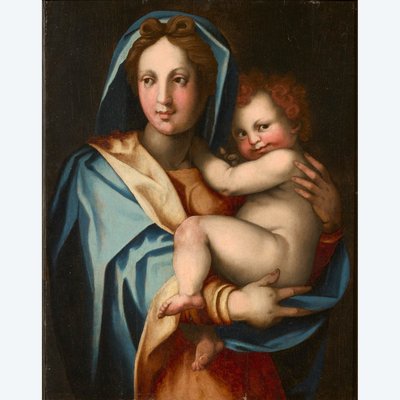
We are pleased to offer this sublime antique oil painting on canvas, executed by an artist of the Northern Italian school, likely Lombard or Emilian, around 1580.
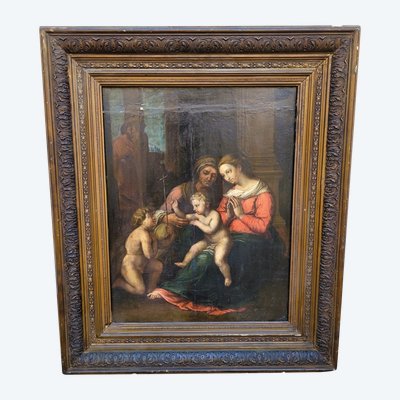
This work of remarkable mystical intensity depicts the Virgin and Child appearing in the clouds, surrounded by angels and saints.
Its luminous, vertical composition embodies the fervor of the Counter-Reformation and the refinement of Italian Mannerism, a period in which beauty became a language of the soul.
Mannerism: Grace Beyond Form
Mannerism (1520–1600) marks the transition between the geometric perfection of the Renaissance and the theatricality of the Baroque.
Artists, heirs to Raphael and Michelangelo, now sought to express spiritual emotion more than reason.
The proportions are elongated, the gestures unfold, the faces are illuminated by a supernatural light.
In this painting:
Saint George's deliberately enlarged hands become the visible instruments of prayer: they convey the power of faith and the communication between humanity and the divine.
The gentle, elongated faces reveal a quest for spiritual beauty, inherited from Parmigianino and Correggio.
Golden light bathes the scene in an atmosphere of mystical vision.
Here, Mannerism transcends realism to reach pictorial ecstasy: a distorted beauty to better express faith.
Iconographic description and figures:
The Virgin Mary
Enthroned on the clouds, draped in celestial blue and crimson red, the Virgin leans tenderly toward the prostrate saints.
His face, bathed in an inner light, embodies mercy and divine purity.
The Infant Jesus
Naked and graceful, the Child blesses the scene with a peaceful gesture.
His gaze, filled with gentleness, turns toward the kneeling knight.
Light glides over his ivory skin, like a divine breath made tangible.
Saint George
On the left, in shining armor, Saint George bows in prayer.
His white banner with a red cross proclaims the victory of faith over evil.
His hands, disproportionately large, convey inner fervor: in Mannerist art, excess is a sign of spiritual intensity.
They seem to receive the blessing light of the Child, a symbol of the believer's inner struggle.
Saint Francis of Assisi
Behind the knight, a Franciscan friar contemplates the scene.
His brown habit, his bowed head, and the stigmata visible on his palms identify him as Saint Francis of Assisi.
A figure of poverty and divine compassion, he embodies silent prayer and communion with the suffering Christ.
The artist has depicted him in an attitude of surrender and mystical love, straight out of the great Bolognese models.
The Prelate or Cardinal
Kneeling on the right, a prelate in a red cassock and white rochet joins his hands in fervent prayer.
He evokes Saint Charles Borromeo, Archbishop of Milan and great reformer of the clergy.
His humility reflects the Church's submission to divine grace.
The Adoring Angel
An angel with diaphanous wings, kneeling in the foreground, contemplates the Virgin and Child.
His androgynous and luminous face symbolizes spiritual purity—a silent link between heaven and earth.
Painting Analysis:
Oil on canvas prepared with lean gesso.
Traditional pigments of the late 16th century:
Cinnabar red, madder, ochres, lead white, vine black.
Slightly oxidized antique varnish, giving a vibrant golden patina.
The soft modeling and diffused light evoke the workshops of Correggio and Guido Reni, where painting becomes prayer.
Provenance:
Former ecclesiastical collection — Bonnefontaine Abbey, in the Ardennes.
Direct acquisition by Le Repaire des Antiquités.
Condition:
Good overall condition for a work of this period. Crazing and oxidized varnish.
Dimensions:
Height: 62 cm (24.4")
Width: 50 cm (19.6")
Below is the link to the video from the antique shop:
https://youtube.com/shorts/HnfhKkPL6F8?si=yRhz1S-Z4--OBeqP
Ref: UYO9W6PSHM

 English
 Français
  Italiano
  Deutsch
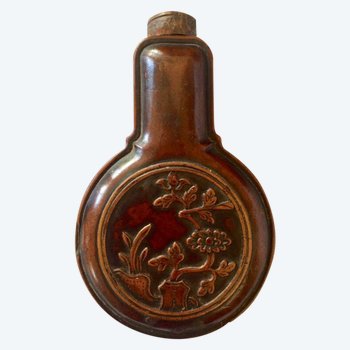
  Powder or tobacco pear in Boxwood. XIXth Asia.
150 € EUR
Powder or tobacco pear in Boxwood. XIXth Asia.
150 € EUR