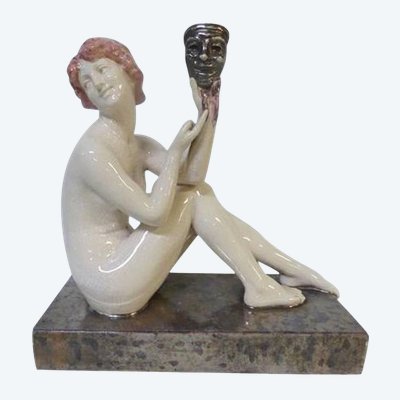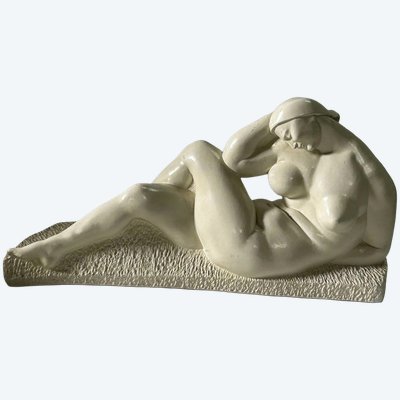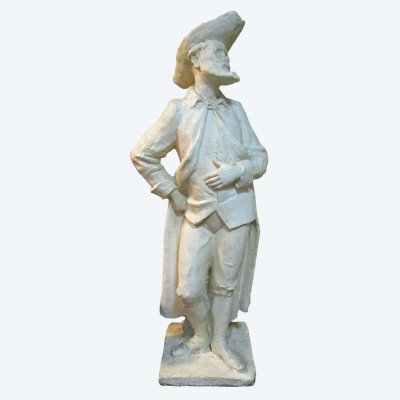


Would you like more images?

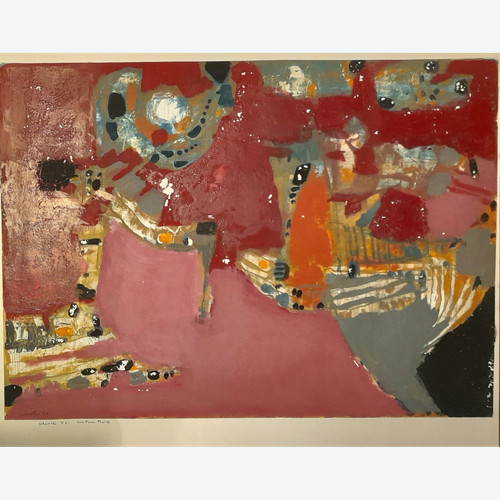
Alain BOURBONNAIS (1925-1988): Gratte-cul (Scratch-Bottom). 1976. Press print made from
lace, fabric, and various materials. Unique print in pink, signed. 67 x 57 cm (sheet)
Alain Bourbonnais, born June 22, 1925, in Ainay-le-Château and died June 20, 1988, in Sens[1], was a French architect, designer, and collector.
He is known for having assembled the collection of "outsider art" housed at La Fabuloserie since 1983.
Architect
A graduate in architecture from the École nationale supérieure des beaux-arts in Paris in 1954, Alain Bourbonnais won numerous national and international public competitions from the 1960s onward. He is notably the architect of the Caen theater and the Grand Théâtre de Luxembourg, built between 1960 and 1964.
A renowned architect, Alain Bourbonnais designs spaces that meet a wide range of needs: residential spaces (the Îlot du Pont, Auxerre), transportation spaces (the first RER station at Nation, Paris), leisure spaces (the Tremblay recreation and leisure park, Champigny-sur-Marne), cultural spaces (the Auxerre municipal library), and places of worship (the Stella-Matutina church in Saint-Cloud, built in 1965) [2].
He was chosen by the students to be head of a workshop at the École nationale supérieure des beaux-arts for four years.
In 1968, he received the title of Chief Architect of Civil Buildings and National Palaces.[3]
Collector
Upon arriving in Paris, Alain Bourbonnais frequented the capital's art galleries. From the 1960s onward, he collected drawings and paintings by artists such as Louis Pons and Yolande Fièvre, while simultaneously building a collection of fairground art objects from his friend Jean-Paul Favand, director of the Musée des Arts Forains (Museum of Fairground Arts) in Paris, and folk art such as Brazilian ex-votos from the Cérès Franco gallery.
On September 15, 1971, the newspaper Le Monde announced the departure of Jean Dubuffet's "Collection de l'Art Brut" (Collection of Outsider Art) for Lausanne, to a new museum. Alain Bourbonnais then discovered that his collection was related to this art and decided to meet Dubuffet. With Dubuffet's support, who provided him with a list of artists in March 1972, he opened a gallery on rue Jacob in Saint-Germain-des-Prés, named Atelier Jacob, which was inaugurated on September 28, 1972, with an exhibition of works by Aloïse Corbaz, on loan from Jean Dubuffet. Alain Bourbonnais then conducted his own research to discover new artists. He met Claude Massé, Alphonse Chave, and discovered the Yugoslavian artist Janko Domsic. Alain Bourbonnais had become, somewhat unwittingly, a patron of the arts, as Dubuffet implied in a letter dated February 28, 1974: "I can't explain how you manage to find all the diverse and excellent artists who find themselves within the orbit of your Atelier Jacob." I commend all your wonderful activity and your superb success”[4]. Despite critical acclaim, the Atelier Jacob was not profitable and had to close.
Unlike Dubuffet, Alain Bourbonnais forged emotional bonds with the artists he discovered. What fascinated him was discovering, meeting these creative people, getting close to them physically, visiting their homes to explore their living spaces, their creative spaces… Thus, Pascal Verbena, Jano Pesset, Michel Nedjar, Marie-Rose Lortet, and Francis Marshall were among his friends[5]. This attitude was fundamental to the formation of his collection, unlike other major collections assembled later. The artists he brought together were “ordinary people,” excluding works by those living in asylums and mediums, which constitute the other two poles of the Collection de l’Art Brut.
Alain Bourbonnais also produces and directs short films, conceived not as art documentaries but as "slices of life," "a piece of a dream." These include: Emile Ratier's Wooden Articles, Pépé Vignes, and Simone Le Carré Galimard.
In 1978, with Michel Ragon, Alain Bourbonnais co-curated the exhibition "Les Singuliers de l’art" (The Singulars of Art) at the Musée d'Art Moderne de la Ville de Paris. This exhibition was a great success, attracting 200,000 visitors.
At his country house in Dicy, Alain Bourbonnais considered creating a cabinet of curiosities showcasing only his creations and his collection in a private setting. In 1983, at the urging of his friends, he decided to open it to the public and created the La Fabuloserie museum with his wife, Caroline Bourbonnais. Upon his death in 1988, his wife took over the management of the museum.[6]
In 2014, following the death of their mother, their daughters, Sophie and Agnès Bourbonnais, took over the management of La Fabuloserie[3].
Creator
Having practiced drawing since childhood, Alain Bourbonnais began painting in the 1960s, experimenting with mixed media techniques from 1963 to 1975. These early works foreshadowed his future creations.
Ref: VDJYN2LU81
| Condition | Good |
| Style | Other style (Sculptures other materials of Other style Style) |
| Period | 20th century (Sculptures other materials 20th century) |
| Country of origin | France |
| Artist | Alain Bourbonnais (1925-1988) |
| Width (cm) | 57 |
| Height (cm) | 67 |
| Shipping Time | Ready to ship in 8-15 Business Days |
| Location | 59350, saint andre lez lille, France |
| Shipping Information | Worldwide shipping Shipping time: 8-15 days |
4 commitments to buy with confidence

 English
 Français
  Italiano
  Deutsch