This description has been translated and may not be completely accurate. Click here to see the original
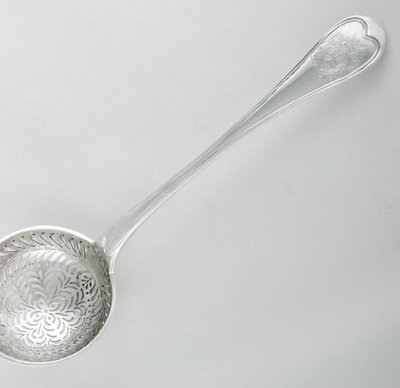
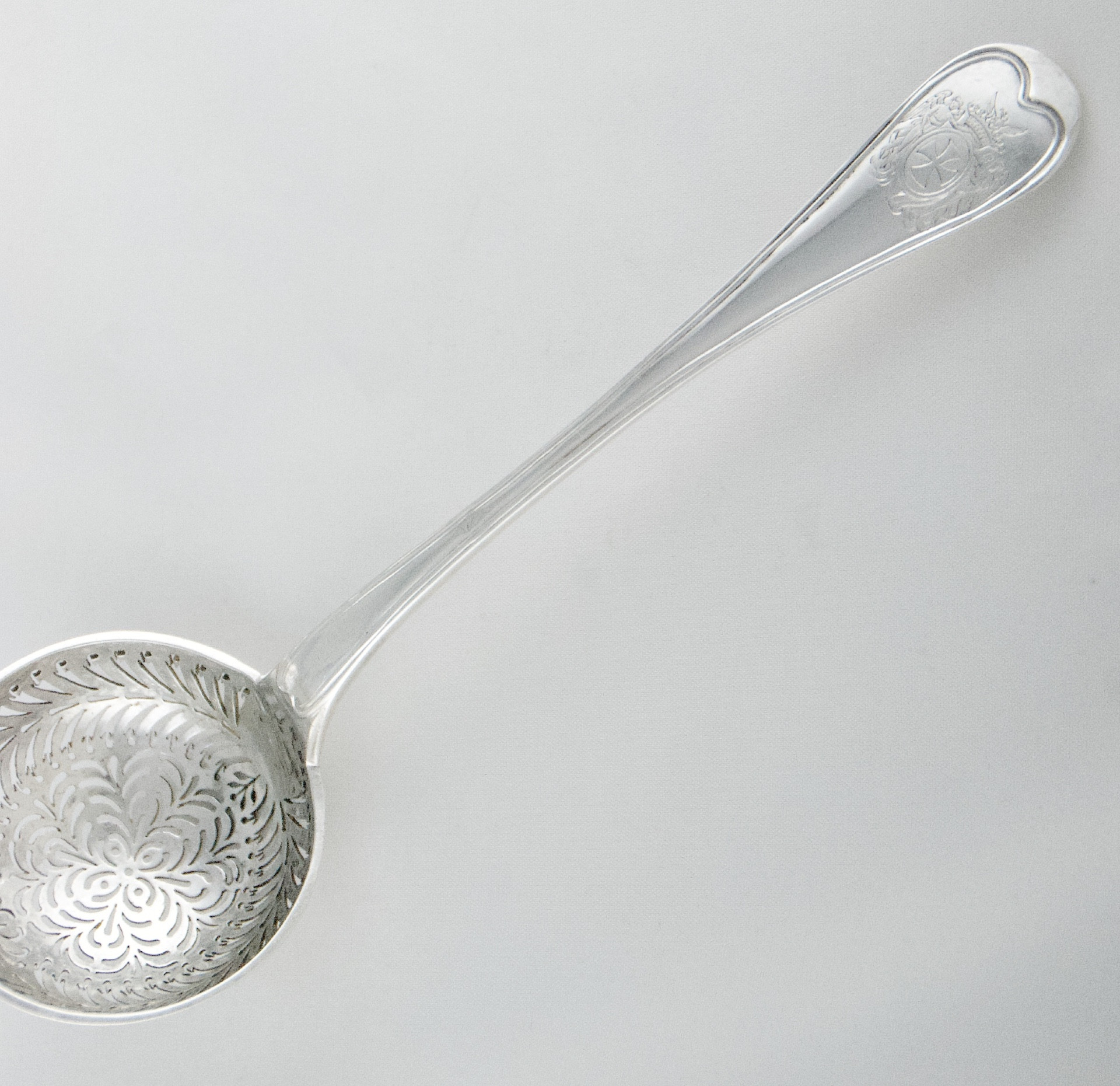
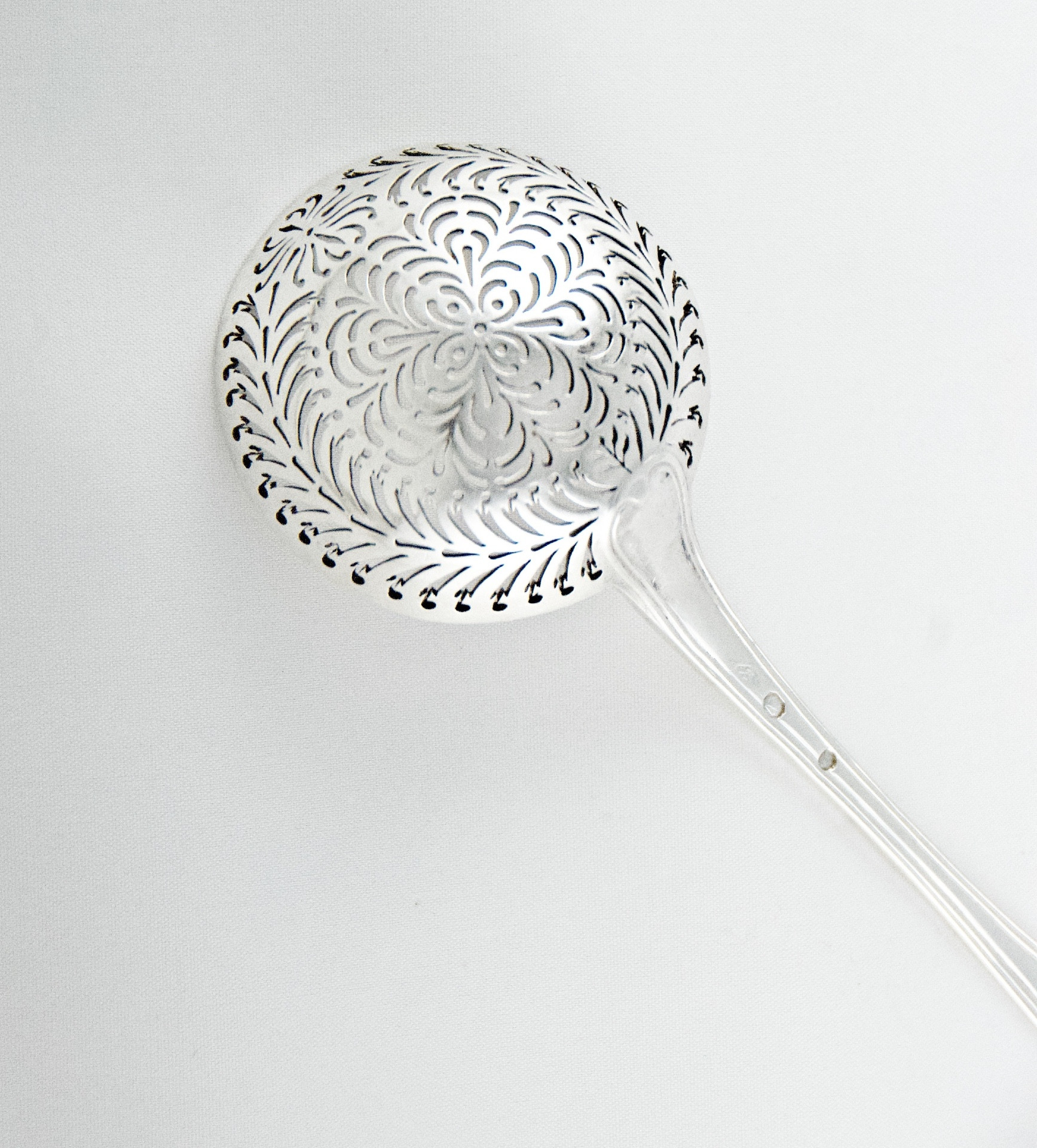
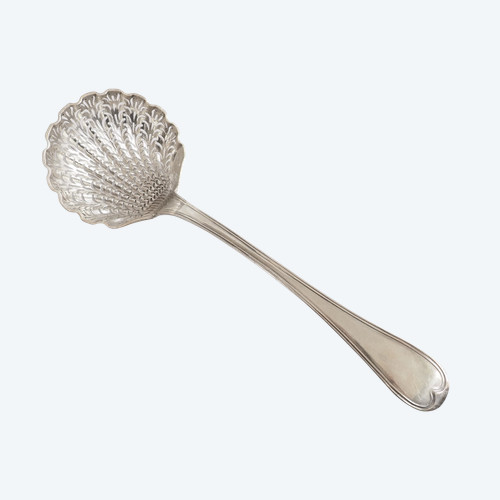
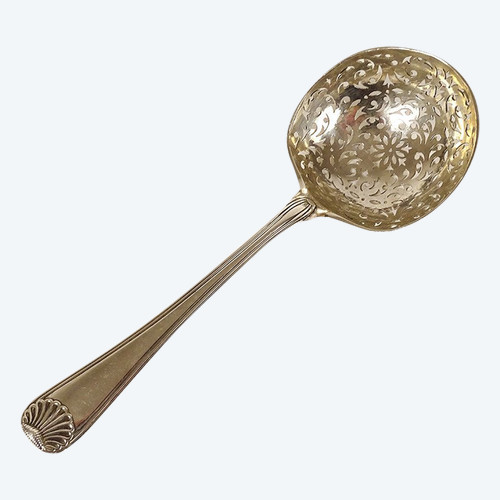
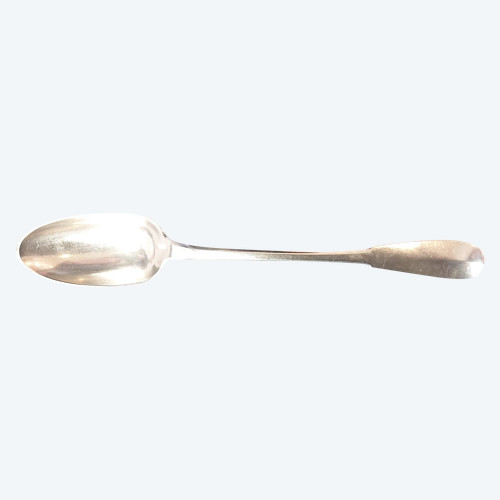
An elegant sprinkling spoon in fine silver (950/1000), crafted in Paris between 1810 and 1819 by silversmith E.-P. ANDRIEU.
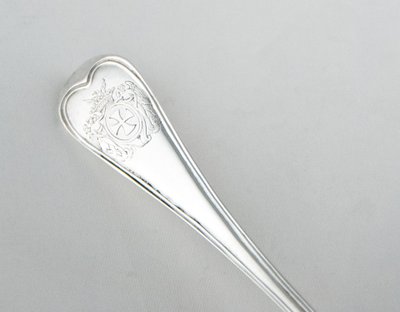
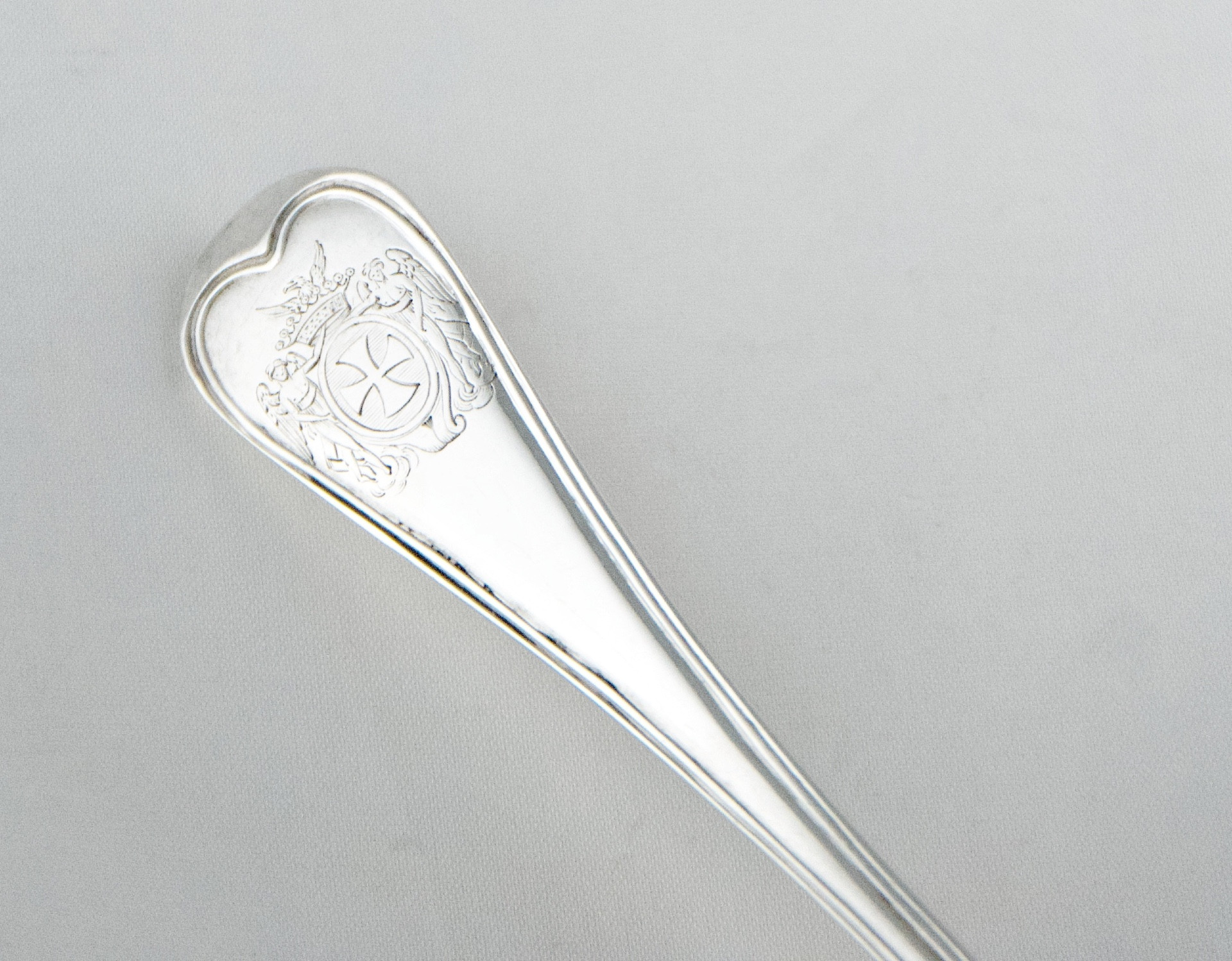
The handle, crafted in the “filet” style, features a slightly curved shaft edged with moldings that flow seamlessly down to the spoon head, whose tip has a delicate, indented contour.
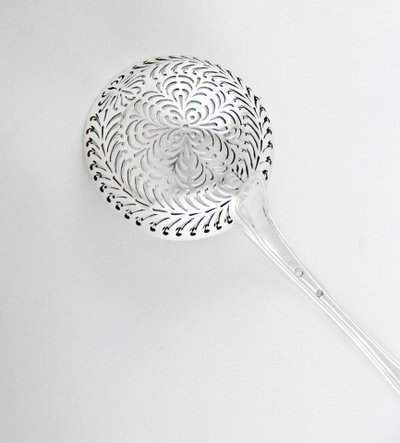
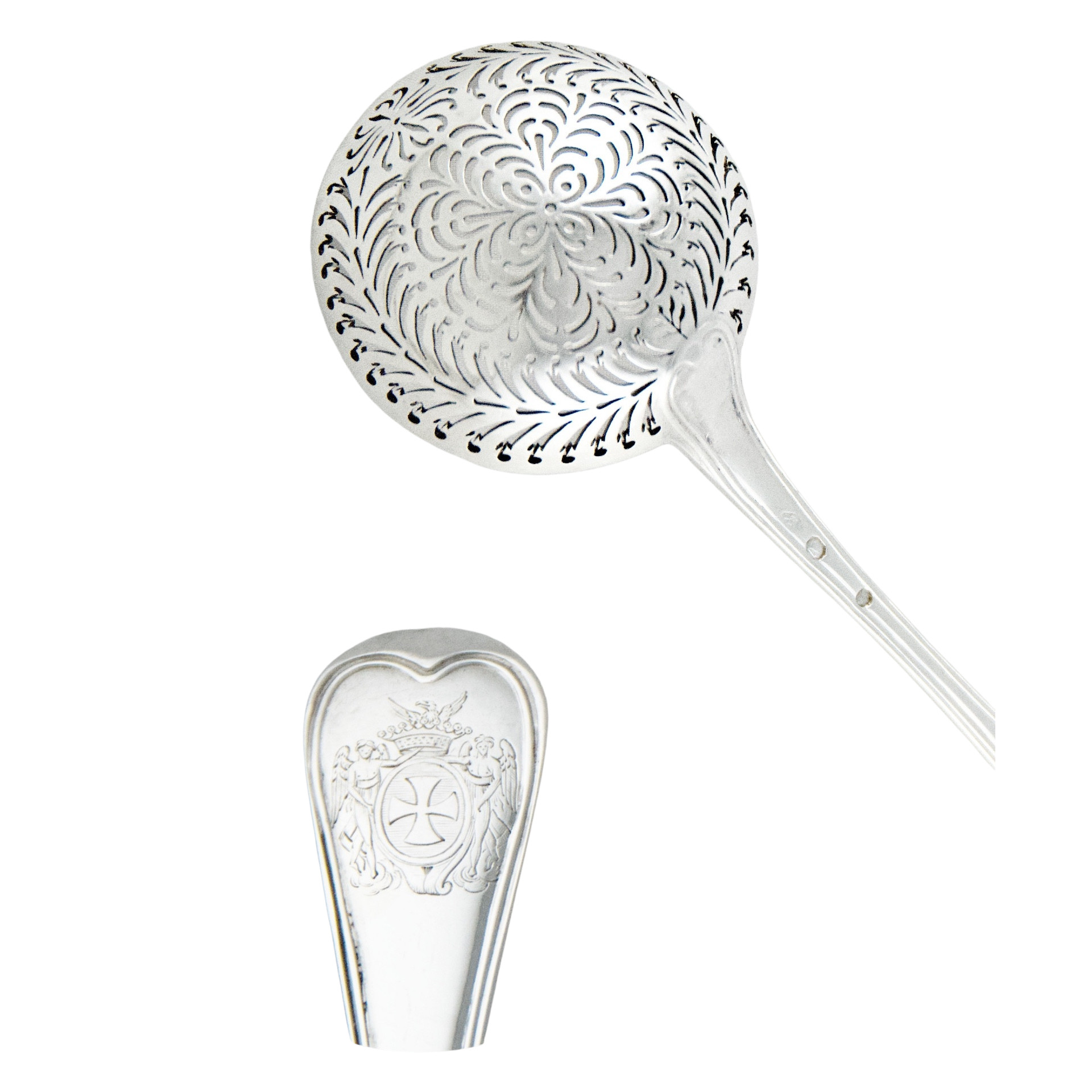
The bowl, circular in shape and deeply hollowed out, is entirely engraved with a rich floral design. A large, blooming rosette, composed of palmettes and stylized leaves arranged in radiating patterns, occupies its center. It is surrounded by a network of lanceolate foliage and small palmettes forming a regular frieze along the rim. The finesse and density of this openwork create an elegant lace-like effect.
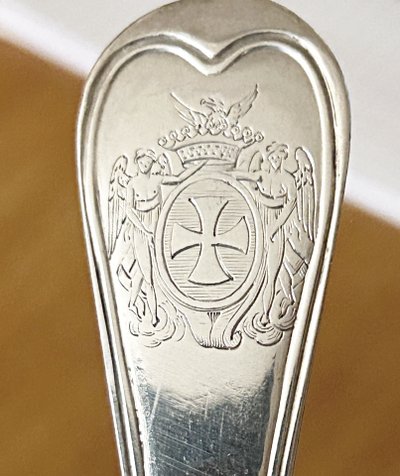
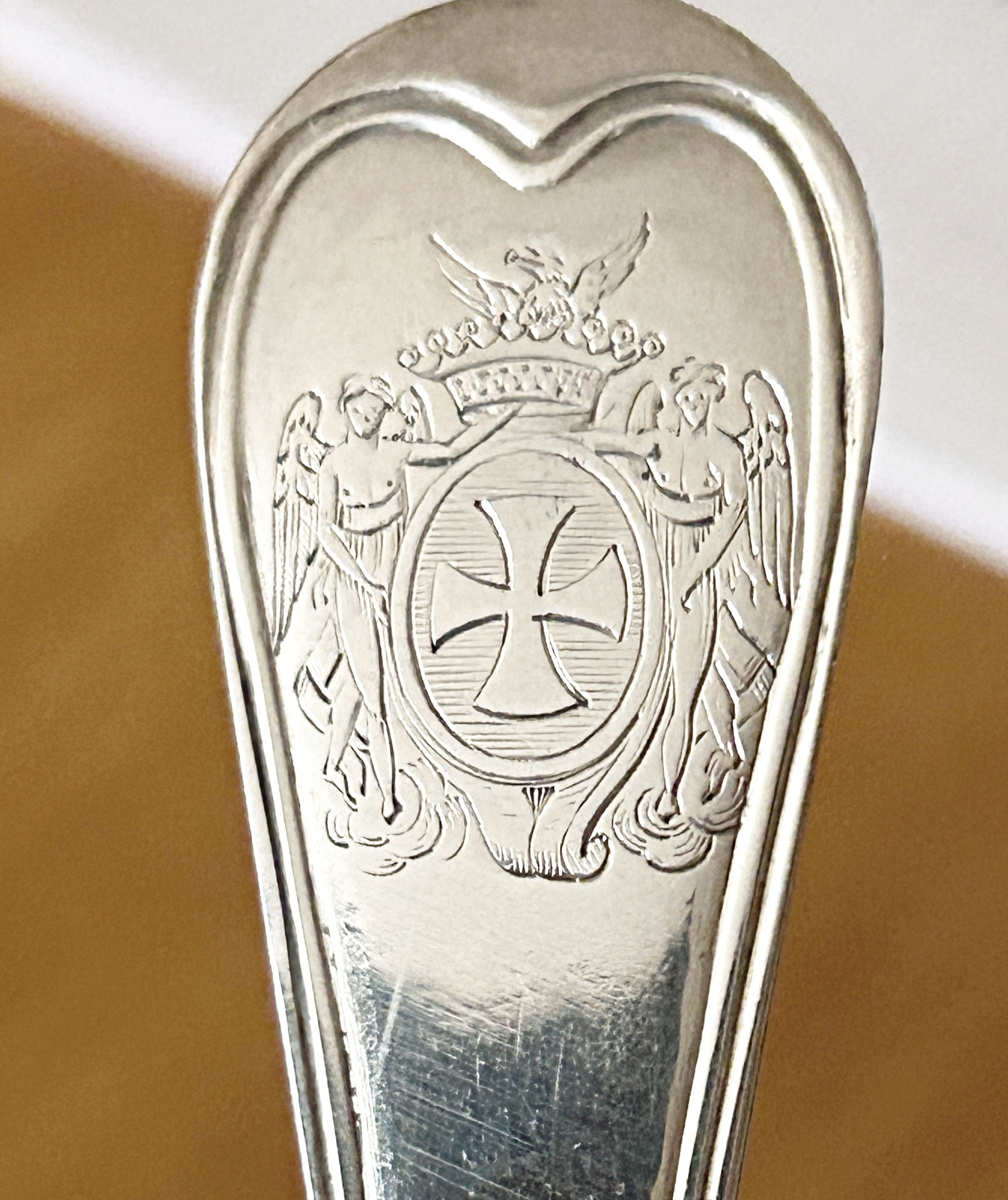
The spatula is engraved with a coat of arms attributed to the de CUMONT family: azure, a cross pattée and bored, argent. The oval shield, set within a cartouche, is held by two angels and surmounted by a count’s crown topped with a soaring eagle.
Empire period or early years of the Restoration.
Hallmarks:
2nd rooster, 1st title (Hallmark for 950/1000 sterling silver in Paris between 1809 and 1819).
Paris hallmark.
Master silversmith: EPA (two crossed spoons) for E.P. ANDRIEU.
Dimensions:
Length: 20.8 cm.
Diameter: 6 cm.
Weight: 69.31 grams.
Condition Report:
In very fine condition. Slight surface scratches and wear consistent with its age and use. Openwork decoration and heraldic engraving are well preserved.
The finesse and regularity of the openwork, the care taken in the heraldic engraving, and the balance of its proportions make this spoon a fine example of Parisian silversmithing from the late Empire or the early years of the Restoration.
HISTORY
E.-P. ANDRIEU had his hallmark registered in Paris in 1810. He was then established at 29 Place Thionville (now Place Dauphine) and is mentioned in 1813 at 6 Cour Lamoignon. His activity is documented in Parisian almanacs at least through 1821.
The coat of arms engraved on the spatula is attributed to the de CUMONT family, a family of ancient nobility originally from the Périgord region, several branches of which settled notably in Poitou, Saintonge, and Anjou. The family appears in records as early as the 14th century: Hugues de CUMONT, a knight, is mentioned in 1340, while Giraud de CUMONT, a squire, is cited in 1351. A seal dated 1340 already bears a cross pattée, attesting to the antiquity of this family emblem.
The family’s coat of arms was registered in 1698 in the Armorial général de France, in the register of the Generality of La Rochelle. Alfred de FROIDEFOND de BOULAZAC and Henri JOUGLA de MORENAS describe them as follows: Azure, a cross pattée and hollowed out Argent. Some younger branches are said to have adopted three cross pattées as a variant. The single cross appearing on the spoon thus corresponds to the coat of arms traditionally assigned to the elder branch.
At the time the spoon was made, Louis-Timothée-Charles-François de CUMONT (1765–1852), known by the title Count of Cumont, was alive. The chronological correspondence and the presence of a count’s crown suggest that these arms may refer to this figure or his immediate family. However, in the absence of documented provenance or another object bearing an exactly identical heraldic composition, this identification must be considered a hypothesis.
BIBLIOGRAPHY
Archive de la Garantie, Paris, hallmark plates nos. 15 and 19.
Almanach Azur, 1811–1821.
Almanach du Commerce, 1813, 1815.
ARMINJON, C., et al., *Dictionary of Hallmarks of Gold and Silver Artisans of Paris and the Seine, 1798–1838*, Paris, 1991.
FILLEAU, H., Historical, Biographical, and Genealogical Dictionary of the Families of the Former Poitou. Vol. II.
FROIDEFOND DE BOULAZAC, A. de, Armorial of the Nobility of Périgord, Vol. I, Périgueux, 1891.
JOUGLA DE MORENAS, H., *Grand Armorial of France*, Vol. III, Paris, 1938.
Ref: 1GCV2TL15K

 English
 Français
 Italiano
 Deutsch
 Oak sideboard, 1950
1 100 € EUR