

Would you like more images?

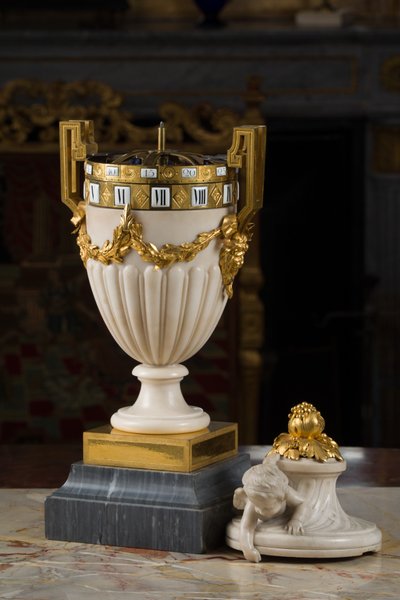
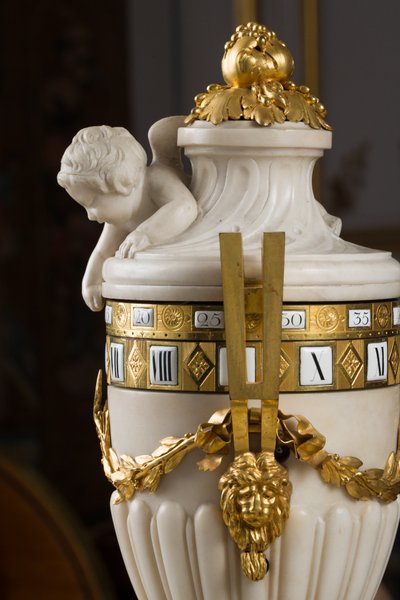
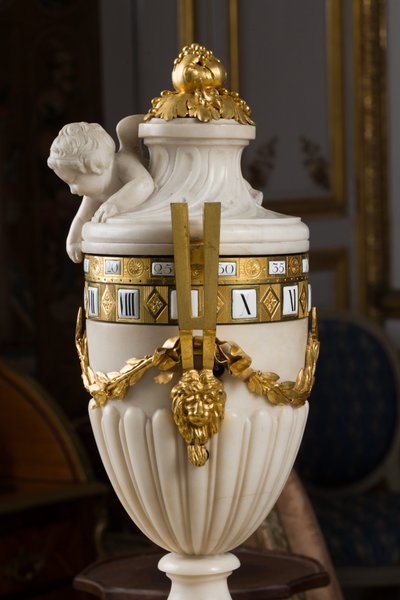
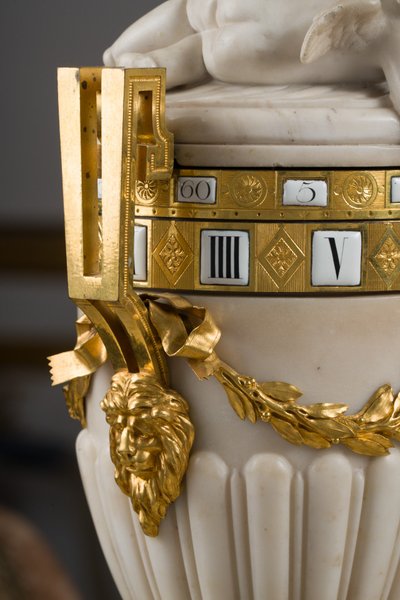
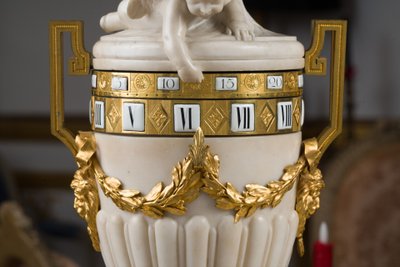
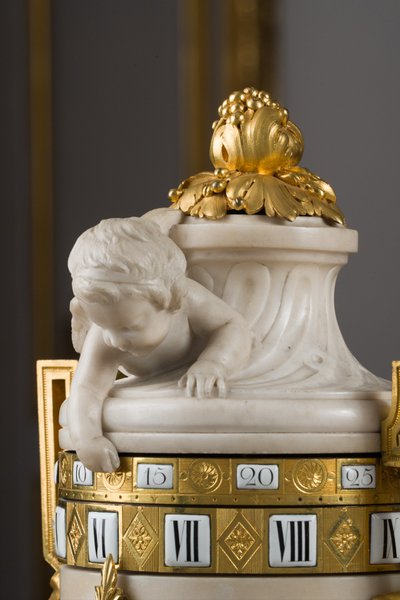
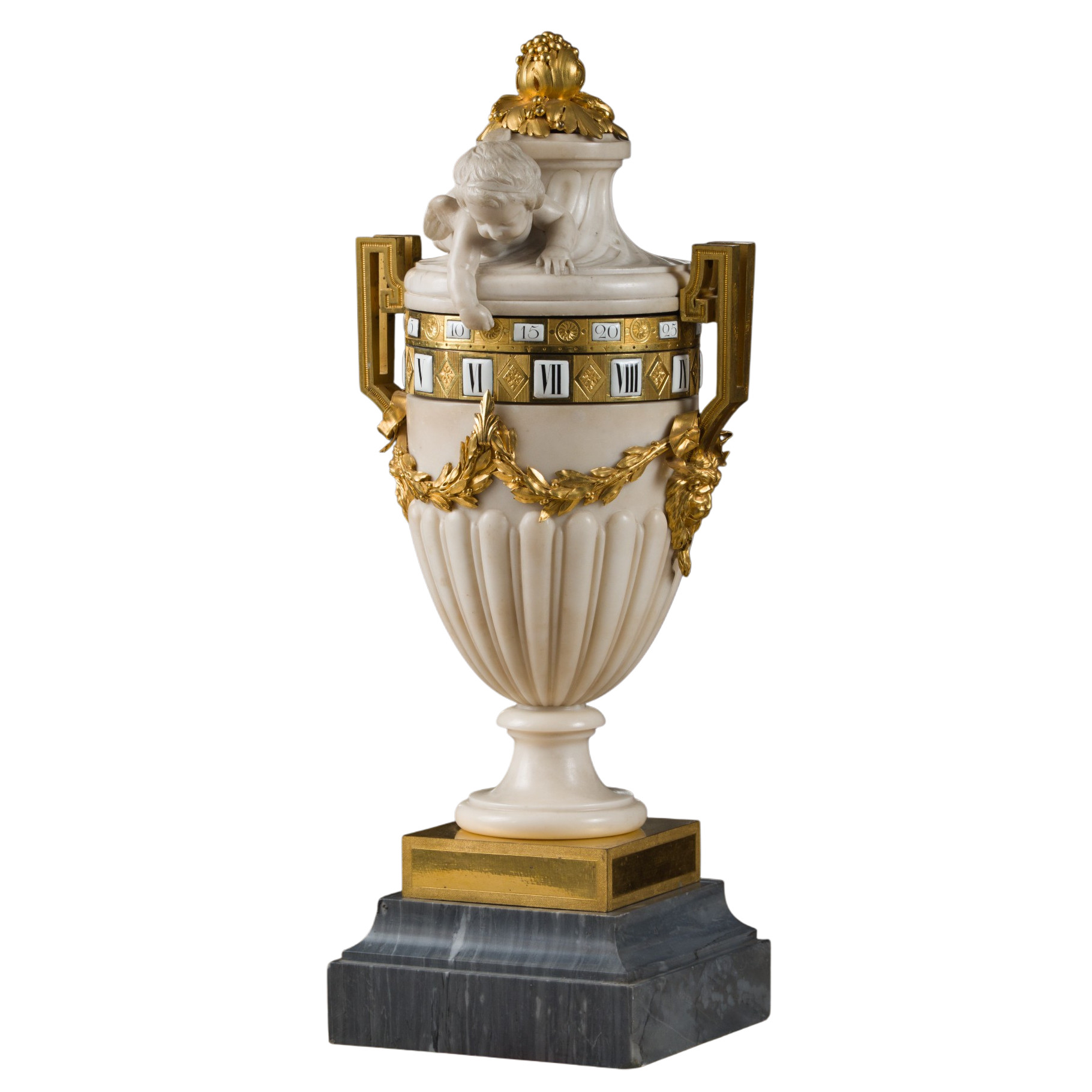
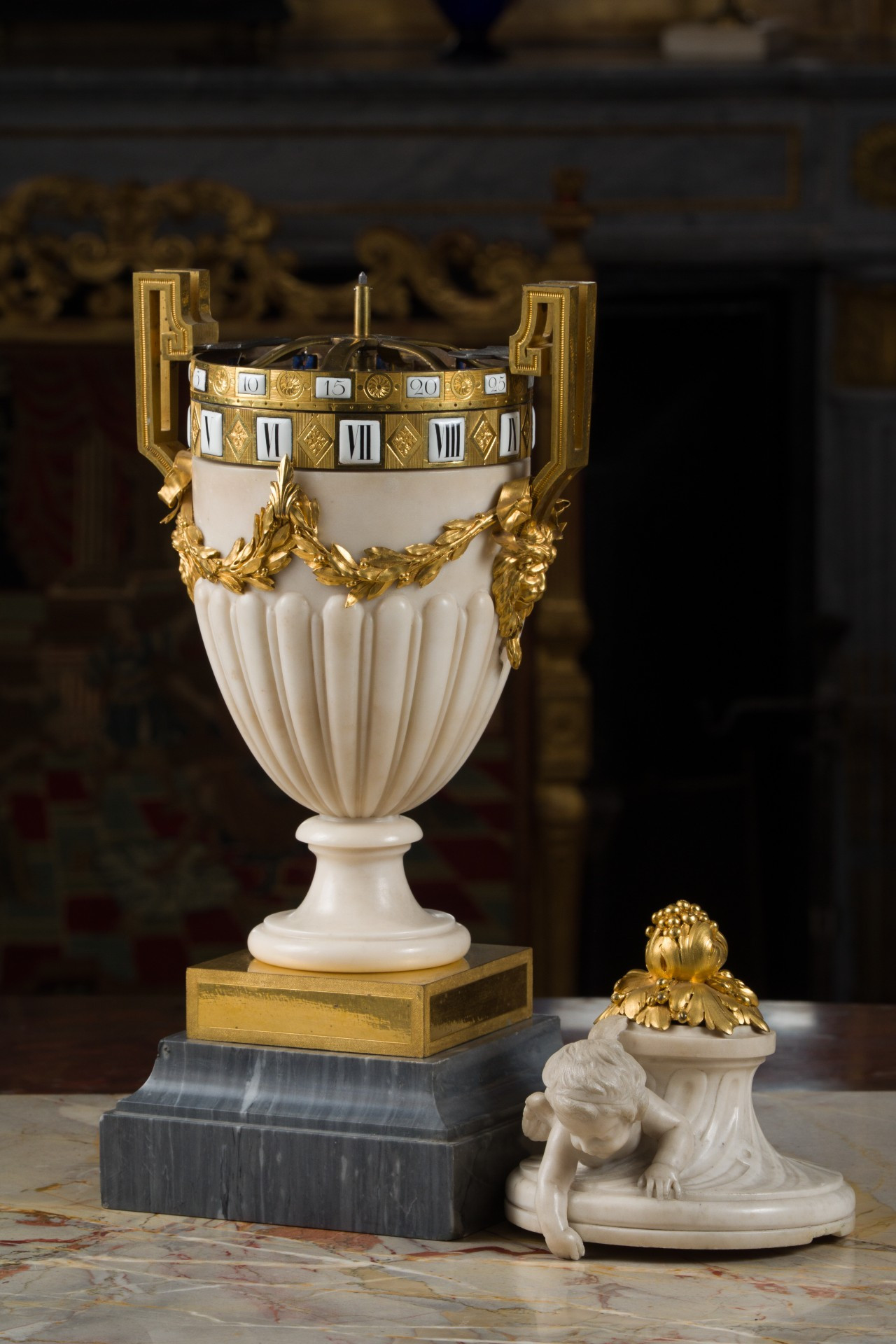
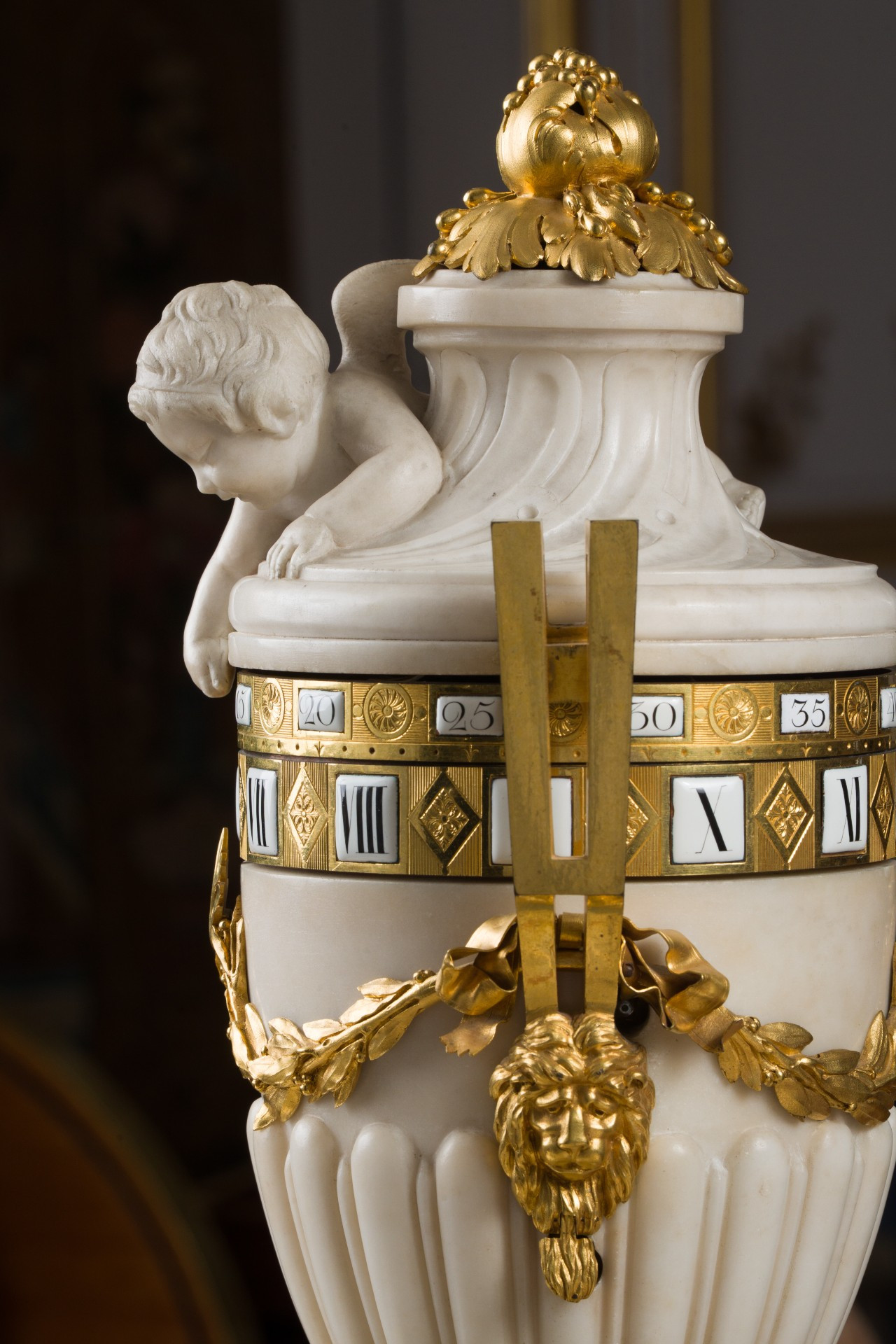
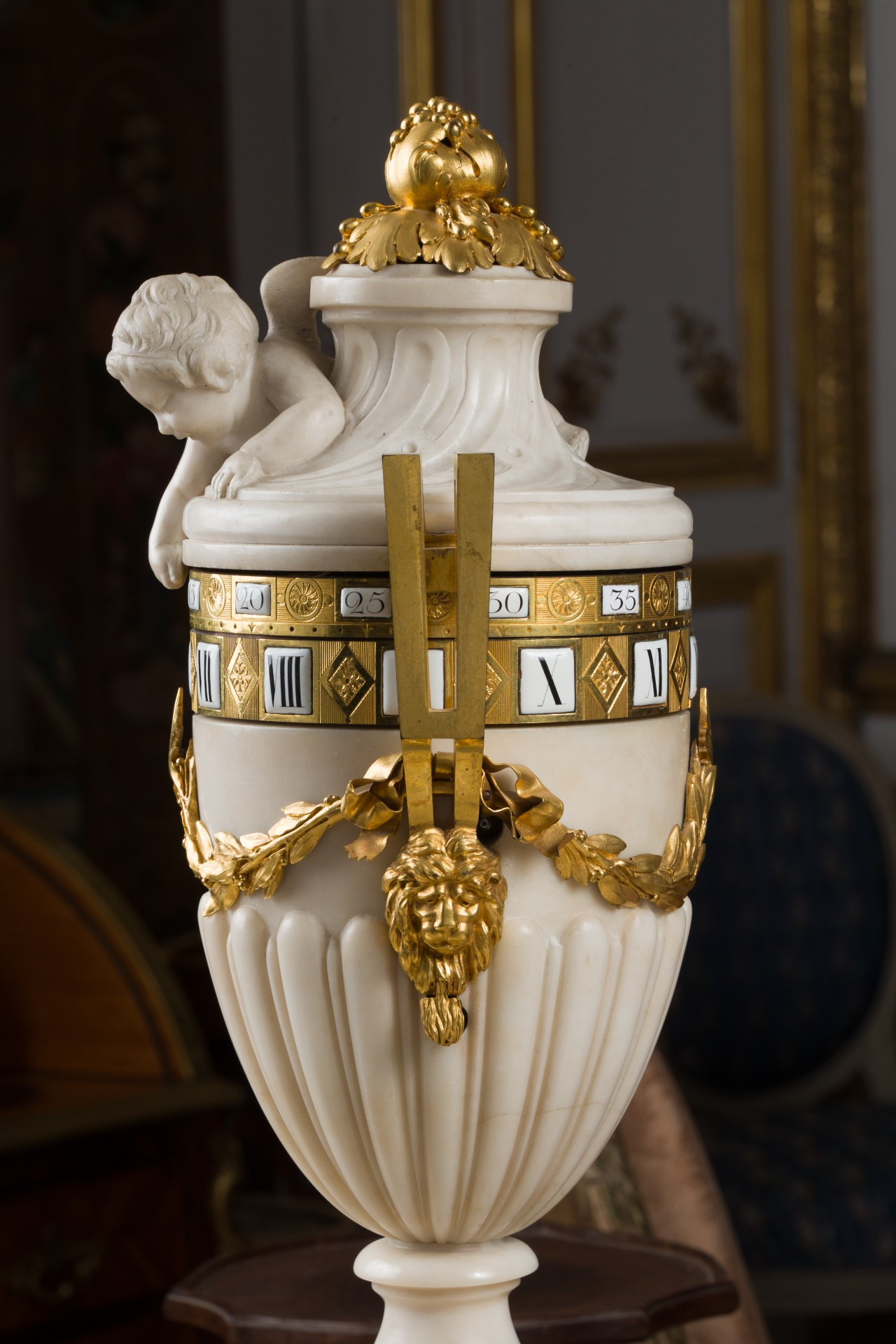
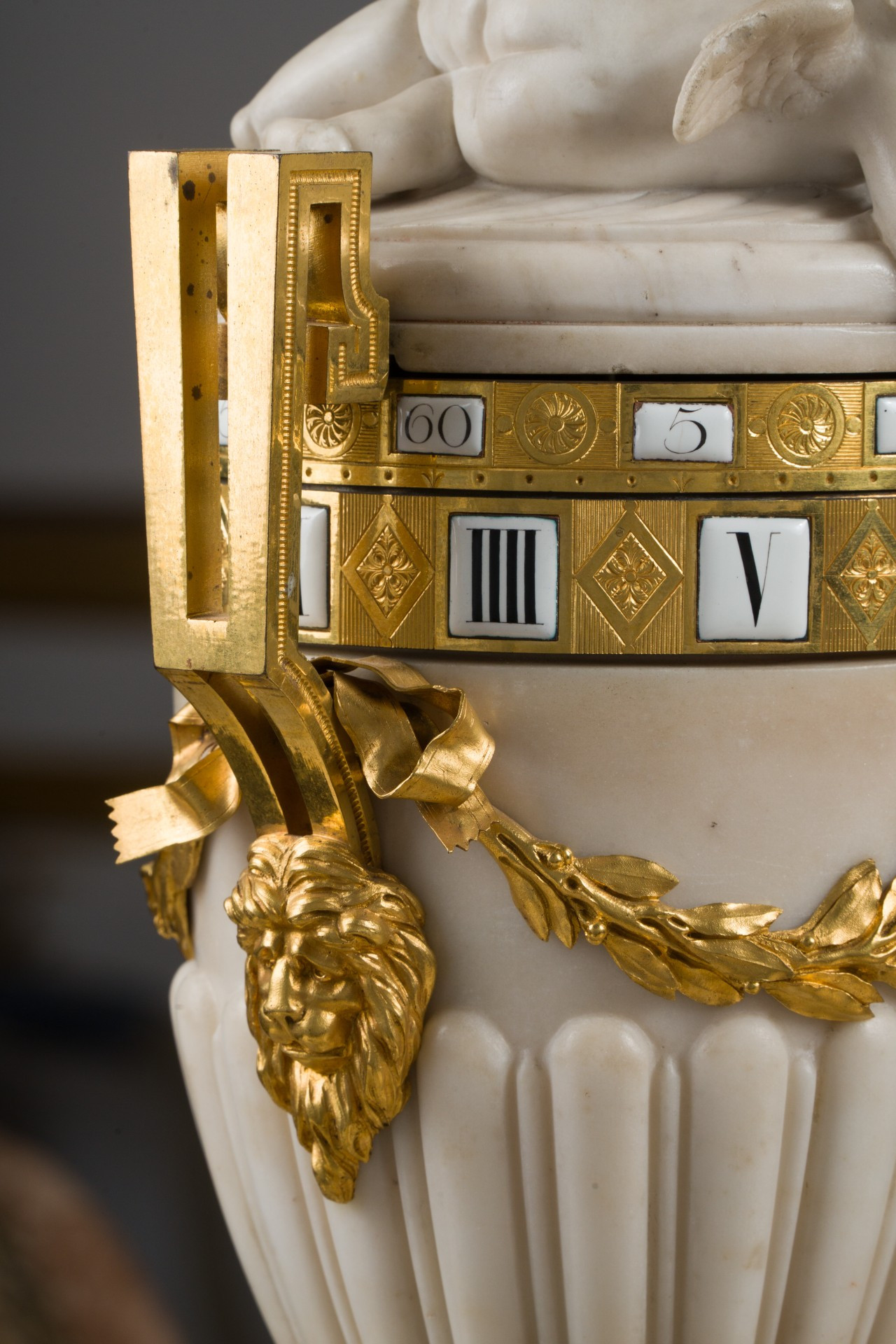
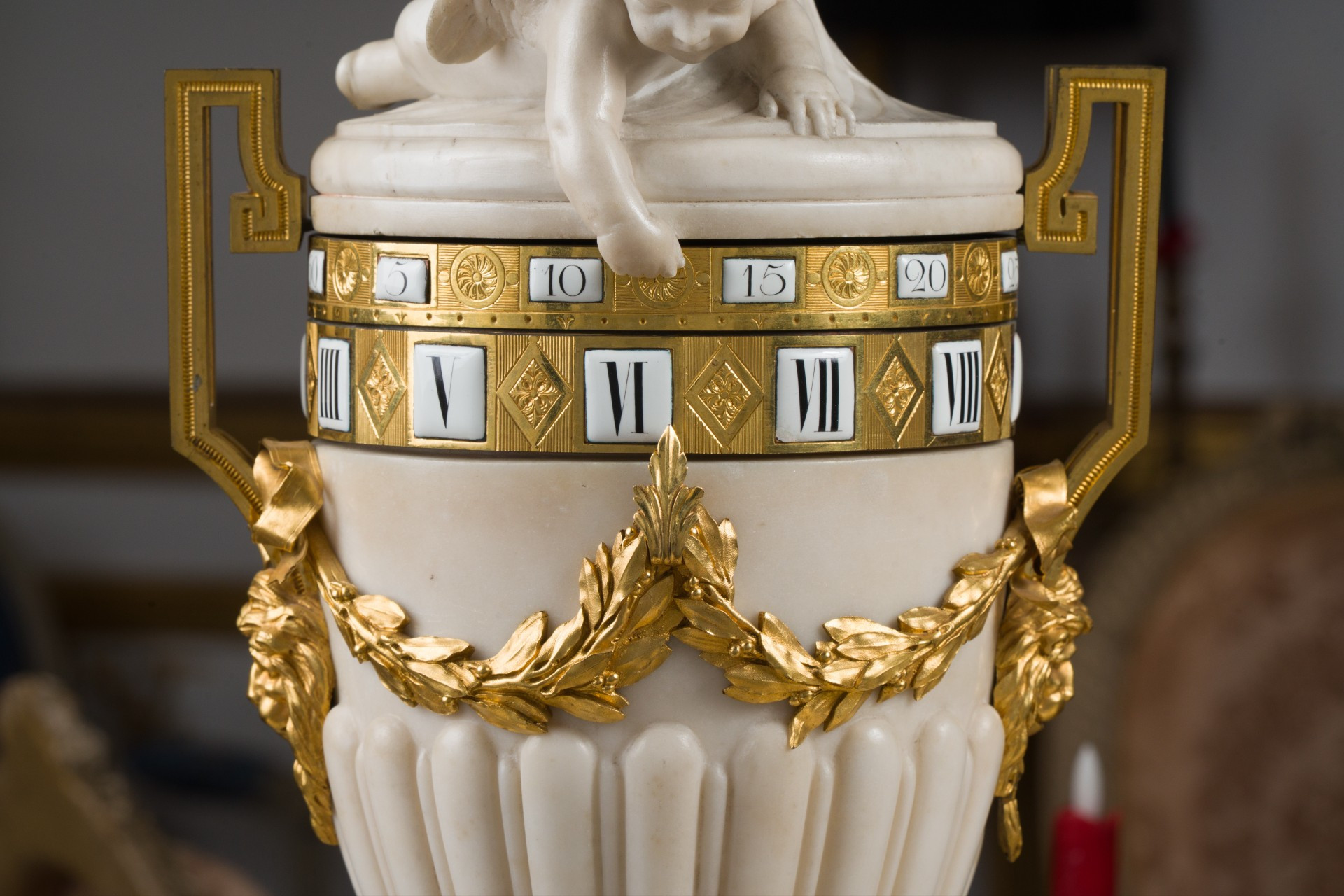
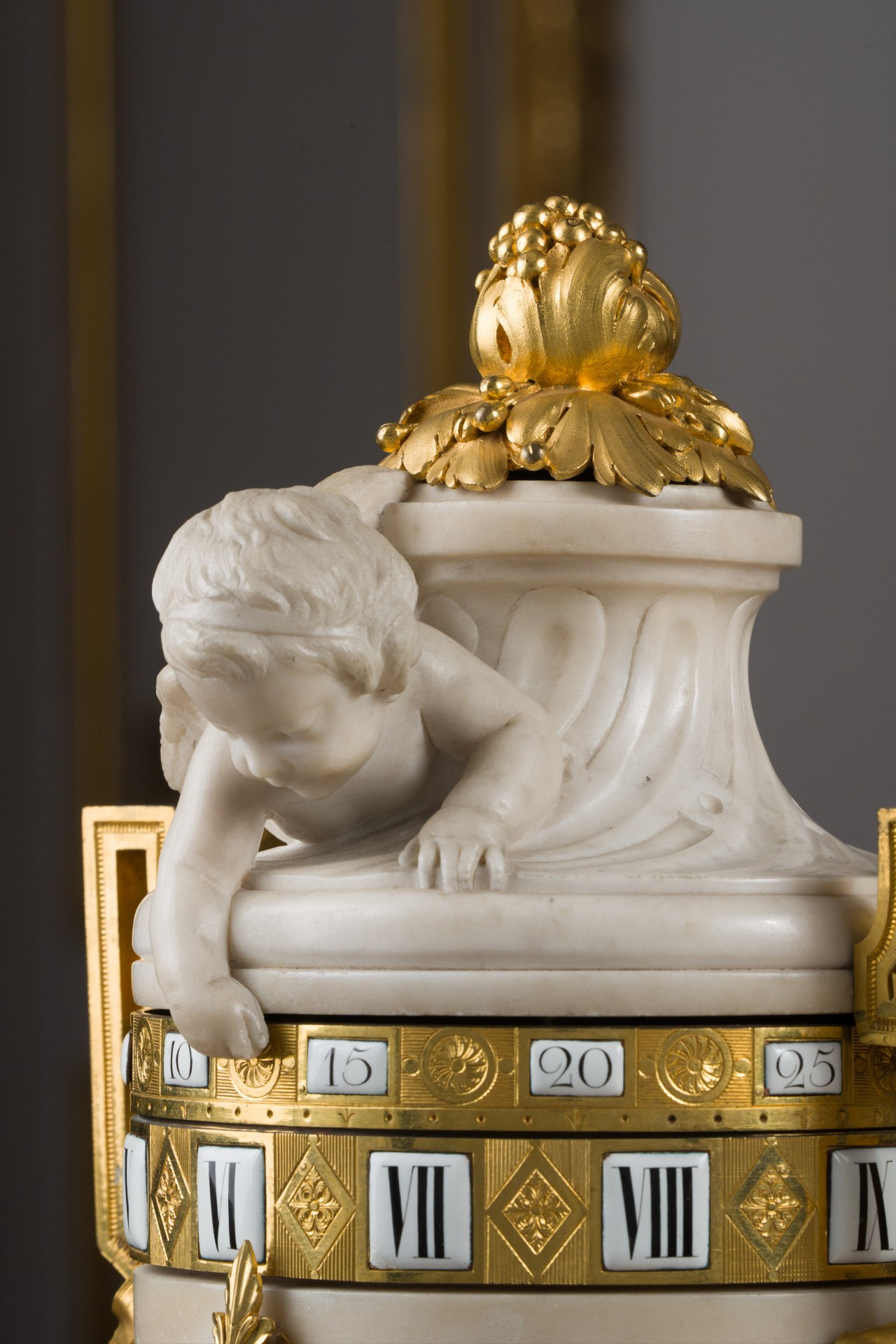
The rectangular movement was made specifically for the vase in which it is housed. It features a verge escapement, a balance wheel suspended by wires, and a striking mechanism that activates on the hour and half-hour, with a count wheel on the backplate. The rotating gilt-bronze circles are decorated with lozenges for the hours and rosettes for the minutes. They feature enamel cartouches with Roman numerals for the hours and Arabic numerals for the minutes. The right hand of Cupid forms the fixed index.
The movement is wound on the right and the striking mechanism on the left, through two openings in the marble on the right side, at the level of the lion's head. The advance/slow adjustment is positioned flat on the top of the movement, indicated by a graduated circular index, A/R.
The balance wheel oscillates vertically from the front to the back of the movement, which is unusual.
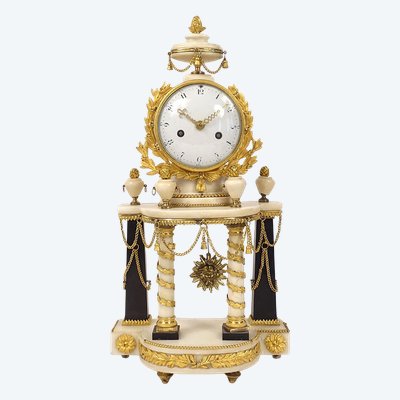
Louis XVI period, circa 1780
Used condition
Height: 52 cm
Width: 20 cm
Depth: 17.4 cm
History
At the beginning of the second half of the 18th century, we witness a renewal of the ornamental designs that had previously prevailed in Parisian decorative arts. Indeed, following the archaeological discoveries of Pompeii and Herculaneum, great connoisseurs, artists, and artisans gradually adopted the new rules of Neoclassicism. In the specific field of clockmaking, this upheaval led to the creation of new models of clocks known as rotating circle clocks, more elegantly adapted than circular dials to their new cases in the form of antique vases. This new trend, which met the expectations of major collectors, reached its peak during the reign of Louis XVI.
The clock we are offering was made in this context and is distinguished from almost all other known examples, made of gilt bronze, by the combination of a white marble base and a chased and gilt bronze decoration whose exquisite execution allows it to be attributed to the chaser Pierre Gouthière. Finally, among the few other recorded examples made in the same style and using these same two materials, we should mention in particular: an early model that was sold at auction at Christie's, London, on April 6, 1978, lot 14; and a second model, with ram's head sides and a vase lid adorned with a putto carved from the same stone, which was formerly in the famous collection of Count Greffulhe, dispersed in London in 1937 (Sotheby's sale, July 23, 1937, lot 38).
White marble and chased and gilt bronze clock, Paris, circa 1775-1780. Formerly in the collection of Count Greffulhe.
The clock we are offering was made in this context and is distinguished from almost all other known examples, made of gilt bronze, by the combination of a white marble vase and a chased and gilded bronze decoration whose exquisite execution allows it to be attributed to the chaser Pierre Gouthière. Finally, among the few other recorded examples made in the same style and using these same two materials, we should mention in particular: an early model that was sold at auction at Christie's, London, on April 6, 1978, lot 14; and a second model, with ram's head sides and a vase lid adorned with a putto carved from a single piece, which was formerly in the famous collection of Count Greffulhe, dispersed in London in 1937 (Sotheby's sale, July 23, 1937, lot 38).
Biography
Pierre Gouthière (1732-1813)
Pierre Gouthière was undoubtedly the most talented Parisian engraver of his time. Patronized by the Duke of Aumont, one of the greatest collectors of the second half of the 18th century, Gouthière obtained his commission as Ordinary Gilder to the King's Menus Plaisirs in 1767. This royal administration managed, among other things, private commissions placed by the sovereign with artists and artisans. This appointment allowed him to acquire extraordinary renown and to cultivate the most prestigious clientele of the time, composed solely of connoisseurs of rare and precious objects. Among them were, in addition to the royal family and the Duke of Aumont, prominent aristocrats such as the Marquis de Marigny, brother of the Marquise de Pompadour, Princess Kinsky, Countess Du Barry (the King's mistress), the Duchess of Mazarin, the Duke of Duras, and the Duchess of Villeroy, as well as major financiers, particularly Baudard de Saint-James, the extremely wealthy Treasurer General of the Navy, and the powerful banker Thélusson.
Detailed Description
Two superimposed dials, or rotating circles, composed of enameled cartouches, indicate the hours in Roman numerals on the first and the minutes in Arabic numerals on the second. The movement is depicted in a superb antique-style vase in white statuary marble, sculpted with broad leaves and gadrooned friezes worked in spirals; the square, openwork handles are highlighted with channel motifs and rest on finials.
Ref: 2ZQYE604W7
| Condition | As is |
| Style | Louis XVI (Table Clocks and Desk Clocks of Louis XVI Style) |
| Period | 18th century (Table Clocks and Desk Clocks 18th century) |
| Country of origin | France |
| Shipping Time | Ready to ship in 4-7 Business Days |
| Location | 78 000, Versailles, France |
4 commitments to buy with confidence

 English
 Français
 Italiano
 Deutsch