

Would you like more images?


ITEM AVAILABLE — PAYMENT OPTIONS ARE LISTED AT THE END OF THE DESCRIPTION.
Analysis & Expertise
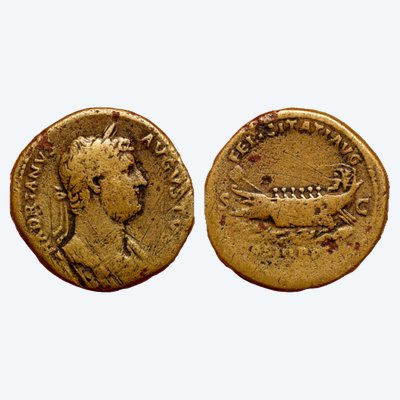
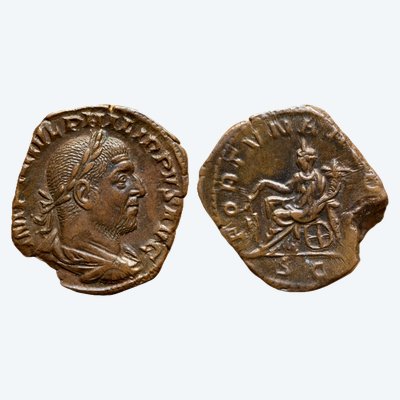
This sestertius of Nero, attributed to the Lugdunum mint and dated to around 65 AD, corresponds to the type listed as RIC 390 / Cohen 14 / BMC 305 / CBN 70. Its iconographic combination—a laureate imperial portrait on the obverse with a globe at the point of his neck, and a large composition “ANNONA AVGVSTI CERES” on the reverse with S – C—belongs to the series of monumental bronzes from the end of his reign, particularly sought after for the narrative scope of their reverses.
Careful observation under a 10x magnifying glass and raking light: examination of the photographs, conducted by progressively reading the perimeter, fields, reliefs, and lettering, reveals a large-module bronze flan with an irregular edge, featuring areas of peripheral weakness and irregularities consistent with prolonged circulation. The surface displays a brown patina punctuated by localized green patches, the appearance and distribution of which suggest stabilized copper oxidation, with, in places, granulation and small field heterogeneities perceptible depending on the angle of illumination. On the obverse, the portrait of Nero appears laureate facing right, with the inscription of the globe at the base of his neck, a characteristic detail of the type. The main volumes remain legible—the outline of the crown, the relief of the forehead, the modeling of the nose, the line of the mouth, and the articulation of the neck—while the peripheral legend, NERO CLAVD CAESAR AVG GER P M TR P IMP P P, appears in sectors, more or less legible depending on the striking and wear, a configuration frequently observed on large bronze coins of this size. On the reverse, the scene remains narratively intelligible despite wear and patina: Ceres, veiled and draped, sits on the left holding ears of grain and a torch, facing Annona standing on the right with a cornucopia. Between them stands the modius placed on a garlanded altar, with the stern of a ship in the background. The whole conforms to the standard description “ANNONA AVGVSTI CERES” for Nero's sestertii. The mark S – C is visible in the field, anchoring the coin in the senatorial tradition of Roman bronze.
Characteristics
Authority: Nero Augustus (54–68).
Nomint mark / metal: Sestertius, Æ.
Mint: Lugdunum.
Date: circa 65.
Weight / diameter: 21.89 g; 33 mm (data provided).
Right: NERO CLAVD CAESAR AVG GER P M TR P IMP P P Laureate head r., with globe at point of neck.
Reverse: ANNONA – AVGVSTI – CERES Ceres, veiled and draped, seated l., holding corn-ears and torch, her feet on stool, facing Annona standing r., r. hand resting on hip and l. holding cornucopiae; between them, Modius on garlanded altar. In the background, ship’s stern. In exergue, S – C.
References: C 14. BMC 305. RIC 390. CBN 70.
Historical context
Issued during a period when the capital was heavily dependent on grain supplies and the logistical stability of Mediterranean trade routes, this reverse articulates an immediately legible political message: the combined presence of Ceres (agriculture, fertility, grain) and Annona (public provision, distribution) depicts organized abundance, while the ship's stern explicitly represents the maritime horizon of the “cura annonae” (care of the grain), transforming the coin into a vehicle for civic doctrine, where abundance is not merely promised but staged as a public order.
Cultural Value
For a collector, this sestertius possesses the major appeal of great imperial bronzes: the material density of the alloyed copper, the depth of the patina, and above all, the almost "painting-like" dimension of the reverse, where imperial rhetoric becomes image. The Ceres-Annona pair offers an immediate institutional interpretation, reinforced by the S-C, a traditional mark that links the coin to the political grammar of Roman bronze and lends the object a particularly expressive historical presence.
Traceability & Guarantees
Each example is examined, described, and accompanied by a certificate of authenticity conforming to the standards of the art and heritage market. The study is conducted with meticulous observation under a 10x loupe and raking light. The provenance is European and comes from an established numismatic dealer, and the acquisition is part of a specialized international transaction, conducted within a recognized numismatic network and validated by leading experts, according to the highest standards of the art and heritage market. Note: Any props visible in the photographs are for illustrative purposes only and are not included in the sale.
Payment Terms: For payment, please send us a message with the delivery address and location. (If within France, we ship via Colissimo with signature confirmation and insurance (€20). If internationally, we ship via UPS with signature confirmation and insurance (€35).
Ref: NRFHMTQJH1
| Condition | Good |
| Style | Rome and ancient Greece (Numismatics of Rome and ancient Greece Style) |
| Period | 16th century and older (Numismatics 16th century and older) |
| Country of origin | Italy |
| Internal reference | SKU: 003318 |
| Shipping Time | Ready to ship in 2-3 Business Days |
| Location | 75008, Paris, France |
| Shipping Information | All our shipments are handled with the utmost care. Secure packaging: Each item is protected by appropriate and reinforced packaging to guarantee its integrity during transport. Tracked shipping: All packages are sent via registered mail or international tracked service with a tracking number provided to the buyer. Processing time: Shipments are generally processed within 2 to 5 business days after payment confirmation. Insurance: Additional insurance can be added to the shipment upon request. Delivery areas: Shipping is available to the European Union. For other destinations, please contact us before purchasing. |
4 commitments to buy with confidence

 English
 Français
  Italiano
  Deutsch