Napoleon III Period Bronze-Mounted Inkwell with Vernis Martin Plaque, c. 1850–1870
slider-bg
more images

Would you like more images?

Napoleon III Period Bronze-Mounted Inkwell with Vernis Martin Plaque, c. 1850–1870

By Gallery MLD Antiquités
Member of the Authenticity-Quality label
1 500 €
19th century
Second Empire style, Napoleon III style
DELIVERY
From: 93400, Saint-Ouen, France

Change your address to get an accurate estimate of shipping costs.

    Item offered for sale by

    See the gallery
    This description has been translated and may not be completely accurate. Click here to see the original

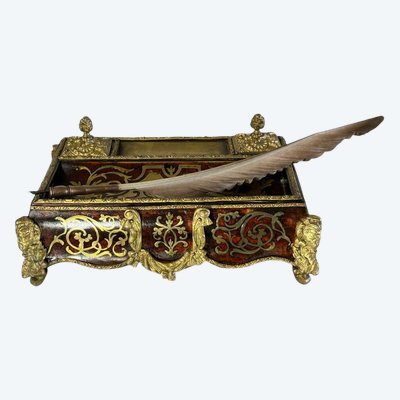
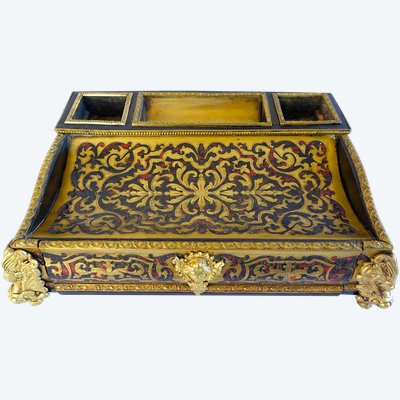
    Napoleon III Period Bronze-Mounted Inkwell with Vernis Martin Plaque, c. 1850–1870


    An elegant and decorative bronze inkwell, finely chased with gilded foliate scrollwork and resting on ball feet, adorned with a red Vernis Martin plaque featuring a Chinese landscape.


    A refined example of French craftsmanship from the Napoleon III period, circa 1850–1870.


    Dimensions:

    Height: 3.3 in (8.5 cm).

    Width: 8.3 in (21 cm).

    Depth: 5.9 in (15 cm).


    Condition:

    Presented in its original used condition.


    Historical and Technical Context:

    Vernis Martin, a copal-based varnish, was developed to rival Asian lacquer. It offered an economical and flexible alternative, perfectly suited to the curves of French furniture. Beyond its practical role, it became a medium for artistic expression, reproducing contemporary works on furniture. Note: In the late 19th century, the term "vernis Martin" was misappropriated to describe folding fans, which had no connection to the original 18th-century technique.


    Biography:

    The Martin Brothers, Pioneers of Vernis Martin in the 18th Century


    In Enlightenment-era France, two Parisian artisans, Guillaume and Étienne-Simon Martin, revolutionized furniture art by perfecting an innovative technique: Vernis Martin. In 1728, they patented this ingenious substitute for Oriental lacquer, composed of copal, pigments, and resins. Their process replicated the luster of Chinese and Japanese lacquer at a lower cost, while adapting to the curves of French furniture—unlike rigid and expensive lacquer panels.


    Based in the artisan quarter of Faubourg-Saint-Antoine, the Martin brothers met the growing demand for exotic décor. Their workshop produced pieces adorned with landscapes, flowers, and chinoiserie motifs, captivating the elite of the time. Though less resistant to humidity than authentic lacquer, their varnish enjoyed lasting popularity, even influencing 19th-century styles.


    Their contribution to the history of decorative arts is significant: They made luxury accessible to a broader audience. Today, their creations are studied and exhibited, as evidenced by the 2014 retrospective at the Musée des Arts Décoratifs in Paris, which highlighted their unique craftsmanship.


    Notable Works:

    In 1742, Mathieu Criaerd (1689–1776, master craftsman since 1738) created a commode, a corner cupboard, and a writing table in blue and white for Madame de Mailly, commissioned by the merchant Hébert. Only the commode and the base of the corner cupboard survive today, preserved in the Louvre.


    Exhibition:

    2014: "The Secrets of French Lacquer: Vernis Martin," Musée des Arts Décoratifs, Paris (February 13–June 8).


    Bibliography:

    Thibaut Wolvesperges, Le Meuble Français en Laque au XVIIIe Siècle, Éditions de l’Amateur.

    Anne Forray-Carlier and Monika Kopplin (eds.), The Secrets of French Lacquer: Vernis Martin, Paris, Les Arts Décoratifs, 2014.

    Ref: QDTL0208G0

    Condition Very good
    Style Second Empire style, Napoleon III style (Writing (Accessories) of Second Empire style, Napoleon III style Style)
    Period 19th century (Writing (Accessories) 19th century)
    Country of origin France
    Materials Gilt bronze, Lacquered wood
    Shipping Time Ready to ship in 2-3 Business Days
    Location 93400, Saint-Ouen, France
    Antikeo Buyer Guarantee

    4 commitments to buy with confidence