This description has been translated and may not be completely accurate. Click here to see the original
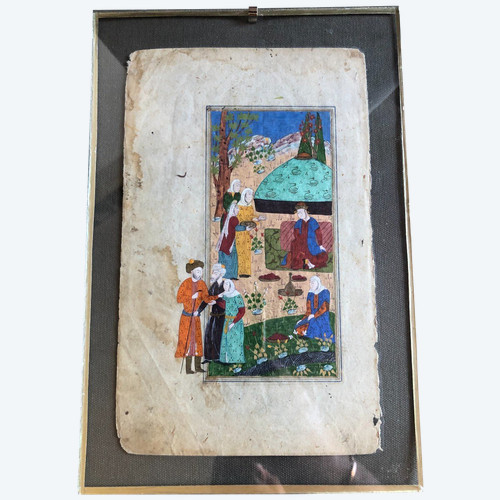
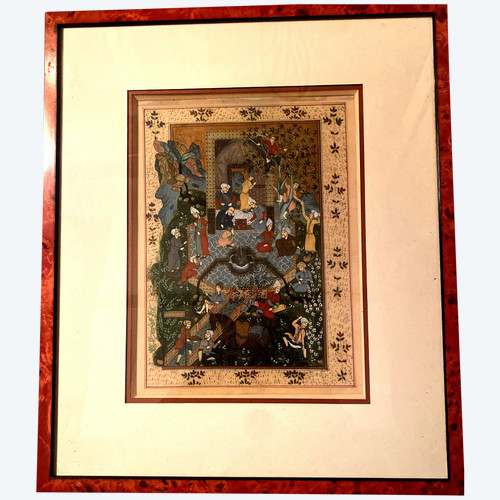
Illustrated Persian manuscript leaf, Iran, Qajar period, first half of the 19th century, circa 1800–1850. Gouache, opaque pigments, and ink on paper.
The recto features a narrative miniature depicting ʿĪsā ibn Maryam (Jesus) in a Persian garden and architectural setting. The composition includes several turbaned figures, a horseman, a horse, flowering plants, trees, and a pavilion with geometric decoration.
The Arabic text is identified as a passage from the Thawāb al-Aʿmāl wa ʿIqāb al-Aʿmāl, a work attributed to the Twelver Shi'a scholar Shaykh al-Ṣadūq (Ibn Bābawayh al-Qummī). The episode recounts Jesus' encounter with the inhabitants of a condemned village and his questioning of the reason for their punishment. It is part of a moral discourse concerning attachment to earthly life and obedience to an unjust authority.
The reverse side bears an extensive Arabic text in cursive naskh script, with ancient marginal annotations and chains of transmission typical of hadith literature.
Ref: WHBS902BCF