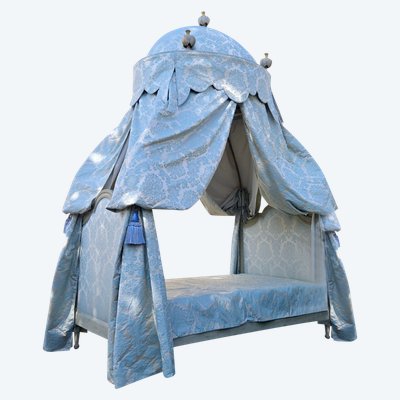
A Polish-style bed made of gray-lacquered wood, molded and carved on all sides with a floral and foliage motif. It rests on four small arched legs and is topped by a canopy, carved at the top with inverted consoles and a bouquet of feathers.
Transitional Period
Stamped “Nicolas Heurtaut”
Normal wear and tear; silk upholstery from the Prelle factory and trimmings from Declercq.
H. 330 x W. 195 x D. 140 cm
The “Polish-style” bed, placed with its long side against a wall and, in principle, reserved for private rooms, differs from the “French-style” or “columned” bed, a ceremonial bed whose canopy spans its entire length and which is placed with its short side against the wall.
Born into a family of Parisian chairmakers, Nicolas Heurtaut was described by his contemporaries as a man full of life and ideas. He initially turned to sculpture and, in 1742, enrolled in the Académie de Saint-Luc—the new name given to his father’s school. It was in this profession that he worked on Rue de Neuve-de-Cléry until 1753, under the guidance of the greatest cabinetmakers of the time, such as Claude Sené and the brothers Nicolas and Jean-Baptiste Tilliard. Admitted as a master cabinetmaker to the Community of Cabinetmakers and Woodworkers in 1753, Heurtaut finally registered his master’s certificate two years later, in 1755, and set up shop on Rue de Bourbon-Villeneuve in his father-in-law’s former workshop, under the sign “La Bonne Foi.” In addition, he owned “a workshop” that he cherished and where he stored his stock of large timber. As a carpenter and sculptor, he worked for merchants as well as upholsterers. He also fulfilled commissions for a wealthy clientele, such as the Duke of La Rochefouchault and the Marquis of Villarceaux.
Nicolas Heurtaut’s work is heavily influenced by his early career as a sculptor. His style evolved in the 1760s in line with the tastes of the time; lines and structures became lighter, sculptural elements were greatly reduced, and the profusion of shells and foliage gave way to roses and more restrained foliage.
Ref: 0EP20CMNK8
| Style | Transition style (Beds of Transition style Style) |
| Period | 18th century (Beds 18th century) |
| Country of origin | France |
| Cabinetmaker | Nicolas Heurtaut |
| Shipping Time | Ready to ship in 4-7 Business Days |
| Location | 78 000, Versailles, France |
4 commitments to buy with confidence

 English
 Français
  Italiano
  Deutsch